

Ahmedabad
(Head Office)Address : 506, 3rd EYE THREE (III), Opp. Induben Khakhrawala, Girish Cold Drink Cross Road, CG Road, Navrangpura, Ahmedabad, 380009.
Mobile : 8469231587 / 9586028957
E-mail: dics.upsc@gmail.com

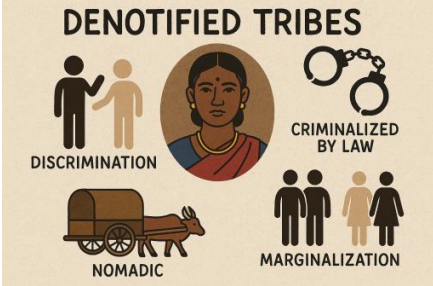
Summary of Key Highlights • Census 2027 Commitment: The Union government has assured that Denotified, Nomadic, and Semi-Nomadic Tribes (DNTs) will be enumerated in the second phase of the upcoming Census in 2027, addressing a long-standing demand for data-backed identification. • The Demand for a \'Separate Column\': Community leaders and scholars are advocating for a distinct column in the Census form, arguing that the current practice of assimilating DNTs into SC, ST, or OBC categories obscures their unique social stigma and specific developmental needs.• Colonial Legacy of Criminalization: These tribes were historically victimized under the Criminal Tribes Act (CTA), 1871, which labeled entire communities as \'born criminals.\' Although repealed in 1952, the subsequent Habitual Offenders Acts in various states have allegedly perpetuated this \'criminal\' stigma. • Commission Recommendations: Both the Renke Commission (2008) and the Idate Commission (2017) emphasized that accurate policy intervention is impossible without a comprehensive Census count. The Idate Commission identified nearly 1,200 DNT communities, with about 268 currently not classified under any existing category. • Implementation Gaps in SEED Scheme: The Scheme for Economic Empowerment of DNTs (SEED) has faced low fund utilization (spending only a fraction of its ₹200 crore budget) primarily due to the difficulty beneficiaries face in obtaining DNT certificates from state authorities. • Movement for Constitutional Status: There is a growing push for a separate Constitutional classification for DNTs, distinct from the SC/ST/OBC triad, to ensure uniform issuance of certificates and targeted sub-classification to address varying levels of backwardness. Key Definitions • Denotified Tribes (Vimukt Jatis): Communities that were originally listed under the Criminal Tribes Act of 1871 and were \'denotified\' when the act was repealed in 1952. • Nomadic and Semi-Nomadic Tribes: Communities that do not have a fixed place of residence and move from one place to another for their livelihood. • SEED Scheme: A multi-sectoral intervention by the Ministry of Social Justice and Empowerment covering educational coaching, health insurance, livelihood initiatives, and housing for DNTs. Constitutional & Legal Provisions • Article 15(4) and 16(4): Provide the basis for the State to make special provisions for the advancement of any socially and educationally backward classes. • Article 340: Empowers the President to appoint a commission to investigate the conditions of backward classes (the basis for DNT commissions). • Article 46 (DPSP): Mandates the State to promote with special care the educational and economic interests of the weaker sections of the people, specifically protecting them from social injustice. • Habitual Offenders Act: State-level laws that replaced the CTA; often criticized by activists for allowing police to target DNTs based on past records rather than fresh evidence. Evolution of DNT Commissions and Status

Important Keypoints for UPSC • The Stigma Paradox: Even after \'denotification,\' these tribes face \'invisible criminalization\' by local law enforcement, hindering their integration into the mainstream economy. • Identity Overlap: Since most DNTs are already in SC/ST/OBC lists, the government has preferred a \'Welfare Board\' over a Permanent Commission, leading to administrative hurdles in providing DNTspecific benefits. • Resistance History: Community leaders are reframing their history, stating that colonial \'criminal\' labeling was actually a punishment for their resistance against British and earlier foreign rule. • NITI Aayog Study: A study by the Anthropological Survey of India remains a critical but under-utilized document for the classification of the 268 \'orphaned\' DNT communities. Conclusion The inclusion of DNTs in the 2027 Census is a vital step toward reparative justice for communities once termed \'criminal\' by birth. However, mere counting is insufficient; the transition from being \'objects of surveillance\' to \'subjects of development\' requires a robust legal framework for DNT certification and a constitutional recognition that acknowledges their unique historical suffering. UPSC Relevance • GS Paper I: Salient features of Indian Society, Diversity of India; Welfare schemes for vulnerable sections. • GS Paper II: Statutory, regulatory and various quasi-judicial bodies; Mechanisms, laws, institutions and Bodies constituted for the protection and betterment of these vulnerable sections. • Prelims: Renke and Idate Commissions, SEED scheme details, and the history of the Criminal Tribes Act.


Address : 506, 3rd EYE THREE (III), Opp. Induben Khakhrawala, Girish Cold Drink Cross Road, CG Road, Navrangpura, Ahmedabad, 380009.
Mobile : 8469231587 / 9586028957
E-mail: dics.upsc@gmail.com
Address: A-306, The Landmark, Urjanagar-1, Opp. Spicy Street, Kudasan – Por Road, Kudasan, Gandhinagar – 382421
Mobile : 9723832444 / 9723932444
E-mail: dics.gnagar@gmail.com
Address: 2nd Floor, 9 Shivali Society, L&T Circle, opp. Ratri Bazar, Karelibaugh, Vadodara, 390018
Mobile : 9725692037 / 9725692054
E-mail: dics.vadodara@gmail.com
Address: 403, Raj Victoria, Opp. Pal Walkway, Near Galaxy Circle, Pal, Surat-394510
Mobile : 8401031583 / 8401031587
E-mail: dics.surat@gmail.com
Address: 303,305 K 158 Complex Above Magson, Sindhubhavan Road Ahmedabad-380059
Mobile : 9974751177 / 8469231587
E-mail: dicssbr@gmail.com
Address: 57/17, 2nd Floor, Old Rajinder Nagar Market, Bada Bazaar Marg, Delhi-60
Mobile : 9104830862 / 9104830865
E-mail: dics.newdelhi@gmail.com