






Ahmedabad
(Head Office)Address : 506, 3rd EYE THREE (III), Opp. Induben Khakhrawala, Girish Cold Drink Cross Road, CG Road, Navrangpura, Ahmedabad, 380009.
Mobile : 8469231587 / 9586028957
Telephone : 079-40098991
E-mail: dics.upsc@gmail.com

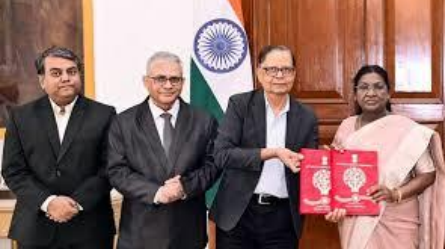
• Shift in Vertical Devolution: While the 16th Finance Commission (FC) maintained the states\' share at 41% of the shareable pool, critics argue the actual \'divisible pool\' has shrunk due to the Centre’s increased reliance on cesses and surcharges, which are not shared with states. • Elimination of Revenue Deficit Grants (RDG): The 16th FC has notably moved away from providing RDGs. This traditionally served as a critical non-discretionary channel to bridge the gap between a state’s fiscal capacity and its normative expenditure needs for essential public services. • Rise of Discretionary Transfers: With a reduction in unconditional FC transfers, the share of Centrally Sponsored Schemes (CSS) has risen to nearly 50% of total transfers. This requires states to match 40% of costs, often diverting their resources from state-list subjects to central priorities. • New Horizontal Formula: The commission introduced \'Contribution to GDP\' with a 10% weight. Experts suggest this favors larger, economically stronger states over poorer ones, potentially undermining the principle of \'equity\' that balanced previous commission awards. • Focus on State \'Freebies\': The report is critical of state-level subsidies and populist schemes (non-merit subsidies) but has been noted for its silence regarding similar central government bailouts or centrally funded welfare schemes, indicating a perceived centrist bias. • Impact on Poorer States: The cumulative effect of the new formula and the removal of grants has led to a projected decline in the share of central revenues for states like Bihar, Uttar Pradesh, Odisha, and the Northeastern hilly states. Key Definitions Vertical Devolution: The division of the shareable pool of central taxes between the Union government and the State governments. Horizontal Devolution: The formula-based distribution of the states\' share of central taxes among the various states based on criteria like population, income distance, and area. Divisible Pool: The portion of central taxes that is constitutionally mandated to be shared with states, excluding cesses, surcharges, and cost of collection. Revenue Deficit Grant (RDG): A grant provided under Article 275 to states that still face a deficit on their revenue account after the tax devolution process. Constitutional and Legal Provisions Article 280: Mandates the President to constitute a Finance Commission every five years to recommend the distribution of net tax proceeds and the principles governing grants-in-aid. Article 270: Governs the distribution of net proceeds of taxes between the Union and the States. Article 271: Empowers the Centre to levy cesses and surcharges for specific purposes; these do not form part of the divisible pool shared with states. Seventh Schedule: Defines the legislative jurisdictions of the Union and States. The rise in CSS is often debated as an encroachment on the State List (List II). Additional Important Keypoints The 16th FC award covers the five-year period from 2026-27 to 2030-31. A significant point of contention is the \'Contribution to GDP\' metric; unlike \'Fiscal Discipline,\' it measures economic size rather than fiscal efficiency. Experts like Dr. C. Rangarajan estimate that the effective transfer of Gross Tax Revenue (GTR) to states has dipped to 32.7% under the current award, compared to a peak of 35.6% during the 14th FC period. This reduction limits the fiscal space for states to invest in human capital (Health and Education), which are primarily state responsibilities. Conclusion The 16th Finance Commission marks a departure from the \'impartiality\' of past awards by emphasizing economic efficiency over regional equity. By shrinking the non-discretionary pool and removing revenue deficit safety nets, the award forces states into greater dependence on central discretionary schemes. For a diverse federation like India, restoring the balance between the Centre\'s fiscal control and the States\' developmental autonomy remains essential for long-term macroeconomic stability. UPSC Relevance GS Paper II: Federal structure, devolution of powers and finances up to local levels, and challenges therein; Appointment to various constitutional posts. GS Paper III: Indian Economy and issues relating to planning, mobilization of resources, growth, and development. Preliminary Examination: Criteria for horizontal devolution (Population, Forest Cover, Income Distance, etc.), Article 280, and the difference between tax devolution and grants-in-aid.


Address : 506, 3rd EYE THREE (III), Opp. Induben Khakhrawala, Girish Cold Drink Cross Road, CG Road, Navrangpura, Ahmedabad, 380009.
Mobile : 8469231587 / 9586028957
Telephone : 079-40098991
E-mail: dics.upsc@gmail.com
Address: A-306, The Landmark, Urjanagar-1, Opp. Spicy Street, Kudasan – Por Road, Kudasan, Gandhinagar – 382421
Mobile : 9723832444 / 9723932444
E-mail: dics.gnagar@gmail.com
Address: 2nd Floor, 9 Shivali Society, L&T Circle, opp. Ratri Bazar, Karelibaugh, Vadodara, 390018
Mobile : 9725692037 / 9725692054
E-mail: dics.vadodara@gmail.com
Address: 403, Raj Victoria, Opp. Pal Walkway, Near Galaxy Circle, Pal, Surat-394510
Mobile : 8401031583 / 8401031587
E-mail: dics.surat@gmail.com
Address: 303,305 K 158 Complex Above Magson, Sindhubhavan Road Ahmedabad-380059
Mobile : 9974751177 / 8469231587
E-mail: dicssbr@gmail.com
Address: 57/17, 2nd Floor, Old Rajinder Nagar Market, Bada Bazaar Marg, Delhi-60
Mobile : 9104830862 / 9104830865
E-mail: dics.newdelhi@gmail.com