

Ahmedabad
(Head Office)Address : 506, 3rd EYE THREE (III), Opp. Induben Khakhrawala, Girish Cold Drink Cross Road, CG Road, Navrangpura, Ahmedabad, 380009.
Mobile : 8469231587 / 9586028957
Telephone : 079-40098991
E-mail: dics.upsc@gmail.com

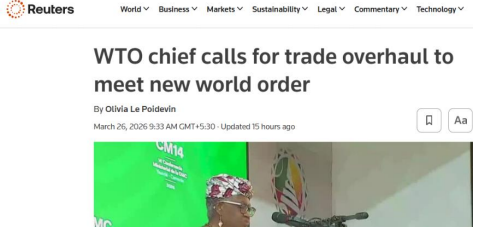
• Call for Structural Overhaul: WTO Director-General Ngozi Okonjo-Iweala, at the ministerial meeting in Cameroon, asserted that the \'old world order\' has irrevocably vanished, necessitating a fundamental overhaul of global trade rules to stay relevant in a fragmented geopolitical landscape.
• Dispute Settlement Paralysis: A primary concern highlighted is the ongoing crisis in the WTO’s dispute-settlement mechanism, which remains largely non-functional, leading to fears that nations may abandon the rules-based system in favor of unilateral regulations.
• Consensus vs. Plurilateralism: The Director-General criticized the current consensus-based decision-making model for causing frequent stalemates; consequently, there is a growing push for \'plurilateral agreements\' where groups of members can form pacts without requiring total unanimity.
• Subsidy Transparency Crisis: The WTO chief identified a critical lack of transparency regarding industrial subsidies as a major source of global mistrust, fueling suspicions of unfair competition and preventing the formulation of new trade rules.
• E-commerce Moratorium Dispute: A significant friction point has emerged as India and other developing nations oppose the US effort to permanently ban cross-border e-commerce duties, arguing that such taxes are essential for domestic revenue and policy space.
• Impact of Geopolitical Turmoil: The meeting takes place against a backdrop of severe trade disruptions caused by the US-Israeli conflict with Iran and rising protectionist tariffs, highlighting the vulnerability of global supply chains to regional wars.
Key Definitions
Nationally Determined Contributions (NDCs): While primarily a climate term, in trade contexts, it refers to the individual commitments countries make toward global goals. Moratorium on E-commerce Duties: A longstanding, temporary agreement among WTO members not to impose customs duties on electronic transmissions (e.g., software, music, digital files). Plurilateral Agreement: A trade pact between a subset of WTO members that applies only to the signatories, unlike multilateral agreements which apply to all 164 members. Dispute Settlement Body (DSB): The branch of the WTO responsible for resolving trade conflicts between member states, currently hampered by the vacancy of its Appellate Body.
Constitutional and Legal Provisions
Article 253: Empowering the Indian Parliament to make any law for the whole or any part of the territory of India for implementing any treaty, agreement, or convention with any other country or countries or any decision made at any international conference. Union List (Schedule VII): \'Trade and commerce with foreign countries; import and export across customs frontiers\' falls under Entry 41, granting the Central Government exclusive jurisdiction over WTO-related negotiations. Marrakesh Agreement (1994): The foundational treaty that established the WTO, replacing the General Agreement on Tariffs and Trade (GATT). Article 51 (DPSP): Mandates the State to foster respect for international law and treaty obligations in the dealings of organized peoples with one another.
Additional Important Keypoints The shift in the US stance—demanding a permanent e-commerce tax ban while resisting detailed reform work plans—reflects a shift toward \'managed trade\' rather than \'free trade.\' India’s opposition is rooted in the • Call for Structural Overhaul: WTO Director-General Ngozi Okonjo-Iweala, at the ministerial meeting in Cameroon, asserted that the \'old world order\' has irrevocably vanished, necessitating a fundamental overhaul of global trade rules to stay relevant in a fragmented geopolitical landscape. • Dispute Settlement Paralysis: A primary concern highlighted is the ongoing crisis in the WTO’s dispute-settlement mechanism, which remains largely non-functional, leading to fears that nations may abandon the rules-based system in favor of unilateral regulations.
• Consensus vs. Plurilateralism: The Director-General criticized the current consensus-based decision-making model for causing frequent stalemates; consequently, there is a growing push for \'plurilateral agreements\' where groups of members can form pacts without requiring total unanimity. • Subsidy Transparency Crisis: The WTO chief identified a critical lack of transparency regarding industrial subsidies as a major source of global mistrust, fueling suspicions of unfair competition and preventing the formulation of new trade rules.
• E-commerce Moratorium Dispute: A significant friction point has emerged as India and other developing nations oppose the US effort to permanently ban cross-border e-commerce duties, arguing that such taxes are essential for domestic revenue and policy space. • Impact of Geopolitical Turmoil: The meeting takes place against a backdrop of severe trade disruptions caused by the US-Israeli conflict with Iran and rising protectionist tariffs, highlighting the vulnerability of global supply chains to regional wars. Key Definitions Nationally Determined Contributions (NDCs): While primarily a climate term, in trade contexts, it refers to the individual commitments countries make toward global goals. Moratorium on E-commerce Duties: A longstanding, temporary agreement among WTO members not to impose customs duties on electronic transmissions (e.g., software, music, digital files). Plurilateral Agreement: A trade pact between a subset of WTO members that applies only to the signatories, unlike multilateral agreements which apply to all 164 members. Dispute Settlement Body (DSB): The branch of the WTO responsible for resolving trade conflicts between member states, currently hampered by the vacancy of its Appellate Body. Constitutional and Legal Provisions Article 253: Empowering the Indian Parliament to make any law for the whole or any part of the territory of India for implementing any treaty, agreement, or convention with any other country or countries or any decision made at any international conference. Union List (Schedule VII): \'Trade and commerce with foreign countries; import and export across customs frontiers\' falls under Entry 41, granting the Central Government exclusive jurisdiction over WTO-related negotiations. Marrakesh Agreement (1994): The foundational treaty that established the WTO, replacing the General Agreement on Tariffs and Trade (GATT). Article 51 (DPSP): Mandates the State to foster respect for international law and treaty obligations in the dealings of organized peoples with one another. Additional Important Keypoints The shift in the US stance—demanding a permanent e-commerce tax ban while resisting detailed reform work plans—reflects a shift toward \'managed trade\' rather than \'free trade.\' India’s opposition is rooted in the \'Digital Divide,\' as losing the right to tax digital imports could result in significant revenue loss for developing economies. Furthermore, the \'vicious cycle of mistrust\' mentioned by the DG refers to the \'tit-for-tat\' subsidies in green energy and semiconductor sectors (e.g., the US Inflation Reduction Act) which the WTO currently lacks the tools to regulate. The Cameroon meeting (MC-14/Interim) is seen as a \'make-or-break\' moment for the Multilateral Trading System (MTS). Conclusion The WTO stands at a historic crossroads where the push for modernization clashes with a resurgence of protectionism and geopolitical rivalry. For India, the challenge lies in defending the interests of the Global South—particularly regarding food security and digital sovereignty—while simultaneously advocating for a functional dispute-redressal system that protects smaller players from the unilateral actions of major powers. UPSC Relevance General Studies Paper II: Important International institutions, agencies and fora - their structure, mandate; Effect of policies and politics of developed and developing countries on India’s interests. General Studies Paper III: Issues relating to intellectual property rights; Indian Economy and issues relating to planning, mobilization of resources, and growth. Preliminary Examination: Fact-based questions on the WTO DirectorGeneral, the e-commerce moratorium, the location of ministerial meetings (Yaoundé, Cameroon), and the structure of the Dispute Settlement Body.


Address : 506, 3rd EYE THREE (III), Opp. Induben Khakhrawala, Girish Cold Drink Cross Road, CG Road, Navrangpura, Ahmedabad, 380009.
Mobile : 8469231587 / 9586028957
Telephone : 079-40098991
E-mail: dics.upsc@gmail.com
Address: A-306, The Landmark, Urjanagar-1, Opp. Spicy Street, Kudasan – Por Road, Kudasan, Gandhinagar – 382421
Mobile : 9723832444 / 9723932444
E-mail: dics.gnagar@gmail.com
Address: 2nd Floor, 9 Shivali Society, L&T Circle, opp. Ratri Bazar, Karelibaugh, Vadodara, 390018
Mobile : 9725692037 / 9725692054
E-mail: dics.vadodara@gmail.com
Address: 403, Raj Victoria, Opp. Pal Walkway, Near Galaxy Circle, Pal, Surat-394510
Mobile : 8401031583 / 8401031587
E-mail: dics.surat@gmail.com
Address: 303,305 K 158 Complex Above Magson, Sindhubhavan Road Ahmedabad-380059
Mobile : 9974751177 / 8469231587
E-mail: dicssbr@gmail.com
Address: 57/17, 2nd Floor, Old Rajinder Nagar Market, Bada Bazaar Marg, Delhi-60
Mobile : 9104830862 / 9104830865
E-mail: dics.newdelhi@gmail.com