






Ahmedabad
(Head Office)Address : 506, 3rd EYE THREE (III), Opp. Induben Khakhrawala, Girish Cold Drink Cross Road, CG Road, Navrangpura, Ahmedabad, 380009.
Mobile : 8469231587 / 9586028957
Telephone : 079-40098991
E-mail: dics.upsc@gmail.com

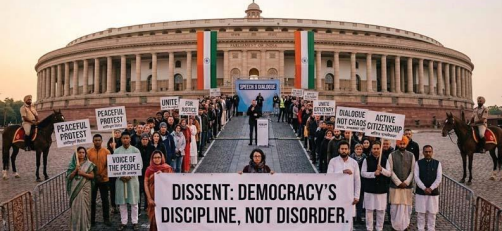
• Protest and Perception: The \'shirtless\' protests by the Indian Youth Congress (IYC) at the India AI Impact Summit have ignited a debate on whether public dissent during international events bolsters or tarnishes India\'s global reputation. • Government vs. State: A critical theoretical distinction exists where the State is a permanent, sovereign entity, while the Government is a temporary executive organ; however, modern political narratives often blur this line, equating criticism of the ruling administration with an attack on the nation. • Dissent as a Safety Valve: In democratic theory, dissent is viewed as a \'safety valve\' that prevents social unrest by allowing citizens to participate in governance through disapproval, whereas critics view it as a threat to a unified national identity. • Unitary vs. Federal Spirit: The tension reflects two readings of the Constitution—one emphasizing a \'strong center\' to prevent centrifugal tendencies, and another highlighting a \'pluralistic federalism\' that celebrates diverse ideological currents. • Role of Media and Narrative: The mass media often acts as a force multiplier for the state, framing policy protests (like CAA or Farmers\' agitation) as \'anti-national\' acts by claiming they are manipulated by forces inimical to India’s integrity. • Democratic Maturity: The ultimate test of a democracy’s strength lies in its ability to accommodate competing voices within the constitutional framework without conflating political opposition with disloyalty to the State. Key Definitions • Dissent: The expression of holding opinions that are at variance with those previously or officially expressed, serving as a tool for accountability in a democracy. • Sedition: Conduct or speech inciting people to rebel against the authority of a state or monarch. In India, the legal boundary between dissent and sedition is a subject of frequent judicial scrutiny. • Centrifugal Tendencies: Political or social forces that push segments of a population away from the central government, potentially threatening national unity. Constitutional and Legal Provisions • Article 19(1)(a) & (b): Guarantees the fundamental right to freedom of speech and expression and to assemble peaceably and without arms, which forms the legal basis for the right to protest. • Article 19(2): Allows the State to impose \'reasonable restrictions\' on free speech in the interests of the sovereignty and integrity of India, security of the State, and public order. • The \'Basic Structure\' Doctrine: Established in the Kesavananda Bharati case (1973), it affirms that federalism and democracy are essential features of the Constitution that cannot be abrogated by the government. • Section 124A of IPC: Historically dealt with sedition; though currently under judicial stay/review, it remains central to debates regarding the criminalization of dissent. Additional Key Points • Historical Precedent: The phrase \'India is Indira, Indira is India\' from the 1970s serves as a historical reminder of the dangers of equating a single leader or government with the entire nation. • Institutional Design: The distribution of power and the independence of the Judiciary and Legislature act as checks against the executive\'s tendency to monopolize the national narrative. • International Standards: In many mature democracies, protests during summits (like the G20 or COP) are viewed as evidence of a vibrant, participatory political culture rather than a sign of instability. Conclusion The debate surrounding the IYC protests transcends the specific act of \'shirtless\' demonstration, touching upon the soul of Indian democracy. While the government must remain alert to genuine threats to national integrity, the health of the republic depends on its capacity to distinguish between a political opponent and a national enemy. True national cohesion is achieved not through forced uniformity or the labeling of critics, but through a robust engagement with diverse perspectives under the umbrella of the Constitution. UPSC Relevance GS Paper II: Indian Constitution—significant provisions and basic structure; Separation of powers between various organs; Role of the Opposition in a democracy; Federal structure and its challenges. GS Paper IV: Ethics and Human Interface; Values in Governance (Tolerance and Dissent). Prelims: Article 19, landmark SC judgements on speech and protest, and the distinction between the State and Government.


Address : 506, 3rd EYE THREE (III), Opp. Induben Khakhrawala, Girish Cold Drink Cross Road, CG Road, Navrangpura, Ahmedabad, 380009.
Mobile : 8469231587 / 9586028957
Telephone : 079-40098991
E-mail: dics.upsc@gmail.com
Address: A-306, The Landmark, Urjanagar-1, Opp. Spicy Street, Kudasan – Por Road, Kudasan, Gandhinagar – 382421
Mobile : 9723832444 / 9723932444
E-mail: dics.gnagar@gmail.com
Address: 2nd Floor, 9 Shivali Society, L&T Circle, opp. Ratri Bazar, Karelibaugh, Vadodara, 390018
Mobile : 9725692037 / 9725692054
E-mail: dics.vadodara@gmail.com
Address: 403, Raj Victoria, Opp. Pal Walkway, Near Galaxy Circle, Pal, Surat-394510
Mobile : 8401031583 / 8401031587
E-mail: dics.surat@gmail.com
Address: 303,305 K 158 Complex Above Magson, Sindhubhavan Road Ahmedabad-380059
Mobile : 9974751177 / 8469231587
E-mail: dicssbr@gmail.com
Address: 57/17, 2nd Floor, Old Rajinder Nagar Market, Bada Bazaar Marg, Delhi-60
Mobile : 9104830862 / 9104830865
E-mail: dics.newdelhi@gmail.com