
Ahmedabad
(Head Office)Address : 506, 3rd EYE THREE (III), Opp. Induben Khakhrawala, Girish Cold Drink Cross Road, CG Road, Navrangpura, Ahmedabad, 380009.
Mobile : 8469231587 / 9586028957
E-mail: dics.upsc@gmail.com

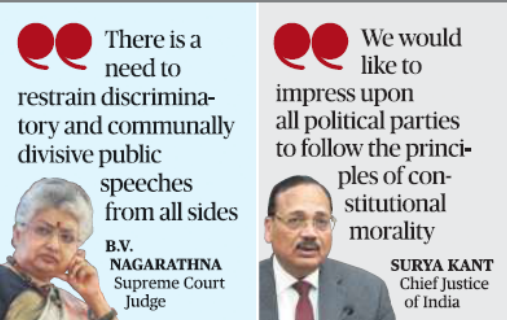
The Supreme Court of India, while hearing a petition regarding hate speech by high-ranking officials, emphasized that political leaders and constitutional functionaries bear a primary responsibility to uphold the spirit of fraternity. The Bench, led by Chief Justice Surya Kant, noted that public statements stigmatizing communities erode the state\'s commitment to equal citizenship and legitimise discriminatory governance. • Upholding Fraternity: The Court highlighted that \'Fraternity\' is not just a word in the Preamble but a foundational duty of leaders to ensure social cohesion and mutual respect among citizens. • Constitutional Morality over Political Rhetoric: The Bench urged political parties to adhere to constitutional morality, noting that in a mature democracy of 75 years, \'toxic\' rhetoric from state authorities is unacceptable. • Impact on Governance: The Court expressed concern that derogatory speech by Chief Ministers and bureaucrats \'normalizes\' exclusion and influences law enforcement, leading to perceived institutional bias. • Restraint and Thought: While Justice B.V. Nagarathna noted the difficulty in controlling \'thought,\' the Court acknowledged that the \'consequences of thought\' (speech) can and should be regulated through guidelines for public office holders. • Institutional Integrity: The judiciary warned against the \'political thicket\' but maintained that holders of high office are not \'ordinary speakers\' and their words carry the weight of state authority, requiring higher accountability. Key Definitions • Fraternity: A sense of common brotherhood among all Indians, transcending individual differences, to ensure the dignity of the individual and the unity and integrity of the Nation. • Constitutional Morality: Adherence to the core principles of the Constitution (like justice, liberty, equality) rather than just its legalistic forms; it involves a commitment to democratic norms and the rule of law. • Prior Restraint: Judicial or government action that prohibits speech or other expression before it can take place. Constitutional & Legal Provisions • Preamble: Explicitly mentions \'Fraternity\' as a core objective to ensure the dignity of the individual. • Article 19(2): Provides \'reasonable restrictions\' on the freedom of speech, including grounds of public order, decency, and incitement to an offence. • Article 51A(e): Fundamental Duty of every citizen to promote harmony and the spirit of common brotherhood. • Representation of the People Act, 1951: Section 123(3) and 125 classify promoting enmity between classes on grounds of religion, race, caste, or community during elections as a \'corrupt practice.\' • Indian Penal Code (IPC) / BNS: Provisions like Section 153A and 505 (now under relevant Bharatiya Nyaya Sanhita sections) criminalize speech that promotes enmity or affects public tranquility. Additional Key Points for Examination • Kaushal Kishore Case (2023): A Constitution Bench previously ruled that a Minister’s statement cannot be vicariously attributed to the Government, but a Minister’s freedom of speech can be restricted if it violates the constitutional rights of a citizen.• The \'Duty of Care\': Public officials owe a higher duty of care to ensure their speech does not trigger communal disharmony or infringe upon the Article 21 rights (Right to Life and Dignity) of marginalized groups. • The Political Thicket Doctrine: The judiciary generally avoids intervening in purely political disputes, but when political speech infringes on fundamental rights or constitutional values, judicial review is triggered. Conclusion The Supreme Court’s observations underscore that the health of a democracy depends not just on the letter of the law, but on the conduct of those who administer it. When high-ranking officials engage in divisive rhetoric, it weakens the social contract. To preserve the \'unity and integrity of the nation,\' it is imperative to bridge the gap between political strategy and constitutional ethics through enforceable guidelines for public discourse. UPSC Relevance • General Studies II: Appointment to various Constitutional posts, powers, functions and responsibilities of various Constitutional Bodies; Important aspects of governance, transparency and accountability. • General Studies IV (Ethics): Ethics in public administration; status and ethical problems in government and private institutions; Strengthening of ethical and moral values in governance. • Essay Paper: Themes related to Democracy, Fraternity, and the role of leadership in nation-building.


Address : 506, 3rd EYE THREE (III), Opp. Induben Khakhrawala, Girish Cold Drink Cross Road, CG Road, Navrangpura, Ahmedabad, 380009.
Mobile : 8469231587 / 9586028957
E-mail: dics.upsc@gmail.com
Address: A-306, The Landmark, Urjanagar-1, Opp. Spicy Street, Kudasan – Por Road, Kudasan, Gandhinagar – 382421
Mobile : 9723832444 / 9723932444
E-mail: dics.gnagar@gmail.com
Address: 2nd Floor, 9 Shivali Society, L&T Circle, opp. Ratri Bazar, Karelibaugh, Vadodara, 390018
Mobile : 9725692037 / 9725692054
E-mail: dics.vadodara@gmail.com
Address: 403, Raj Victoria, Opp. Pal Walkway, Near Galaxy Circle, Pal, Surat-394510
Mobile : 8401031583 / 8401031587
E-mail: dics.surat@gmail.com
Address: 303,305 K 158 Complex Above Magson, Sindhubhavan Road Ahmedabad-380059
Mobile : 9974751177 / 8469231587
E-mail: dicssbr@gmail.com
Address: 57/17, 2nd Floor, Old Rajinder Nagar Market, Bada Bazaar Marg, Delhi-60
Mobile : 9104830862 / 9104830865
E-mail: dics.newdelhi@gmail.com