



Ahmedabad
(Head Office)Address : 506, 3rd EYE THREE (III), Opp. Induben Khakhrawala, Girish Cold Drink Cross Road, CG Road, Navrangpura, Ahmedabad, 380009.
Mobile : 8469231587 / 9586028957
Telephone : 079-40098991
E-mail: dics.upsc@gmail.com

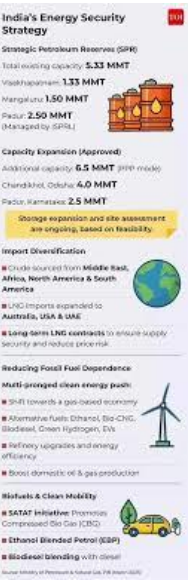
The Union Minister for Petroleum and Natural Gas recently addressed the Lok Sabha, asserting that India has successfully secured its crude oil supply despite the escalating geopolitical volatility in West Asia. Highlighting the government’s proactive stance, the Minister emphasized that there is no shortage of essential fuels— including petrol, diesel, kerosene, and aviation turbine fuel (ATF)—while specifically outlining a new allocation strategy to stabilize the LPG market. • Strategic Crude Securing: Amidst the most severe global energy disruption in recorded history, India has diversified its import basket and leveraged strategic partnerships to ensure that the domestic energy supply remains insulated from West Asian conflicts. • Prioritizing Household Energy: The government’s \'foremost priority\' remains the uninterrupted supply of cooking gas to over 33 crore households, focusing specifically on the poor and underprivileged to prevent energy poverty. • Commercial LPG Regulation: To curb hoarding and black-marketing, Oil Marketing Companies (OMCs) will now allocate 20% of the average monthly commercial LPG requirement in direct coordination with State governments. • Combating Market Distortions: The new regulatory measures aim to prevent the illegal diversion of domestic (subsidized) cylinders into the commercial sector, ensuring price stability and availability for genuine commercial users. • Crisis Management Resilience: The administration dismissed \'shortage narratives\' as rumor-mongering, stating that the current logistics and buffer stocks are robust enough to navigate the ongoing global supply chain disruptions. • Inter-Governmental Coordination: The involvement of State governments in the allocation process marks a shift toward a more decentralized and monitored distribution network for commercial fuels. Key Definitions • Energy Security: The uninterrupted availability of energy sources at an affordable price, involving long-term investments and short-term ability to respond to sudden changes in the supply-demand balance. • Oil Marketing Companies (OMCs): Entities (mostly PSUs like IOCL, BPCL, HPCL) responsible for the refining, distribution, and marketing of petroleum products in India. • Strategic Petroleum Reserves (SPR): Huge stockpiles of crude oil maintained by the government to manage potential supply disruptions. Constitutional and Legal Provisions • Entry 53, List I (Union List): The Seventh Schedule of the Constitution grants the Central Government exclusive power over \'Regulation and development of oilfields and mineral oil resources; petroleum and petroleum products.\' • Essential Commodities Act (ECA), 1955: This Act empowers the government to regulate the production, supply, and distribution of essential commodities (including petroleum and LPG) to prevent hoarding and ensure equitable distribution. • LPG (Regulation of Supply and Distribution) Order, 2000: Issued under the ECA, this provides the legal framework for prohibiting the unauthorized sale or possession of LPG cylinders and prevents diversion of domestic cylinders for commercial use. Conclusion India’s energy strategy currently hinges on balancing geopolitical risks with domestic welfare. By securing crude supplies and tightening the regulatory grip on LPG distribution through the 20% allocation rule, the government aims to mitigate the \'triple challenge\' of availability, affordability, and accessibility. The transition from a centralized supply model to a state-coordinated monitoring system for commercial LPG signifies a move toward more granular governance of essential fuels during global crises. UPSC Relevance • GS Paper II: Government policies and interventions for development in various sectors; Issues arising out of their design and implementation. • GS Paper III: Energy Security, Infrastructure, and the impact of global geopolitical conflicts on the Indian economy. • Prelims: Functional understanding of the Essential Commodities Act, the role of OMCs, and India’s energy import dependency.


Address : 506, 3rd EYE THREE (III), Opp. Induben Khakhrawala, Girish Cold Drink Cross Road, CG Road, Navrangpura, Ahmedabad, 380009.
Mobile : 8469231587 / 9586028957
Telephone : 079-40098991
E-mail: dics.upsc@gmail.com
Address: A-306, The Landmark, Urjanagar-1, Opp. Spicy Street, Kudasan – Por Road, Kudasan, Gandhinagar – 382421
Mobile : 9723832444 / 9723932444
E-mail: dics.gnagar@gmail.com
Address: 2nd Floor, 9 Shivali Society, L&T Circle, opp. Ratri Bazar, Karelibaugh, Vadodara, 390018
Mobile : 9725692037 / 9725692054
E-mail: dics.vadodara@gmail.com
Address: 403, Raj Victoria, Opp. Pal Walkway, Near Galaxy Circle, Pal, Surat-394510
Mobile : 8401031583 / 8401031587
E-mail: dics.surat@gmail.com
Address: 303,305 K 158 Complex Above Magson, Sindhubhavan Road Ahmedabad-380059
Mobile : 9974751177 / 8469231587
E-mail: dicssbr@gmail.com
Address: 57/17, 2nd Floor, Old Rajinder Nagar Market, Bada Bazaar Marg, Delhi-60
Mobile : 9104830862 / 9104830865
E-mail: dics.newdelhi@gmail.com