

Ahmedabad
(Head Office)Address : 506, 3rd EYE THREE (III), Opp. Induben Khakhrawala, Girish Cold Drink Cross Road, CG Road, Navrangpura, Ahmedabad, 380009.
Mobile : 8469231587 / 9586028957
Telephone : 079-40098991
E-mail: dics.upsc@gmail.com

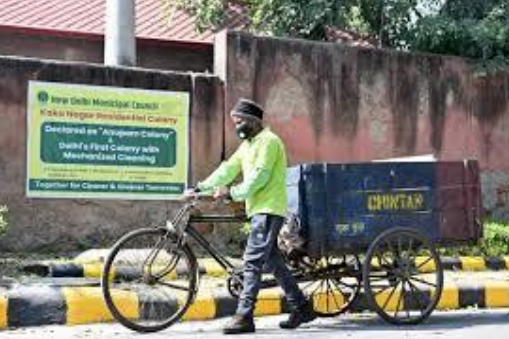
The New Delhi Municipal Council (NDMC) has pioneered the ‘Anupam’ model, a decentralized waste management strategy aimed at achieving 100% source segregation and on-site processing. By treating waste as a resource rather than a burden to be transported, this model sets a benchmark for sustainable urban governance and circular economy principles. • Decentralized Processing: The core shift involves moving away from centralized dumping towards onsite treatment, where wet and horticultural waste are composted within the colony using wire-mesh bins and pits, eliminating the carbon footprint of waste transportation. • Three-Way Source Segregation: Residents must segregate waste into wet, dry, and sanitary categories at the doorstep. Dry waste is further sub-categorized to maximize the recovery of recyclables, while ewaste is channeled to CPCB-authorized recyclers. • Community-Led Governance: The model leverages Resident Welfare Associations (RWAs) and NGOs to manage collection and sorting, moving from a top-down municipal approach to a participatory \'bottom-up\' governance structure. • Integration of Technology and Labor: The model combines mechanized sweeping systems with dedicated sanitation inspectors and specialized staff to oversee composting, ensuring that the process is both efficient and scientifically managed. • Behavioral Change and Enforcement: Success is driven by intensive door-to-door awareness campaigns and \'regular meetings\' with stakeholders, backed by the strategic use of penalties for mixed waste to ensure 100% compliance. • Zero-Waste Circularity: By converting organic waste into high-quality compost (e.g., producing 800 kg in initial phases) used for local parks and green belts, the model closes the nutrient loop within the urban ecosystem. Key Definitions • Decentralized Waste Management: A system where waste is collected, sorted, and treated close to the point of generation rather than being transported to a distant, large-scale landfill or processing plant. • Source Segregation: The practice of dividing waste into different groups (biodegradable and nonbiodegradable) at the point of origin to facilitate recycling and composting. • Circular Economy: An economic system aimed at eliminating waste and the continual use of resources through reuse, sharing, repair, refurbishment, and recycling. Constitutional & Legal Provisions • Article 51A (g): Fundamental Duty of every citizen to protect and improve the natural environment. • Article 21: The Right to Life includes the right to a clean and healthy environment as interpreted by the Judiciary. • Solid Waste Management (SWM) Rules, 2016: These rules mandate the segregation of waste at source and emphasize the role of local bodies in setting up decentralized processing facilities. • Swachh Bharat Mission (Urban) 2.0: Focuses on making cities \'garbage-free\' and mandates 100% processing of all waste. Additional Key Points • Economic Viability: Reduces municipal spending on fuel, vehicle maintenance, and large-scale landfill management.• Environmental Impact: Significantly reduces methane emissions from landfills and lowers the environmental hazards associated with \'waste-to-energy\' incineration. • Scalability: While currently a pilot in six colonies (including Chanakyapuri and Bapu Dham), the NDMC aims to scale this to all residential areas under its jurisdiction. Conclusion The ‘Anupam’ model represents a paradigm shift from \'waste disposal\' to \'resource management.\' By empowering local communities and utilizing simple yet effective composting technologies, it addresses the urban crisis of overflowing landfills. For a sustainable future, such micro-models must be integrated into the broader Urban Development Framework to ensure cities breathe easier. UPSC Relevance • GS Paper II: Statutory, regulatory, and various quasi-judicial bodies (NDMC roles); Governance and the role of NGOs/SHGs in development. • GS Paper III: Environmental pollution and degradation; Waste management (Solid Waste/E-waste); Circular economy. • Essay/Ethics: Case study on community participation and civic responsibility.


Address : 506, 3rd EYE THREE (III), Opp. Induben Khakhrawala, Girish Cold Drink Cross Road, CG Road, Navrangpura, Ahmedabad, 380009.
Mobile : 8469231587 / 9586028957
Telephone : 079-40098991
E-mail: dics.upsc@gmail.com
Address: A-306, The Landmark, Urjanagar-1, Opp. Spicy Street, Kudasan – Por Road, Kudasan, Gandhinagar – 382421
Mobile : 9723832444 / 9723932444
E-mail: dics.gnagar@gmail.com
Address: 2nd Floor, 9 Shivali Society, L&T Circle, opp. Ratri Bazar, Karelibaugh, Vadodara, 390018
Mobile : 9725692037 / 9725692054
E-mail: dics.vadodara@gmail.com
Address: 403, Raj Victoria, Opp. Pal Walkway, Near Galaxy Circle, Pal, Surat-394510
Mobile : 8401031583 / 8401031587
E-mail: dics.surat@gmail.com
Address: 303,305 K 158 Complex Above Magson, Sindhubhavan Road Ahmedabad-380059
Mobile : 9974751177 / 8469231587
E-mail: dicssbr@gmail.com
Address: 57/17, 2nd Floor, Old Rajinder Nagar Market, Bada Bazaar Marg, Delhi-60
Mobile : 9104830862 / 9104830865
E-mail: dics.newdelhi@gmail.com