
Ahmedabad
(Head Office)Address : 506, 3rd EYE THREE (III), Opp. Induben Khakhrawala, Girish Cold Drink Cross Road, CG Road, Navrangpura, Ahmedabad, 380009.
Mobile : 8469231587 / 9586028957
E-mail: dics.upsc@gmail.com

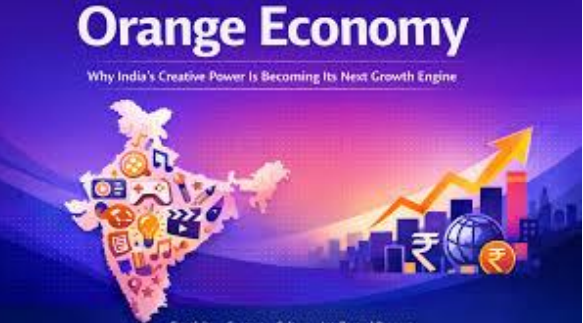
The \'Orange Economy\' encompasses sectors where value is derived from intellectual property, creativity, and cultural heritage. In the 21st century, India is transitioning from a traditional manufacturing focus to a serviceled creative powerhouse, utilizing the Media, Entertainment, and AVGC-XR (Animation, Visual Effects, Gaming, Comics, and Extended Reality) sectors as primary drivers of GDP and soft power. Key Summary Points for UPSC • Economic Contribution: The Media and Entertainment (M&E) sector was valued at approximately ₹2.5 trillion in 2024, with a projected annual growth rate of 7% to reach over ₹3 trillion by 2027. • Employment Generation: The creative economy currently supports over 10 million livelihoods. Projections suggest the AVGC-XR sector alone will require 20 lakh (2 million) professionals by 2030. • Digital Transformation: Digital media now accounts for one-third of sector revenues, signaling a shift from traditional television and print to platform-driven consumption and online gaming. • AVGC-XR Frontier: This is the most tech-intensive segment, merging art with advanced computing. India serves as a global production hub, contributing to international cinema, advertising, and immersive virtual environments. • Experiential Economy: Live entertainment and organized events (concerts, festivals) are stimulating urban tourism and infrastructure development, moving beyond sponsorship-led models to ticketed, audience-driven growth. • Institutional Framework: The establishment of the Indian Institute of Creative Technologies (IICT) as a National Centre of Excellence aims to bridge the gap between creative talent and global industry standards. Constitutional and Legal Provisions • Article 19(1)(a): Protects the freedom of speech and expression, which is the bedrock of the creative and media industries. • Article 29: Protects the interests of minorities and the right to conserve distinct language, script, or culture, providing a constitutional basis for the \'Orange Economy.\' • Article 51A(f): A Fundamental Duty to value and preserve the rich heritage of our composite culture. • Copyright Act, 1957: The primary legal framework for protecting Intellectual Property Rights (IPR) in creative works, essential for monetizing content. • Cinematograph (Amendment) Act, 2023: Aims to curb piracy and streamline age-based certification, protecting the financial interests of the film industry. Important Definitions • Orange Economy: An economy based on the interaction between culture, economy, and technology, where the value lies in intellectual property. • AVGC-XR: An acronym for Animation, Visual Effects, Gaming, Comics, and Extended Reality (including VR/AR). • Soft Power: A country\'s ability to influence others through cultural and ideological appeal rather than coercion or payment. • Extended Reality (XR): An umbrella term covering virtual reality (VR), augmented reality (AR), and mixed reality (MR). Strategic Initiatives and Platforms• WAVES (World Audio Visual and Entertainment Summit): A global forum to facilitate networking, deal-making, and policy dialogue in the M&E sector. • WaveX: An initiative to foster startup innovation in the creative field through incubation and investor engagement. • Create in India Challenge: A talent discovery program designed to link local creators with international commercial platforms. • Education Integration: The proposed setup of AVGC labs in 15,000 secondary schools to build a grassroots talent pipeline. Conclusion India’s creative economy has transcended its role as a cultural byproduct to become a strategic economic pillar. By institutionalizing talent through the IICT and leveraging digital platforms, India is not only creating millions of jobs but also cementing its global soft power. The transition from \'services provider\' to \'IP creator\' will be the defining theme for India’s Orange Economy in the coming decade. UPSC Relevance • GS Paper II: Government policies and interventions for development in various sectors. • GS Paper III: Indian Economy (Growth, Development, and Employment); Technology (AVGC-XR, Digital Media). • Essay: Cultural influence, Soft Power, and the future of work in a digital age.


Address : 506, 3rd EYE THREE (III), Opp. Induben Khakhrawala, Girish Cold Drink Cross Road, CG Road, Navrangpura, Ahmedabad, 380009.
Mobile : 8469231587 / 9586028957
E-mail: dics.upsc@gmail.com
Address: A-306, The Landmark, Urjanagar-1, Opp. Spicy Street, Kudasan – Por Road, Kudasan, Gandhinagar – 382421
Mobile : 9723832444 / 9723932444
E-mail: dics.gnagar@gmail.com
Address: 2nd Floor, 9 Shivali Society, L&T Circle, opp. Ratri Bazar, Karelibaugh, Vadodara, 390018
Mobile : 9725692037 / 9725692054
E-mail: dics.vadodara@gmail.com
Address: 403, Raj Victoria, Opp. Pal Walkway, Near Galaxy Circle, Pal, Surat-394510
Mobile : 8401031583 / 8401031587
E-mail: dics.surat@gmail.com
Address: 303,305 K 158 Complex Above Magson, Sindhubhavan Road Ahmedabad-380059
Mobile : 9974751177 / 8469231587
E-mail: dicssbr@gmail.com
Address: 57/17, 2nd Floor, Old Rajinder Nagar Market, Bada Bazaar Marg, Delhi-60
Mobile : 9104830862 / 9104830865
E-mail: dics.newdelhi@gmail.com