

Ahmedabad
(Head Office)Address : 506, 3rd EYE THREE (III), Opp. Induben Khakhrawala, Girish Cold Drink Cross Road, CG Road, Navrangpura, Ahmedabad, 380009.
Mobile : 8469231587 / 9586028957
E-mail: dics.upsc@gmail.com

Core Summary
• Strategic Shift: India has operationalized alternative shipping services to bypass the Strait of Hormuz—a vital chokepoint handling 20% of global oil and gas trade—due to heightened regional conflict and blockades.
• Alternative Port Activation: Shipping lines like Maersk and CMA CGM are now connecting Indian hubs (JNPA, Mundra, Hazira) to West Asian ports outside the conflict zone, specifically Sohar (Oman), Fujairah (UAE), and Khorfakkan (UAE).
• Economic Stakes: The West Asia and North Africa (WANA) region is critical for India, with bilateral trade exceeding $216 billion in FY25 and MSMEs contributing nearly 48% of the country total exports.
• Energy Security Management: To prevent domestic fuel shortages during geopolitical instability, the government is coordinating refinery maintenance schedules (e.g., Jamnagar and Vadinar) and exploring new LPG storage facilities.
• Logistics Challenges: Despite the normalization of port congestion, exporters face surging freight costs and last-mile connectivity issues from neutral ports to final inland destinations in the Gulf.
• MSME Impact: Rising freight rates and cargo delays are disproportionately affecting small-scale exporters, necessitating government intervention through fixed shipping schedules and logistics assistance.
Key Definitions
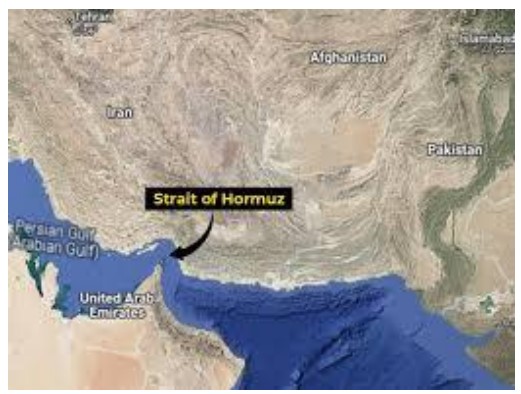
• Strait of Hormuz: A narrow waterway between the Persian Gulf and the Gulf of Oman; it is the world most important oil transit chokepoint.
• WANA Region: West Asia and North Africa; a geo-economic grouping vital for India\'s energy security and diaspora remittances.
• Chokepoint: A strategic narrow passage (usually maritime) that can be easily blocked to disrupt international traffic and trade.
Constitutional & Legal Provisions
• Article 73: Extends the executive power of the Union to matters with respect to which Parliament has power to make laws, including Foreign Affairs and Trade and Commerce with foreign countries under the Union List (Seventh Schedule).
• Territorial Waters, Continental Shelf, Exclusive Economic Zone and Other Maritime Zones Act, 1976: Provides the legal framework for India’s maritime rights and security of trade routes.
• Energy Conservation Act, 2001: While primarily for efficiency, it provides the statutory basis for the government to manage energy resources during national exigencies and supply disruptions.
Additional Key Insights
• Refinery Synergy: The Ministry of Petroleum is ensuring that major refineries do not undergo maintenance simultaneously, safeguarding the domestic supply of 33 million tonnes from the Jamnagar complex.
• Strategic Petroleum Reserves (SPR): The crisis underscores the urgency of Phase II of India SPR program to mitigate supply shocks from the Hormuz blockade.
• Multi-modal Connectivity: The reliance on ports like Khorfakkan highlights the need for integrated road-rail links within the Arabian Peninsula to move cargo when sea lanes are contested.
Conclusion
India proactive tapping of Omani and UAE ports reflects a pragmatic de-risking strategy in its neighborhood policy. By diversifying transit points, India is not just securing its $64 billion export market but also ensuring that domestic energy prices remain insulated from global volatility. However, for these alternatives to be sustainable, the government must address the assistance gap in moving cargo from neutral transshipment hubs to conflict-adjacent destinations.
UPSC Relevance
• GS Paper II: India and its neighborhood relations; Effect of policies and politics of developed and developing countries on India’s interests (West Asia crisis impact).
• GS Paper III: Energy security; Infrastructure (Ports and Shipping); Mobilization of resources; and Growth/Development challenges.
• Geography (Mapping): Location of the Strait of Hormuz, Port of Sohar, Fujairah, Khorfakkan, and Indian West Coast ports.


Address : 506, 3rd EYE THREE (III), Opp. Induben Khakhrawala, Girish Cold Drink Cross Road, CG Road, Navrangpura, Ahmedabad, 380009.
Mobile : 8469231587 / 9586028957
E-mail: dics.upsc@gmail.com
Address: A-306, The Landmark, Urjanagar-1, Opp. Spicy Street, Kudasan – Por Road, Kudasan, Gandhinagar – 382421
Mobile : 9723832444 / 9723932444
E-mail: dics.gnagar@gmail.com
Address: 2nd Floor, 9 Shivali Society, L&T Circle, opp. Ratri Bazar, Karelibaugh, Vadodara, 390018
Mobile : 9725692037 / 9725692054
E-mail: dics.vadodara@gmail.com
Address: 403, Raj Victoria, Opp. Pal Walkway, Near Galaxy Circle, Pal, Surat-394510
Mobile : 8401031583 / 8401031587
E-mail: dics.surat@gmail.com
Address: 303,305 K 158 Complex Above Magson, Sindhubhavan Road Ahmedabad-380059
Mobile : 9974751177 / 8469231587
E-mail: dicssbr@gmail.com
Address: 57/17, 2nd Floor, Old Rajinder Nagar Market, Bada Bazaar Marg, Delhi-60
Mobile : 9104830862 / 9104830865
E-mail: dics.newdelhi@gmail.com