


Ahmedabad
(Head Office)Address : 506, 3rd EYE THREE (III), Opp. Induben Khakhrawala, Girish Cold Drink Cross Road, CG Road, Navrangpura, Ahmedabad, 380009.
Mobile : 8469231587 / 9586028957
E-mail: dics.upsc@gmail.com

Executive Summary
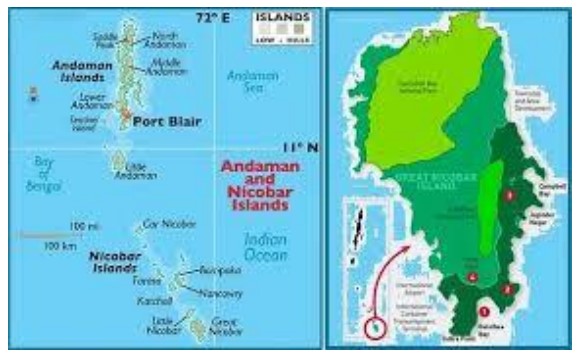
• Quorum Violation: The Andaman and Nicobar administration reportedly bypassed the mandatory 50% quorum requirement under the Forest Rights Act (FRA) for the ₹72,000-crore Great Nicobar Island project.
• Discrepancy in Figures: Attendance at Gram Sabha meetings ranged from a mere 1.83% to 14.72% of the population, significantly lower than the statutory requirement.
• Legal Defense: The administration argued in the Calcutta High Court that these figures constituted a proper quorum, claiming resolutions for the project were passed unanimously despite the low turnout.
• Procedural Lapses: Petitions allege that the Stage-I forest clearance was granted based on these contested consents, potentially violating the rights of the local tribal communities and settlers.
• FRA Implementation: Central rules explicitly state that a Gram Sabha quorum is achieved only if one-half (50%) of the adult members are present, with at least one-third being women.
• Scale of Consent: In total, only 349 individuals (approximately 4.6% of the 2011 Census population) signed off on a project impacting seven villages and vast tracts of ecologically sensitive forest land.
Key Definitions
• Gram Sabha: A body consisting of persons registered in the electoral rolls relating to a village comprised within the area of Panchayat at the village level. It is the cornerstone of local selfgovernance.
• Quorum: The minimum number of members of an assembly or society that must be present at any of its meetings to make the proceedings of that meeting valid.
• Forest Rights Act (FRA), 2006: A landmark legislation that recognizes the rights of forestdwelling communities to land and other resources, which had been denied to them over decades.
Constitutional & Legal Provisions
• Forest Rights Act (FRA) Rules: The 2012 amendment to the FRA Rules specifies that for the purpose of seeking consent for the diversion of forest land, the quorum of the Gram Sabha must be at least 50% of the members.
• Article 243G: Empowers State Legislatures to endow Panchayats with such powers and authority as may be necessary to enable them to function as institutions of self-government.
• PESA Act, 1996: While the A&NI are not currently under the Fifth Schedule, the principles of the Provisions of the Panchayats (Extension to Scheduled Areas) Act emphasize the informed consent of Gram Sabhas in tribal regions.
• The Scheduled Tribes and Other Traditional Forest Dwellers (Recognition of Forest Rights) Act, 2006: Specifically Section 6, which outlines the authorities to vest forest rights and the process for verification by the Gram Sabha.
Critical Analysis & Key Points
• Procedural Integrity: The reliance on 2011 Census data suggests that even by older population standards, the participation was insufficient. Using current population estimates would likely show an even lower percentage of participation.
• Women Representation: The FRA mandate for one-third women\'s participation in the quorum is a safeguard for gender-inclusive decision-making, which is often sidelined in largescale infrastructure projects.
• Environmental vs. Development Balance: The Great Nicobar project (including a transshipment port, airport, and power plant) faces scrutiny for its impact on the Shompen and Nicobarese tribes and the endemic biodiversity of the region.
Conclusion The controversy surrounding the Great Nicobar project highlights a significant friction point between ambitious national development goals and the statutory rights of grassroots democratic institutions. The bypass of quorum requirements undermines the spirit of the Forest Rights Act, which seeks to rectify historical injustices against forest dwellers. A judicial determination on whether attendance figures can override statutory percentages will set a critical precedent for future infrastructure projects in ecologically and culturally sensitive zones.
UPSC Relevance
• General Studies II: Governance, Constitution, PESA Act, and the role of Gram Sabhas in decentralized decision-making. Issues relating to the development and management of Social Sector/Services.
• General Studies III: Environmental impact assessment, biodiversity conservation, and the challenges of balancing infrastructure with tribal rights.
• Essay & Ethics: Ethical dimensions of consent in development and the rights of marginalized indigenous communities.


Address : 506, 3rd EYE THREE (III), Opp. Induben Khakhrawala, Girish Cold Drink Cross Road, CG Road, Navrangpura, Ahmedabad, 380009.
Mobile : 8469231587 / 9586028957
E-mail: dics.upsc@gmail.com
Address: A-306, The Landmark, Urjanagar-1, Opp. Spicy Street, Kudasan – Por Road, Kudasan, Gandhinagar – 382421
Mobile : 9723832444 / 9723932444
E-mail: dics.gnagar@gmail.com
Address: 2nd Floor, 9 Shivali Society, L&T Circle, opp. Ratri Bazar, Karelibaugh, Vadodara, 390018
Mobile : 9725692037 / 9725692054
E-mail: dics.vadodara@gmail.com
Address: 403, Raj Victoria, Opp. Pal Walkway, Near Galaxy Circle, Pal, Surat-394510
Mobile : 8401031583 / 8401031587
E-mail: dics.surat@gmail.com
Address: 303,305 K 158 Complex Above Magson, Sindhubhavan Road Ahmedabad-380059
Mobile : 9974751177 / 8469231587
E-mail: dicssbr@gmail.com
Address: 57/17, 2nd Floor, Old Rajinder Nagar Market, Bada Bazaar Marg, Delhi-60
Mobile : 9104830862 / 9104830865
E-mail: dics.newdelhi@gmail.com