







Ahmedabad
(Head Office)Address : 506, 3rd EYE THREE (III), Opp. Induben Khakhrawala, Girish Cold Drink Cross Road, CG Road, Navrangpura, Ahmedabad, 380009.
Mobile : 8469231587 / 9586028957
E-mail: dics.upsc@gmail.com

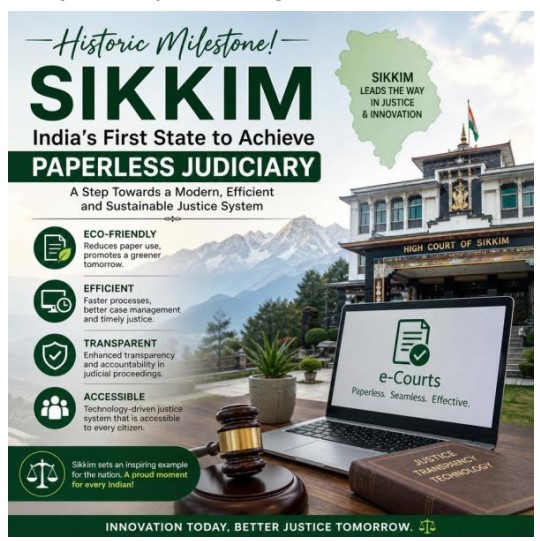
• Pioneering Milestone: Chief Justice of India Surya Kant has officially declared Sikkim as the first state in the country to achieve a completely paperless judiciary, marking a transformative shift in India\'s legal landscape.
• Overcoming Geographical Barriers: The integration of technology is specifically designed to dismantle constraints posed by Sikkim difficult Himalayan terrain, where unpredictable weather and narrow paths previously made physical access to courts a test of endurance.
• Digital Ecosystem Transition: The move signifies a departure from the era of the paper trail, where vital legal records were often languishing in physical storage, moving instead toward a vibrant and accessible digital ecosystem.
• Practical Necessity for Rule of Law: Judicial digital reform is characterized not merely as a theoretical enhancement but as a practical necessity essential for sustaining the rule of law and ensuring justice is not delayed by distance or financial barriers.
• Impact of e-Courts Project: The Chief Justice noted that the e-Courts project has fundamentally rewritten the relationship between the litigant and the law, replacing toilsome physical inquiry with a simple, efficient digital interface.
• National Conclave Context: This declaration was made during the inaugural session of a two-day National Conclave on Technology and Judicial Education held in Gangtok, emphasizing the role of digital literacy in modernizing the courts.
Key Definitions & Concepts
• Paperless Court: A judicial environment where all processes—including filing, tracking, and record-keeping—are handled digitally, eliminating the need for physical documents.
• e-Courts Project: A mission-mode project aimed at transforming the Indian Judiciary by ICT enablement of courts, enhancing efficiency and accessibility for litigants.
• ICT (Information and Communication Technology) in Judiciary: The application of digital tools like video conferencing, e-filing, and digital databases to streamline legal proceedings.
Constitutional & Legal Provisions
• Article 21: The Right to Life and Personal Liberty has been interpreted by the Supreme Court to include the Right to a Speedy Trial and Access to Justice, which are facilitated by digital court systems.
• Article 39A: A Directive Principle of State Policy that mandates the State to ensure that the operation of the legal system promotes justice on a basis of equal opportunity and provides free legal aid.
• Information Technology Act, 2000: Provides the primary legal framework in India for electronic governance by giving legal recognition to electronic records and digital signatures.
Additional Key Points for Analysis
• Financial Inclusivity: Digital processes reduce the financial burden on litigants who previously had to spend significant resources on travel and physical documentation.
• Data Security & Privacy: As judiciaries go paperless, the focus shifts to robust cybersecurity measures to protect sensitive legal data and maintain the integrity of judicial records.
• Judicial Education: The success of such initiatives depends heavily on the continuous training of judges, lawyers, and court staff to navigate evolving digital platforms effectively.
Conclusion
Sikkim transition to a paperless judiciary serves as a blueprint for the rest of India, demonstrating that technological intervention can effectively neutralize even the most challenging geographical constraints. By turning the toilsome inquiry into a simple digital interface, this reform ensures that the reach of justice is determined by the speed of the internet rather than the difficulty of the terrain. Moving forward, the national challenge will be to replicate this model across states while bridging the digital divide among rural litigants.
UPSC Relevance
• General Studies II: Structure, organization, and functioning of the Judiciary; Government policies and interventions for development in various sectors; e-governance applications and models.
• General Studies III: Challenges to internal security through communication networks; Role of media and social networking sites in security challenges; Basics of cybersecurity.
• Prelims: e-Courts Integrated Mission Mode Project; National Conclave on Technology and Judicial Education; Landmark judgments related to the Right to Justice.


Address : 506, 3rd EYE THREE (III), Opp. Induben Khakhrawala, Girish Cold Drink Cross Road, CG Road, Navrangpura, Ahmedabad, 380009.
Mobile : 8469231587 / 9586028957
E-mail: dics.upsc@gmail.com
Address: A-306, The Landmark, Urjanagar-1, Opp. Spicy Street, Kudasan – Por Road, Kudasan, Gandhinagar – 382421
Mobile : 9723832444 / 9723932444
E-mail: dics.gnagar@gmail.com
Address: 2nd Floor, 9 Shivali Society, L&T Circle, opp. Ratri Bazar, Karelibaugh, Vadodara, 390018
Mobile : 9725692037 / 9725692054
E-mail: dics.vadodara@gmail.com
Address: 403, Raj Victoria, Opp. Pal Walkway, Near Galaxy Circle, Pal, Surat-394510
Mobile : 8401031583 / 8401031587
E-mail: dics.surat@gmail.com
Address: 303,305 K 158 Complex Above Magson, Sindhubhavan Road Ahmedabad-380059
Mobile : 9974751177 / 8469231587
E-mail: dicssbr@gmail.com
Address: 57/17, 2nd Floor, Old Rajinder Nagar Market, Bada Bazaar Marg, Delhi-60
Mobile : 9104830862 / 9104830865
E-mail: dics.newdelhi@gmail.com