


Ahmedabad
(Head Office)Address : 506, 3rd EYE THREE (III), Opp. Induben Khakhrawala, Girish Cold Drink Cross Road, CG Road, Navrangpura, Ahmedabad, 380009.
Mobile : 8469231587 / 9586028957
Telephone : 079-40098991
E-mail: dics.upsc@gmail.com

• Safeguarding Strategic Assets: Iran’s Supreme Leader, Mojtaba Khamenei, has formally declared that the nation will safeguard its nuclear and missile capabilities, signaling a firm stance against external pressure to disarm. This assertion comes despite a lingering U.S. demand for a comprehensive nuclear deal before economic restrictions are eased.
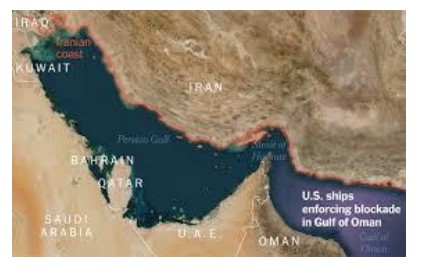
• New Management for Strait of Hormuz: Tehran is set to implement new legal frameworks and management rules for the Strait of Hormuz to secure the Persian Gulf. This move is interpreted as a strategic counter-maneuver to the U.S. naval blockade and aims to dismantle what Iran describes as exploitative schemes by foreign powers in the waterway.
• Maritime Battle of Wills: Following a ceasefire announced on April 8, the conflict between Iran and the U.S.-Israel alliance has transitioned into a maritime confrontation. While the ceasefire holds, the U.S. maintains a blockade on Iran-linked vessels in the Gulf of Oman to exert economic pressure, while Iran retains its chokehold over the Strait of Hormuz.
• Blockade vs. Diplomacy: President Donald Trump has emphasized that the U.S. blockade is more effective than bombing, stating it will remain in place until a deal addressing America’s core nuclear concerns is reached. The U.S. objective remains preventing Iran from acquiring a nuclear weapon through sustained economic and maritime isolation.
• Backchannel Proposals: Recent reports suggest Iran has proposed easing its control over the Strait via Pakistan in exchange for the U.S. lifting the blockade. Iran has expressed a willingness to discuss the nuclear program and other outstanding issues in a subsequent round of negotiations.
• Regional Security Implications: The Islamic Republic claims its new management of the Strait will bring peace and progress to regional nations. However, the international community views these developments as a potential threat to the free flow of global oil supplies, given the Strait role as the mouth of the oil-rich Persian Gulf.
Key Definitions
• Strait of Hormuz: A strategic chokepoint between the Persian Gulf and the Gulf of Oman, through which approximately 1/5th of the world total oil consumption passes.
• Maritime Blockade: An act of war where a belligerent prevents vessels from entering or leaving specified ports or coastal areas of an enemy to cut off supplies and trade.
• Nuclear Safeguards: Measures and technical means used to verify that a state is living up to its international commitments not to use nuclear programs for weapons purposes. Constitutional & Legal Provisions
• UNCLOS (United Nations Convention on the Law of the Sea): The international agreement that defines the rights and responsibilities of nations regarding their use of the world\'s oceans, including the right of transit passage through international straits like Hormuz.
• NPT (Nuclear Non-Proliferation Treaty): An international treaty whose objective is to prevent the spread of nuclear weapons and weapons technology; Iran is a signatory, which creates a legal basis for international nuclear inspections.
• Article 152 of the Iranian Constitution: Directs Iran\'s foreign policy toward the rejection of all forms of domination and the preservation of the country\'s independence and territorial integrity.
Additional Keypoints
• Energy Security: Any disruption in the Strait of Hormuz leads to immediate volatility in global Brent crude prices, impacting energy-importing nations like India significantly.
• Role of Mediators: The use of Pakistan as a diplomatic conduit highlights the complex regional dynamics and the search for track-two diplomacy channels.
• Geopolitical Leverage: Iran utilizes its geographical control over the Strait as a symmetric response to asymmetric economic sanctions imposed by the West.
Conclusion
The hardening stance of the Iranian leadership regarding its nuclear and missile sovereignty, coupled with the U.S. insistence on a blockade-led resolution, suggests a prolonged period of regional instability. The shift toward maritime management by Tehran is a clear attempt to rewrite the rules of engagement in the Persian Gulf, forcing the international community to balance freedom of navigation with the pressures of nuclear non-proliferation.
UPSC Relevance
• GS Paper II: International Relations—Effect of policies and politics of developed and developing countries on India interests; Strategic importance of the Persian Gulf region.
• GS Paper III: Energy Security—Impact of global maritime chokepoints on India’s oil supply chain and economic stability.
• Significance: For the Civil Services Exam, candidates must understand the Chokepoint Diplomacy of the Middle East and how the Iran-U.S. standoff affects India’s Connect West policy and the International North-South Transport Corridor (INSTC).


Address : 506, 3rd EYE THREE (III), Opp. Induben Khakhrawala, Girish Cold Drink Cross Road, CG Road, Navrangpura, Ahmedabad, 380009.
Mobile : 8469231587 / 9586028957
Telephone : 079-40098991
E-mail: dics.upsc@gmail.com
Address: A-306, The Landmark, Urjanagar-1, Opp. Spicy Street, Kudasan – Por Road, Kudasan, Gandhinagar – 382421
Mobile : 9723832444 / 9723932444
E-mail: dics.gnagar@gmail.com
Address: 2nd Floor, 9 Shivali Society, L&T Circle, opp. Ratri Bazar, Karelibaugh, Vadodara, 390018
Mobile : 9725692037 / 9725692054
E-mail: dics.vadodara@gmail.com
Address: 403, Raj Victoria, Opp. Pal Walkway, Near Galaxy Circle, Pal, Surat-394510
Mobile : 8401031583 / 8401031587
E-mail: dics.surat@gmail.com
Address: 303,305 K 158 Complex Above Magson, Sindhubhavan Road Ahmedabad-380059
Mobile : 9974751177 / 8469231587
E-mail: dicssbr@gmail.com
Address: 57/17, 2nd Floor, Old Rajinder Nagar Market, Bada Bazaar Marg, Delhi-60
Mobile : 9104830862 / 9104830865
E-mail: dics.newdelhi@gmail.com