






Ahmedabad
(Head Office)Address : 506, 3rd EYE THREE (III), Opp. Induben Khakhrawala, Girish Cold Drink Cross Road, CG Road, Navrangpura, Ahmedabad, 380009.
Mobile : 8469231587 / 9586028957
Telephone : 079-40098991
E-mail: dics.upsc@gmail.com

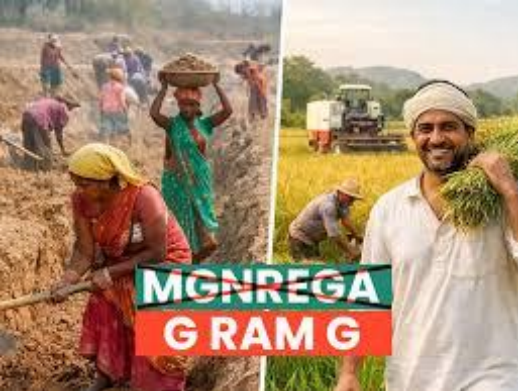
The transition from the Mahatma Gandhi National Rural Employment Guarantee Act (MGNREGA) to the Viksit Bharat – Guarantee for Rozgar and Ajeevika Mission (Gramin) Act (VB-GRAM G) has sparked a critical debate regarding wage suppression. While the new Act introduces a 60:40 cost-sharing model between the Centre and States, it perpetuates a \'real-wage freeze\' that has decoupled employment guarantee wages from both state minimum wages and market realities. Key Summary Points for UPSC • Evolution of Wage Determination: Under MGNREGA Section 6, wages transitioned from being linked to State-specific minimum agricultural wages (Section 6(2)) to being centrally notified (Section 6(1)). This allowed the Centre to decouple MGNREGA rates from rising state minimum wages. • The Real-Wage Freeze: Since 2009, MGNREGA wages have been indexed only to the Consumer Price Index for Agricultural Labourers (CPI-AL). This has resulted in a stagnation of \'real wages,\' causing them to lag significantly behind market rates and statutory minimum wages in most states. • The \'Discouragement Effect\': The widening gap between market wages and guarantee wages, compounded by chronic payment delays and technical failures in the Aadhaar-based system, has led to a decline in genuine worker enthusiasm and participation. • VB-GRAM G Statutory Shift: The new VB-GRAM G Act retains the Centre’s power to set wages (Section 10) but omits the \'non-obstante\' clause that previously allowed MGNREGA to legally override the Minimum Wages Act, 1948, creating a potential legal vacuum. • Fiscal Federalism and Cost Sharing: Unlike MGNREGA, where the Centre bore 100% of wage costs, VB-GRAM G adopts a 60:40 sharing ratio. Critics argue this should have logically led to a return to State-determined minimum wages, as States now have \'skin in the game.\' • Governance and Leakages: Discrepancies between official employment statistics and Periodic Labour Force Survey (PLFS) data suggest that while \'on-paper\' employment remains high, actual field participation is declining, often replaced by administrative leakages and corruption. Additional Important Keypoints • Productivity vs. Wages: The freeze in real wages ignores the rising cost of living and the increased productivity expectations in rural asset creation. • Legal Vulnerability: Without the non-obstante clause in the new Act, paying workers less than the notified State minimum wage may be interpreted as \'forced labour\' under Article 23 of the Constitution. • Market Wage Tightening: Historically, MGNREGA (2006-2014) acted as a \'floor\' for rural wages; the current stagnation risks depressing the entire rural labour market. Constitutional & Legal Provisions • Article 21: The Right to Life includes the right to live with human dignity, which encompasses receiving a \'living wage\' rather than just a subsistence wage. • Article 23: Prohibits \'begar\' and other similar forms of forced labour. The Supreme Court has previously held that paying less than the minimum wage amounts to forced labour. • The Minimum Wages Act, 1948: Provides for fixing minimum rates of wages in certain employments. The exclusion of the \'notwithstanding\' clause in VB-GRAM G makes this Act applicable to rural employment works. • Article 43 (DPSP): Directs the State to secure a \'living wage\' and conditions of work ensuring a decent standard of life for all workers. Definition of Key Words • Real-Wage Freeze: A situation where nominal wages increase only enough to keep up with inflation (CPI-AL), resulting in zero growth in actual purchasing power over time. • Non-obstante Clause: A legal provision (usually starting with \'Notwithstanding anything contained...\') used to allow one law to override the provisions of another conflicting law. • CPI-AL (Consumer Price Index for Agricultural Labourers): A price index used specifically to adjust the wages of rural labourers to account for inflation in essential commodities. • Ajeevika Mission (Gramin): The rural component of the national livelihood mission aimed at promoting self-employment and skilled wage employment. Conclusion The VB-GRAM G Act represents a missed opportunity to harmonize rural employment wages with the Minimum Wages Act. By retaining central control over wage rates while shifting 40% of the financial burden to States, the legislation creates a structural imbalance. For the mission to truly contribute to a \'Viksit Bharat,\' the wage framework must move beyond a mere \'poverty alleviation\' mindset toward a \'dignified labour\' model that ensures timely, market-aligned payments. UPSC Relevance • GS Paper II (Governance): Issues relating to the development and management of Social Sector/Services relating to Health, Education, Human Resources. • GS Paper III (Economy): Issues related to direct and indirect farm subsidies and minimum support prices; Public Distribution System- objectives, functioning, limitations, revamping; issues of food security


Address : 506, 3rd EYE THREE (III), Opp. Induben Khakhrawala, Girish Cold Drink Cross Road, CG Road, Navrangpura, Ahmedabad, 380009.
Mobile : 8469231587 / 9586028957
Telephone : 079-40098991
E-mail: dics.upsc@gmail.com
Address: A-306, The Landmark, Urjanagar-1, Opp. Spicy Street, Kudasan – Por Road, Kudasan, Gandhinagar – 382421
Mobile : 9723832444 / 9723932444
E-mail: dics.gnagar@gmail.com
Address: 2nd Floor, 9 Shivali Society, L&T Circle, opp. Ratri Bazar, Karelibaugh, Vadodara, 390018
Mobile : 9725692037 / 9725692054
E-mail: dics.vadodara@gmail.com
Address: 403, Raj Victoria, Opp. Pal Walkway, Near Galaxy Circle, Pal, Surat-394510
Mobile : 8401031583 / 8401031587
E-mail: dics.surat@gmail.com
Address: 303,305 K 158 Complex Above Magson, Sindhubhavan Road Ahmedabad-380059
Mobile : 9974751177 / 8469231587
E-mail: dicssbr@gmail.com
Address: 57/17, 2nd Floor, Old Rajinder Nagar Market, Bada Bazaar Marg, Delhi-60
Mobile : 9104830862 / 9104830865
E-mail: dics.newdelhi@gmail.com