







Ahmedabad
(Head Office)Address : 506, 3rd EYE THREE (III), Opp. Induben Khakhrawala, Girish Cold Drink Cross Road, CG Road, Navrangpura, Ahmedabad, 380009.
Mobile : 8469231587 / 9586028957
Telephone : 079-40098991
E-mail: dics.upsc@gmail.com

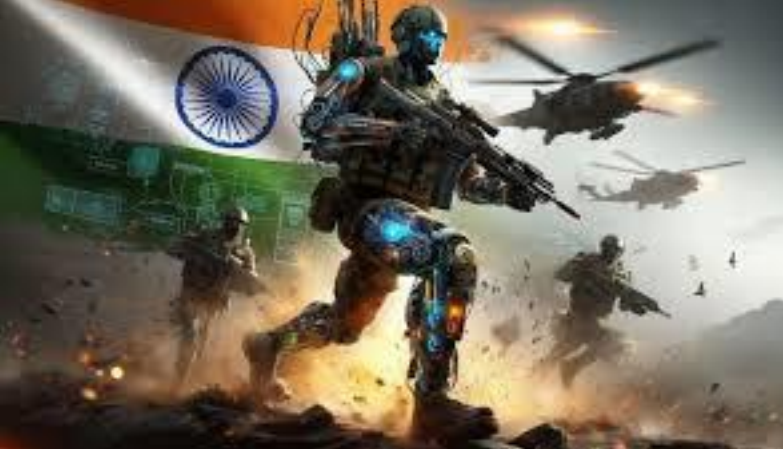
• Shift from Maneuver to Attrition: Contemporary conflicts, particularly the Russia-Ukraine war, demonstrate a transition from swift \'blitzkrieg\' maneuvers to protracted wars of attrition, where endurance and long-term industrial capacity outweigh initial numerical superiority. • Democratization of Lethality: The proliferation of low-cost, high-impact systems like FPV drones and loitering munitions has empowered smaller actors to impose disproportionate costs on advanced militaries, challenging the traditional dominance of heavy platforms like tanks. • Battlefield Transparency: The integration of commercial satellites, Open-Source Intelligence (OSINT), and networked sensors has rendered the modern battlefield \'transparent,\' making operational surprise nearly impossible and forcing a reliance on dispersion and mobility for survival. • Multi-Domain Coercion: The US-Israel-Iran confrontation highlights the \'invisible\' enablers of war— cyber operations, electronic warfare, and space-based data—which allow for rapid degradation of leadership nodes and critical infrastructure before kinetic strikes occur. • Asymmetric and Economic Warfare: Adversaries are increasingly leveraging non-traditional strategies, such as targeting maritime chokepoints (e.g., Strait of Hormuz) and using proxy networks, to transform regional military conflicts into global economic crises. • Supremacy of Adaptation: Success in the 21st-century theater is defined less by \'decisive victory\' and more by \'escalation management\' and the organizational agility to learn and adjust tactics in real-time under constant surveillance. Key Definitions • War of Attrition: A strategic concept where a side attempts to win a war by wearing down the enemy to the point of collapse through continuous losses in personnel and resources. • Multi-Domain Operations (MDO): A combat doctrine involving the rapid and continuous integration of all domains of warfare—land, sea, air, space, and cyberspace—to counter an adversary. • Kinetic and Non-Kinetic Strikes: Kinetic refers to traditional physical force (bombs, bullets), while non-kinetic involves electronic warfare, cyberattacks, or psychological operations that achieve objectives without direct physical destruction. • Loitering Munitions: Often called \'suicide drones,\' these are weapon systems that hover over a target area for some time and attack once a target is located. Constitutional and Legal Provisions • Article 51: The Directive Principles of State Policy mandate that India shall strive to promote international peace and security and maintain just and honorable relations between nations. • The Geneva Conventions: International legal treaties that establish the standards of international law for humanitarian treatment in war, which are increasingly challenged by autonomous weapon systems and cyber warfare. • Manual on International Law Applicable to Cyber Warfare (Tallinn Manual): While not a treaty, it is the influential academic guide on how international law applies to cyber conflicts and \'invisible\' domain coercion. • Section 3 of the Defence of India Act: Provides the Union government the power to make rules for ensuring the public safety and interest, and the defense of India, during external aggression. Additional Keypoints • Supply Chain Resilience: Modern logistics are shifting from \'just-in-time\' efficiency to \'just-in-case\' redundancy, recognizing that centralized depots are vulnerable to precision long-range strikes. • The \'Grey Zone\' Conflict: Many modern confrontations occur in the \'Grey Zone\'—a space between peace and settled war—involving disinformation, economic coercion, and sub-threshold cyberattacks. • Informational Sovereignty: Controlling the narrative through global media and social platforms has moved from the periphery to the center of strategy, affecting international support and domestic legitimacy. • Integrated Deterrence: The reliance on alliances and regional partnerships (as seen in Western support for Ukraine) shows that military power cannot operate in isolation from diplomatic and economic blocks. Conclusion Modern warfare has entered an era of \'messy equilibrium\' where technological sophistication does not necessarily guarantee a quick end to hostilities. The juxtaposition of high-tech precision in West Asia and industrial-age attrition in Eastern Europe suggests that future conflicts will be multidimensional, persistent, and globally disruptive. For a rising power like India, the lesson is clear: national security depends not just on the acquisition of hardware, but on the indigenous ability to innovate, secure the electromagnetic spectrum, and build an economically resilient state capable of enduring long-term friction. UPSC Relevance • GS Paper II: Effect of policies and politics of developed and developing countries on India\'s interests; International Relations and global security architecture. • GS Paper III: Internal Security; Role of external state and non-state actors in creating challenges to internal security; Basics of cyber security; Challenges to security in border areas. • Ethics (GS IV): Ethical issues in international relations and funding; Morality of autonomous weapons and \'collateral damage\' in high-precision strikes.


Address : 506, 3rd EYE THREE (III), Opp. Induben Khakhrawala, Girish Cold Drink Cross Road, CG Road, Navrangpura, Ahmedabad, 380009.
Mobile : 8469231587 / 9586028957
Telephone : 079-40098991
E-mail: dics.upsc@gmail.com
Address: A-306, The Landmark, Urjanagar-1, Opp. Spicy Street, Kudasan – Por Road, Kudasan, Gandhinagar – 382421
Mobile : 9723832444 / 9723932444
E-mail: dics.gnagar@gmail.com
Address: 2nd Floor, 9 Shivali Society, L&T Circle, opp. Ratri Bazar, Karelibaugh, Vadodara, 390018
Mobile : 9725692037 / 9725692054
E-mail: dics.vadodara@gmail.com
Address: 403, Raj Victoria, Opp. Pal Walkway, Near Galaxy Circle, Pal, Surat-394510
Mobile : 8401031583 / 8401031587
E-mail: dics.surat@gmail.com
Address: 303,305 K 158 Complex Above Magson, Sindhubhavan Road Ahmedabad-380059
Mobile : 9974751177 / 8469231587
E-mail: dicssbr@gmail.com
Address: 57/17, 2nd Floor, Old Rajinder Nagar Market, Bada Bazaar Marg, Delhi-60
Mobile : 9104830862 / 9104830865
E-mail: dics.newdelhi@gmail.com