





Ahmedabad
(Head Office)Address : 506, 3rd EYE THREE (III), Opp. Induben Khakhrawala, Girish Cold Drink Cross Road, CG Road, Navrangpura, Ahmedabad, 380009.
Mobile : 8469231587 / 9586028957
Telephone : 079-40098991
E-mail: dics.upsc@gmail.com

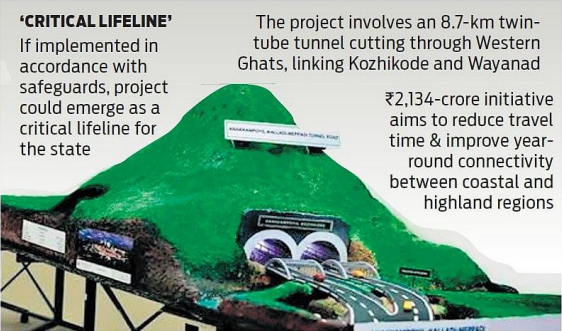
Context: The Supreme Court of India has refused to stay the environmental clearance granted to the twin-tube tunnel corridor in the Western Ghats. Despite petitions citing the 2024 Wayanad landslides and ecological fragility, the Court categorized the project as one of \'national importance\' aimed at resolving severe traffic congestion in land-starved Kerala. Key Analysis of the Judicial Ruling and Environmental Concerns • Recognition of National Importance: The Bench, led by Chief Justice Surya Kant, emphasized that the tunnel project is vital for connectivity in a state characterized by high population density, limited land availability, and extreme road bottlenecks. • Ecological Fragility vs. Infrastructure: The petitioner (Wayanad Prakrithi Samrakshana Samithi) argued that the project lies deep within the ecologically fragile Western Ghats and near the Nilgiri Biosphere, asserting that such projects require Category ‘A’ central-level appraisal rather than state-level clearance. • Landslide Risks: Significant concerns were raised regarding the impact of blasting and vibrations in a region that witnessed devastating landslides in 2024, resulting in over 420 deaths. The petitioners alleged that the environmental clearance was a \'cut-paste job\' without proper scientific application of mind. • Expertise and Safety Protocols: The Apex Court noted that the Central Expert Appraisal Committee (CEAC) had accorded approval subject to rigorous safety and structural conditions. The Court maintained that engineers and experts are better equipped to handle technical safety aspects. • Judicial Recourse and Oversight: While disposing of the petition, the Court allowed the petitioners to approach the National Green Tribunal (NGT) if any environmental conditions are violated or if there is a \'cause for alarm\' during execution. • Federal and Technical Balance: The ruling highlights the judicial tendency to defer to executive and expert wisdom in infrastructure projects deemed critical for public interest, provided a regulatory framework for compliance is in place. Essential Definitions • Ecologically Sensitive Zones (ESZ): Areas notified by the Ministry of Environment, Forest and Climate Change (MoEFCC) around Protected Areas, National Parks, and Wildlife Sanctuaries to create \'shock absorbers\' for the ecosystem. • Category ‘A’ Project: High-impact projects that require mandatory Environmental Clearing from the Central Government (MoEFCC) based on the recommendations of an Expert Appraisal Committee (EAC). • Twin-Tube Tunnel: A design involving two separate tunnels for traffic moving in opposite directions, enhancing safety by providing emergency egress and better ventilation. Constitutional and Legal Framework • Article 21: While usually interpreted as the Right to Life, the Court here balanced the right to a safe environment against the right to infrastructure and development essential for the state\'s survival. • Article 48A (DPSP): Directs the State to protect and improve the environment. The project proponent is constitutionally bound to ensure \'meticulous compliance\' with safety norms to satisfy this mandate. • Environment Protection Act (EPA), 1986: The parent legislation under which the Environmental Impact Assessment (EIA) notifications are issued, governing the grant of clearances for infrastructure projects. • The Precautionary Principle: A core tenet of Indian Environmental Law (Velore Citizens Welfare Forum case) which suggests that where there are threats of serious damage, lack of full scientific certainty shall not be used as a reason for postponing cost-effective measures to prevent environmental degradation. Conclusion The Supreme Court’s decision underscores the complex trade-off between infrastructure development and environmental preservation in biodiversity hotspots like the Western Ghats. While the \'national importance\' tag provides the project legal momentum, the 2024 disaster serves as a grim reminder that engineering solutions must be subordinate to geological realities. The oversight of the NGT will be crucial in ensuring that \'national importance\' does not come at the cost of \'ecological catastrophe.\' UPSC Relevance • GS Paper III (Environment & Disaster Management): Environmental Impact Assessment (EIA); Conservation of Western Ghats (Gadgil and Kasturirangan Committee reports); Landslide vulnerability and mitigation. • GS Paper II (Judiciary & Governance): Judicial review of executive decisions; Balancing Development vs. Environment; Role of the National Green Tribunal (NGT).


Address : 506, 3rd EYE THREE (III), Opp. Induben Khakhrawala, Girish Cold Drink Cross Road, CG Road, Navrangpura, Ahmedabad, 380009.
Mobile : 8469231587 / 9586028957
Telephone : 079-40098991
E-mail: dics.upsc@gmail.com
Address: A-306, The Landmark, Urjanagar-1, Opp. Spicy Street, Kudasan – Por Road, Kudasan, Gandhinagar – 382421
Mobile : 9723832444 / 9723932444
E-mail: dics.gnagar@gmail.com
Address: 2nd Floor, 9 Shivali Society, L&T Circle, opp. Ratri Bazar, Karelibaugh, Vadodara, 390018
Mobile : 9725692037 / 9725692054
E-mail: dics.vadodara@gmail.com
Address: 403, Raj Victoria, Opp. Pal Walkway, Near Galaxy Circle, Pal, Surat-394510
Mobile : 8401031583 / 8401031587
E-mail: dics.surat@gmail.com
Address: 303,305 K 158 Complex Above Magson, Sindhubhavan Road Ahmedabad-380059
Mobile : 9974751177 / 8469231587
E-mail: dicssbr@gmail.com
Address: 57/17, 2nd Floor, Old Rajinder Nagar Market, Bada Bazaar Marg, Delhi-60
Mobile : 9104830862 / 9104830865
E-mail: dics.newdelhi@gmail.com