






Ahmedabad
(Head Office)Address : 506, 3rd EYE THREE (III), Opp. Induben Khakhrawala, Girish Cold Drink Cross Road, CG Road, Navrangpura, Ahmedabad, 380009.
Mobile : 8469231587 / 9586028957
Telephone : 079-40098991
E-mail: dics.upsc@gmail.com

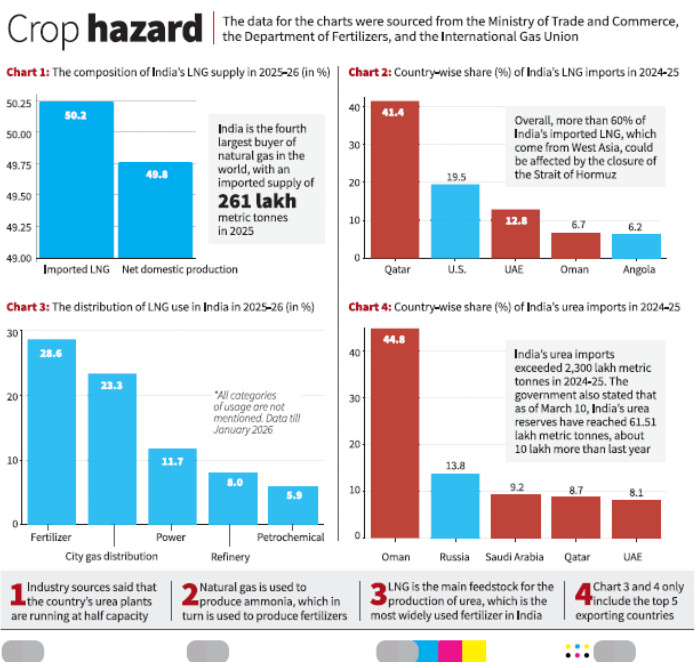
The ongoing conflict in West Asia has exposed India’s \'dual dependence\' on the region for its agrarian stability. India relies on West Asian imports not only for the finished urea but also for the Liquefied Natural Gas (LNG) required to produce it domestically. With the Strait of Hormuz becoming a geopolitical chokepoint, the disruption in the \'Ammonia-Urea\' value chain poses a direct threat to India’s food security and the upcoming Kharif sowing season. • The Dual Dependence Trap: India faces a two-fold risk: first, the disruption of raw material (LNG) for domestic urea plants, and second, the potential blockage of finished urea imports. Currently, over 71% of India’s urea imports and more than 60% of its LNG imports transit through the volatile Strait of Hormuz. • Impact on Domestic Production: Natural gas is the primary feedstock for ammonia, the precursor to urea. Due to current maritime disruptions, major entities like Petronet LNG have declared force majeure, leading to supply curtailments for state-owned distributors (GAIL, IOCL, BPCL). Consequently, domestic urea plants are reportedly operating at only 50% capacity. • Energy Transition and Feedstock Shift: Historically, urea plants used naphtha or fuel oil. However, to meet environmental standards and efficiency, the industry shifted to natural gas. This shift, while greener, has tied India\'s agricultural output directly to the global LNG market and West Asian stability. • Strategic Buffer and Policy Response: In response to the crisis, the Government issued the Natural Gas (Supply Regulation) Order, 2026, placing the fertilizer sector on the \'Priority List\' for gas allocation. Additionally, the government has shored up urea reserves to 61.51 lakh metric tonnes to cushion the impact on the Kharif season. • Market Magnitude: India is the world\'s fourth-largest buyer of natural gas. In 2025, national urea consumption reached 387 lakh metric tonnes, outstripping domestic production (306 lakh metric tonnes). This gap is bridged by imports, primarily from Oman (45%), Saudi Arabia, Qatar, and the UAE. Definitions of Key Terms • Force Majeure: A legal clause in contracts that frees both parties from liability or obligation when an extraordinary event or circumstance beyond their control (like war or natural disaster) occurs. • Feedstock: Raw material used to fuel a machine or industrial process. In this context, natural gas is the feedstock for producing ammonia. • Strait of Hormuz: A narrow waterway between the Persian Gulf and the Gulf of Oman. It is the world\'s most important oil and gas chokepoint, through which one-fifth of the world\'s total oil consumption passes. • Kharif Season: The autumn harvest season in India, involving crops like rice, maize, and cotton that are sown at the beginning of the monsoon (June-July). Constitutional and Legal Provisions • Article 39(b): A Directive Principle of State Policy (DPSP) stating that the State shall direct its policy toward ensuring that the ownership and control of the material resources of the community are so distributed as best to subserve the common good (relevant for fertilizer subsidy and distribution). • Essential Commodities Act, 1955: Fertilizers are declared as \'essential commodities\' under this Act, allowing the government to regulate their production, supply, and distribution to ensure availability at fair prices. • Natural Gas (Supply Regulation) Order, 2026: A recent executive order under the administrative powers of the Ministry of Petroleum and Natural Gas to prioritize gas supply to critical sectors during shortages. Important Keypoints for UPSC Mains • Food Security vs. Energy Security: The crisis highlights how India’s food security is inextricably linked to its energy security. Any spike in LNG prices or supply shock directly translates into higher fertilizer subsidy bills for the government or higher input costs for farmers. • Diversification of Supply: There is an urgent need to diversify LNG and urea sources beyond West Asia—exploring options in Russia, Central Asia, and Africa—and accelerating \'Coal Gasification\' projects to produce urea from domestic coal reserves. • Strategic Petroleum & Gas Reserves: Similar to Strategic Petroleum Reserves (SPR), India needs to develop dedicated long-term storage for LNG to act as a buffer against such geopolitical \'Black Swan\' events. Conclusion The West Asian conflict serves as a \'stress test\' for India\'s self-reliance in agriculture. While the government\'s \'Priority List\' and increased reserves provide short-term relief, the long-term solution lies in reducing the import elasticity of the fertilizer sector. Moving toward \'Green Ammonia\' (produced using renewable energy) and indigenous feedstock alternatives is no longer just an environmental goal, but a strategic imperative to decouple Indian farms from West Asian fires. UPSC Relevance • Prelims: Mapping (Strait of Hormuz, Qatar, Oman), Fertilizer types, and Government orders/Acts (Essential Commodities Act). • Mains (GS Paper III): Issues related to direct and indirect farm subsidies; Food security; Infrastructure: Energy; and the impact of geopolitics on the Indian economy


Address : 506, 3rd EYE THREE (III), Opp. Induben Khakhrawala, Girish Cold Drink Cross Road, CG Road, Navrangpura, Ahmedabad, 380009.
Mobile : 8469231587 / 9586028957
Telephone : 079-40098991
E-mail: dics.upsc@gmail.com
Address: A-306, The Landmark, Urjanagar-1, Opp. Spicy Street, Kudasan – Por Road, Kudasan, Gandhinagar – 382421
Mobile : 9723832444 / 9723932444
E-mail: dics.gnagar@gmail.com
Address: 2nd Floor, 9 Shivali Society, L&T Circle, opp. Ratri Bazar, Karelibaugh, Vadodara, 390018
Mobile : 9725692037 / 9725692054
E-mail: dics.vadodara@gmail.com
Address: 403, Raj Victoria, Opp. Pal Walkway, Near Galaxy Circle, Pal, Surat-394510
Mobile : 8401031583 / 8401031587
E-mail: dics.surat@gmail.com
Address: 303,305 K 158 Complex Above Magson, Sindhubhavan Road Ahmedabad-380059
Mobile : 9974751177 / 8469231587
E-mail: dicssbr@gmail.com
Address: 57/17, 2nd Floor, Old Rajinder Nagar Market, Bada Bazaar Marg, Delhi-60
Mobile : 9104830862 / 9104830865
E-mail: dics.newdelhi@gmail.com