






Ahmedabad
(Head Office)Address : 506, 3rd EYE THREE (III), Opp. Induben Khakhrawala, Girish Cold Drink Cross Road, CG Road, Navrangpura, Ahmedabad, 380009.
Mobile : 8469231587 / 9586028957
Telephone : 079-40098991
E-mail: dics.upsc@gmail.com

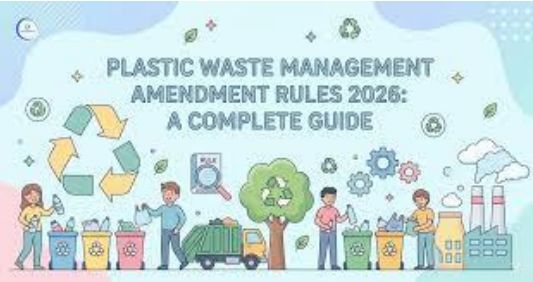
• Extended Flexibility for Deficits: The Ministry of Environment, Forest and Climate Change has introduced a provision allowing companies to carry forward any shortfall in their 2025-26 plastic recycling targets for three subsequent years. This shift from strictly annual compliance requires firms to meet at least one-third of the unfulfilled deficit each year until the target is fully achieved. • Formalization of Plastic Credits: The new rules establish a system of tradable certificates, enabling companies to fulfill their Extended Producer Responsibility (EPR) by purchasing credits from entities that have exceeded their recycling targets. This market-based mechanism aims to reduce overall compliance costs while providing operational flexibility. • Recycled Content Mandates: For the 2025-26 period, rigid plastic packaging (Category I) must contain at least 30% recycled material, while flexible (Category II) and multi-layered plastics (Category III) have lower thresholds of 10% and 5% respectively. These targets are set to scale up significantly by 2028-29 to promote a circular economy. • Exemptions for Food Safety: Recognizing the conflict between recycling and hygiene, the rules stipulate that recycled content targets will not apply where other regulations—such as food safety standards—restrict the use of recycled plastics. This could exempt a substantial portion of the food and beverage packaging sector. • Categorization of Plastic Waste: The framework maintains a clear hierarchy of plastic types: Category 1 (Rigid, e.g., PET bottles) is the most easily recyclable; Category 2 (Flexible, e.g., grocery bags) has moderate difficulty; and Category 3 (Multilayered, e.g., foil wrappers) remains the most challenging to collect and process. • The Compliance Gap: Despite the 2024-25 mandate for companies to collect 100% of the plastic they introduce into the market, there is a lack of comprehensive public data to verify system-wide compliance. The current reporting remains heavily reliant on self-declarations via a centralized portal. Important Keypoints & Provisions • Extended Producer Responsibility (EPR): A policy approach under which producers are given a significant responsibility—financial and/or physical—for the treatment or disposal of post-consumer products. • Reuse Obligations: Beyond recycling, the rules mandate specific reuse targets for rigid packaging, such as 70% for large water containers and 10% for smaller containers (0.9-4.9 litres). • Rigid vs. Multi-layered Plastics: Rigid plastics (shampoo bottles, milk jars) have higher recycling potential compared to multi-layered plastics (chips packets, beverage cartons) which are harder to segregate. Constitutional & Legal Context • Article 48A (DPSP): The State shall endeavour to protect and improve the environment and to safeguard the forests and wildlife of the country. • Article 51A(g) (Fundamental Duties): It shall be the duty of every citizen of India to protect and improve the natural environment. • Environment Protection Act (EPA), 1986: The umbrella legislation under which the Plastic Waste Management Rules are notified and amended. • National Green Tribunal (NGT) Act, 2010: The legal body that adjudicates disputes related to environmental non-compliance and EPR violations. Key Definitions • Plastic Credits: A certificate representing a specific weight of plastic waste that has been collected and recycled beyond the mandatory target, which can be sold to other producers. • Tradable Certificates: Marketable documents that allow companies to \'offset\' their recycling shortfall by funding recycling efforts elsewhere. • Gazette Notification: An official public journal of the government used to notify the public of new laws, rules, or amendments. Conclusion: The 2026 amendment represents a pragmatic \'middle path\' by the government, balancing ambitious environmental targets with the ground realities of industrial compliance. While the carry-forward provision and credit system prevent immediate legal bottlenecks for companies, they also risk diluting the urgency of the 100% collection mandate. For a successful rollout, the government must move beyond selfreported data and establish a transparent, third-party audited monitoring system to ensure that \'flexibility\' does not lead to \'evasion.\' UPSC Relevance • GS Paper II: Government policies and interventions for development in various sectors and issues arising out of their design and implementation. • GS Paper III: Conservation, environmental pollution and degradation, environmental impact assessment; Circular economy and waste-to-wealth initiatives. • Prelims: Categories of plastics, EPR framework, Ministry of Environment\'s role, and the difference between recycling and reuse targets.


Address : 506, 3rd EYE THREE (III), Opp. Induben Khakhrawala, Girish Cold Drink Cross Road, CG Road, Navrangpura, Ahmedabad, 380009.
Mobile : 8469231587 / 9586028957
Telephone : 079-40098991
E-mail: dics.upsc@gmail.com
Address: A-306, The Landmark, Urjanagar-1, Opp. Spicy Street, Kudasan – Por Road, Kudasan, Gandhinagar – 382421
Mobile : 9723832444 / 9723932444
E-mail: dics.gnagar@gmail.com
Address: 2nd Floor, 9 Shivali Society, L&T Circle, opp. Ratri Bazar, Karelibaugh, Vadodara, 390018
Mobile : 9725692037 / 9725692054
E-mail: dics.vadodara@gmail.com
Address: 403, Raj Victoria, Opp. Pal Walkway, Near Galaxy Circle, Pal, Surat-394510
Mobile : 8401031583 / 8401031587
E-mail: dics.surat@gmail.com
Address: 303,305 K 158 Complex Above Magson, Sindhubhavan Road Ahmedabad-380059
Mobile : 9974751177 / 8469231587
E-mail: dicssbr@gmail.com
Address: 57/17, 2nd Floor, Old Rajinder Nagar Market, Bada Bazaar Marg, Delhi-60
Mobile : 9104830862 / 9104830865
E-mail: dics.newdelhi@gmail.com