





Ahmedabad
(Head Office)Address : 506, 3rd EYE THREE (III), Opp. Induben Khakhrawala, Girish Cold Drink Cross Road, CG Road, Navrangpura, Ahmedabad, 380009.
Mobile : 8469231587 / 9586028957
Telephone : 079-40098991
E-mail: dics.upsc@gmail.com

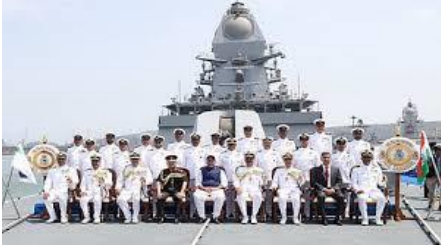
• Enhanced Maritime Capabilities: The commissioning of INS Taragiri, a Nilgiri-class guided-missile stealth frigate, at the Eastern Naval Command in Visakhapatnam significantly strengthens India’s naval presence in the Bay of Bengal and the wider Indo-Pacific region. • Technological Advancement: Representing a generational leap in naval engineering, the vessel features advanced stealth signatures (reduced radar cross-section), a \'Combined Diesel or Gas\' (CODOG) propulsion system, and sophisticated supersonic surface-to-surface missile systems. • Aatmanirbharta in Defence: Built under Project 17A, the frigate boasts approximately 75% indigenous content, involving numerous Indian MSMEs and public sector undertakings, thereby reducing dependency on foreign Original Equipment Manufacturers (OEMs). • Integrated Combat System: The ship is equipped with state-of-the-art sensors, an advanced electronic warfare suite, and high-tech anti-submarine warfare (ASW) capabilities, making it a versatile platform for multidimensional maritime operations. • Strategic Induction: The presence of the Defence Minister and the Chief of Defence Staff at the ceremony underscores the ship\'s role as a cornerstone of the Eastern Fleet, particularly in the context of rising maritime competition and the need for credible deterrence. • Regional Security Architecture: The induction aligns with India’s \'SAGAR\' (Security and Growth for All in the Region) vision, enabling the Indian Navy to act as a \'First Responder\' and a \'Preferred Security Partner\' in the Indian Ocean Region (IOR). Important Keypoints & Technical Specifications • Project 17A (Alpha): A follow-on to the Project 17 (Shivalik-class) frigates, involving the construction of seven stealth frigates with improved stealth features, advanced weapons, and sensors. • Integrated Construction Methodology: The vessel was constructed using \'modular integrated construction,\' where blocks were pre-outfitted before being joined, significantly reducing the build cycle time. • Weaponry: It features the BrahMos supersonic cruise missile for surface-to-surface strikes and the Barak-8 Long Range Surface-to-Air Missile (LRSAM) for air defence. • Sensors: Outfitted with the MF-STAR (Multi-Function Surveillance Track and Missile Guidance Radar) for 360-degree situational awareness. Key Definitions • Stealth Frigate: A naval vessel designed to use stealth technology to avoid detection by radar, visual, sonar, and infrared methods. • CODOG Propulsion: A propulsion system for ships that need a maximum speed considerably faster than their cruise speed, using diesel engines for cruising and gas turbines for high-speed sprints. • Eastern Naval Command (ENC): One of the three command-level formations of the Indian Navy, headquartered in Visakhapatnam, responsible for the maritime security of the eastern seaboard. Constitutional & Legal Context • Article 51: While promoting international peace, the State ensures national security as a prerequisite for global stability. • Entry 1 & 2 (Union List): Defence of India and Naval, Military, and Air Forces are exclusive domains of the Union Parliament, providing the legal basis for such inductions. • Defence Acquisition Procedure (DAP) 2020: The policy framework that prioritizes \'Make in India\' and ensures transparency and speed in the induction of platforms like INS Taragiri. Conclusion: The commissioning of INS Taragiri is a landmark event in India’s journey toward becoming a blue-water navy. It serves as a testament to the country\'s growing prowess in indigenous warship design and construction. By integrating lethal firepower with advanced stealth, the Indian Navy is better positioned to safeguard its maritime interests and uphold a rules-based order in the volatile Indo-Pacific theatre. UPSC Relevance • GS Paper III (Science & Technology): Indigenization of technology and developing new technology; Awareness in the fields of Space, IT, and Robotics. • GS Paper III (Security): Security challenges and their management in border areas; Various Security forces and agencies and their mandate. • Prelims: Specifics of Project 17A, indigenous missile systems (BrahMos/LRSAM), and the geographical significance of the Eastern Naval Command.


Address : 506, 3rd EYE THREE (III), Opp. Induben Khakhrawala, Girish Cold Drink Cross Road, CG Road, Navrangpura, Ahmedabad, 380009.
Mobile : 8469231587 / 9586028957
Telephone : 079-40098991
E-mail: dics.upsc@gmail.com
Address: A-306, The Landmark, Urjanagar-1, Opp. Spicy Street, Kudasan – Por Road, Kudasan, Gandhinagar – 382421
Mobile : 9723832444 / 9723932444
E-mail: dics.gnagar@gmail.com
Address: 2nd Floor, 9 Shivali Society, L&T Circle, opp. Ratri Bazar, Karelibaugh, Vadodara, 390018
Mobile : 9725692037 / 9725692054
E-mail: dics.vadodara@gmail.com
Address: 403, Raj Victoria, Opp. Pal Walkway, Near Galaxy Circle, Pal, Surat-394510
Mobile : 8401031583 / 8401031587
E-mail: dics.surat@gmail.com
Address: 303,305 K 158 Complex Above Magson, Sindhubhavan Road Ahmedabad-380059
Mobile : 9974751177 / 8469231587
E-mail: dicssbr@gmail.com
Address: 57/17, 2nd Floor, Old Rajinder Nagar Market, Bada Bazaar Marg, Delhi-60
Mobile : 9104830862 / 9104830865
E-mail: dics.newdelhi@gmail.com