






Ahmedabad
(Head Office)Address : 506, 3rd EYE THREE (III), Opp. Induben Khakhrawala, Girish Cold Drink Cross Road, CG Road, Navrangpura, Ahmedabad, 380009.
Mobile : 8469231587 / 9586028957
Telephone : 079-40098991
E-mail: dics.upsc@gmail.com

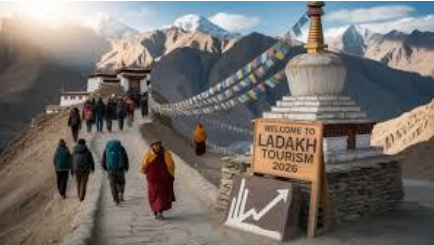
• Joint Resolution on External Investment: The Ladakh Tourist Trade Alliance (LTTA), representing 14 Leh-based organizations, has passed a resolution calling for \'restricted external investment\' in the tourism sector, stipulating that any such entry must involve local participation. • Threat to Local Livelihoods: Stakeholders have flagged increasing pressure from large external businesses and \'vested interests\' seeking to dominate the region\'s tourism. They argue this poses a dual threat to the fragile Himalayan environment and the limited economic opportunities available to the local population. • Call for Policy Protection: The resolution emphasizes that the economic interests and entrepreneurial opportunities of residents must be prioritized through policy advocacy and community-led initiatives to ensure that tourism remains a sustainable and locally-owned asset. • Advocacy for Constitutional Safeguards: Climate activist Sonam Wangchuk, recently released after a sixmonth detention under the National Security Act, reiterated that Ladakh’s demands for Statehood and Sixth Schedule status are rooted in a desire to protect the region\'s land, culture, and ecology. • Search for a \'Middle-Path\' Solution: Wangchuk stressed the importance of unity between the Buddhist and Muslim communities of Leh and Kargil. He advocated for a constructive, open-minded dialogue with the Central Government to find a balanced solution that ensures development without compromising local autonomy. • Patriotism vs. Protests: Addressing the labeling of protesters as \'anti-national,\' the leadership clarified that the movement is a patriotic effort to secure constitutional protections for a sensitive border region rather than an opposition to the state. Key Definitions • Sixth Schedule: A provision under Article 244 of the Indian Constitution that provides for the administration of tribal areas in certain states through Autonomous District Councils (ADCs) with legislative and judicial powers. • Fragile Environment: An ecosystem (like the high-altitude cold desert of Ladakh) that has low resilience to human interference, where even minor changes in land use or pollution can lead to permanent ecological damage. • Statehood: The status of being a full-fledged state within the Indian Union, granting the region its own elected legislative assembly and greater control over domestic governance compared to a Union Territory. Constitutional and Legal Provisions • Article 239A: The provision under which certain Union Territories (like Puducherry or potentially a future Ladakh) can have a legislature; currently, Ladakh is a UT without a legislature. • Sixth Schedule (Article 244 & 275): Provides for Autonomous District Councils which can make laws on land, forest, water, agriculture, and town management—protections currently sought by Ladakhi groups. • National Security Act (NSA), 1980: An act that allows the government to detain a person for up to 12 months without a charge if they are deemed a threat to national security or public order. • Article 19(1)(g) vs. Reasonable Restrictions: While the Constitution guarantees the right to practice any profession or trade, Article 19(6) allows the state to impose reasonable restrictions in the interest of the general public or for the protection of the interests of any Scheduled Tribe. Additional Key Points • Tourism as an Economic Pillar: Tourism is the backbone of Ladakh\'s economy; however, unregulated mass tourism can lead to water scarcity, waste management crises, and cultural erosion. • The Leh-Kargil Unity: The joint struggle of the Leh Apex Body (LAB) and the Kargil Democratic Alliance (KDA) marks a significant socio-political shift toward a unified regional identity. • Geopolitical Sensitivity: As a border region sharing boundaries with China and Pakistan, the internal stability and satisfaction of the local population are considered vital for national security. Conclusion The resolution by Ladakh’s tourism stakeholders reflects a growing global trend of \'responsible tourism\' where the focus shifts from volume to value and local benefit. The demand for restricted investment is not a rejection of development but a plea for \'protective development\' that aligns with the ecological and cultural realities of the plateau. A \'middle-path\' solution involving constitutional safeguards like the Sixth Schedule could potentially bridge the gap between central administrative goals and local aspirations for self-governance. UPSC Relevance • GS Paper II: Federalism and challenges related to Union Territories; Comparison of the Indian constitutional scheme with others; Issues relating to the 5th and 6th Schedules. • GS Paper III: Conservation, environmental pollution, and degradation; Infrastructure and Tourism; Internal Security challenges.


Address : 506, 3rd EYE THREE (III), Opp. Induben Khakhrawala, Girish Cold Drink Cross Road, CG Road, Navrangpura, Ahmedabad, 380009.
Mobile : 8469231587 / 9586028957
Telephone : 079-40098991
E-mail: dics.upsc@gmail.com
Address: A-306, The Landmark, Urjanagar-1, Opp. Spicy Street, Kudasan – Por Road, Kudasan, Gandhinagar – 382421
Mobile : 9723832444 / 9723932444
E-mail: dics.gnagar@gmail.com
Address: 2nd Floor, 9 Shivali Society, L&T Circle, opp. Ratri Bazar, Karelibaugh, Vadodara, 390018
Mobile : 9725692037 / 9725692054
E-mail: dics.vadodara@gmail.com
Address: 403, Raj Victoria, Opp. Pal Walkway, Near Galaxy Circle, Pal, Surat-394510
Mobile : 8401031583 / 8401031587
E-mail: dics.surat@gmail.com
Address: 303,305 K 158 Complex Above Magson, Sindhubhavan Road Ahmedabad-380059
Mobile : 9974751177 / 8469231587
E-mail: dicssbr@gmail.com
Address: 57/17, 2nd Floor, Old Rajinder Nagar Market, Bada Bazaar Marg, Delhi-60
Mobile : 9104830862 / 9104830865
E-mail: dics.newdelhi@gmail.com