






Ahmedabad
(Head Office)Address : 506, 3rd EYE THREE (III), Opp. Induben Khakhrawala, Girish Cold Drink Cross Road, CG Road, Navrangpura, Ahmedabad, 380009.
Mobile : 8469231587 / 9586028957
Telephone : 079-40098991
E-mail: dics.upsc@gmail.com

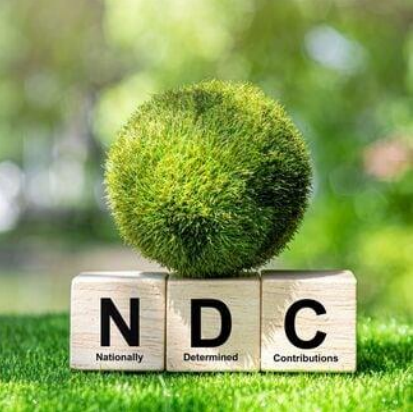
In March 2026, the Union Cabinet approved India’s third round of Nationally Determined Contributions (NDCs) for the 2031-2035 period. This update represents an incremental yet strategic advancement of India\'s climate ambition, rooted in the principle of \'Common But Differentiated Responsibilities\' (CBDR). While many developed nations face \'climate fatigue\' or policy reversals, India has opted for a \'continuity and confidence\' model, raising its targets based on a proven track record of meeting previous goals ahead of schedule. The revised pledges aim to decouple economic growth from greenhouse gas emissions while ensuring that the transition does not compromise India’s developmental space as a lower-middle-income nation. • Enhanced Emissions Target: India has committed to reducing the emissions intensity of its GDP by 47% by 2035 (relative to 2005 levels), up from the previous 2030 target of 45%. • Shift to Non-Fossil Energy: The target for non-fossil fuel-based installed electricity capacity has been raised to 60% by 2035, reflecting a significant leap from the 50% target set for 2030. • Expanded Carbon Sinks: India aims to create an additional carbon sink of 3.5–4 billion tonnes of CO₂ equivalent through enhanced forest and tree cover by 2035. • Economic Realism: The NDCs acknowledge structural constraints, such as the continued role of coal as an energy security backstop and the high costs of grid-scale battery storage (estimated at several trillion rupees). • Strategic Diversification: Beyond solar and wind, the update emphasizes \'leap-frogging\' technologies including Green Hydrogen, Green Steel, and Carbon Capture, Utilization, and Storage (CCUS). • Climate Justice Framework: India maintains that its targets are its \'fair share\' of global action, refusing to compromise manufacturing growth while per capita emissions remain a third of the global average. Key Definitions & Technical Terms • Nationally Determined Contributions (NDCs): Climate action plans to cut emissions and adapt to climate impacts, which each party to the Paris Agreement is required to establish and update every five years. • Emissions Intensity: The volume of greenhouse gas emissions emitted per unit of GDP; reducing it means the economy is becoming more energy-efficient. • Non-Fossil Fuel Sources: Energy derived from solar, wind, biomass, hydro, and nuclear power, which do not emit CO₂ during generation. • Carbon Sink: Anything that absorbs more carbon from the atmosphere than it releases—for example, plants, the ocean, and soil. Constitutional & Legal Provisions • Article 48A (DPSP): Mandates that the State shall endeavor to protect and improve the environment and to safeguard the forests and wildlife of the country. • Article 51A(g) (Fundamental Duties): States that it shall be the duty of every citizen to protect and improve the natural environment including forests, lakes, rivers, and wildlife. • Environment (Protection) Act, 1986: The umbrella legislation that provides the legal framework for the government to take measures to protect the environment and implement international climate agreements. • Energy Conservation (Amendment) Act, 2022: Provides a legal mandate for a domestic Carbon Credit Trading Scheme and the use of non-fossil energy sources. Additional Key Points for Examination • The \'Cicada\' Strategy: Similar to its diplomatic stance, India’s climate policy is \'dormant\' on radical shifts but \'pops up\' with credible, implementation-focused updates that reflect its national circumstances. • Storage Challenges: Utility-scale RE expansion is currently limited by the lack of cost-effective battery storage and the environmental/regulatory hurdles of pumped hydropower. • Global Context: India\'s per capita emissions (approx. 2 tonnes) are significantly lower than those of the US (14 tonnes) or China (8 tonnes), justifying its demand for \'carbon space\' to achieve its Viksit Bharat @2047 vision. Conclusion India’s updated NDCs for 2035 are a masterclass in \'Strategic Circumspection.\' By refusing to succumb to international pressure for an immediate coal phase-out, yet raising its efficiency and renewable targets, India is hedging its developmental future against climate volatility. The success of these targets will depend heavily on the availability of international climate finance and the domestic scaling of storage technologies. UPSC Relevance • GS Paper III (Environment): Conservation, environmental pollution and degradation, environmental impact assessment; National Action Plan on Climate Change (NAPCC). • GS Paper III (Economy): Infrastructure: Energy; Growth and development.


Address : 506, 3rd EYE THREE (III), Opp. Induben Khakhrawala, Girish Cold Drink Cross Road, CG Road, Navrangpura, Ahmedabad, 380009.
Mobile : 8469231587 / 9586028957
Telephone : 079-40098991
E-mail: dics.upsc@gmail.com
Address: A-306, The Landmark, Urjanagar-1, Opp. Spicy Street, Kudasan – Por Road, Kudasan, Gandhinagar – 382421
Mobile : 9723832444 / 9723932444
E-mail: dics.gnagar@gmail.com
Address: 2nd Floor, 9 Shivali Society, L&T Circle, opp. Ratri Bazar, Karelibaugh, Vadodara, 390018
Mobile : 9725692037 / 9725692054
E-mail: dics.vadodara@gmail.com
Address: 403, Raj Victoria, Opp. Pal Walkway, Near Galaxy Circle, Pal, Surat-394510
Mobile : 8401031583 / 8401031587
E-mail: dics.surat@gmail.com
Address: 303,305 K 158 Complex Above Magson, Sindhubhavan Road Ahmedabad-380059
Mobile : 9974751177 / 8469231587
E-mail: dicssbr@gmail.com
Address: 57/17, 2nd Floor, Old Rajinder Nagar Market, Bada Bazaar Marg, Delhi-60
Mobile : 9104830862 / 9104830865
E-mail: dics.newdelhi@gmail.com