


Ahmedabad
(Head Office)Address : 506, 3rd EYE THREE (III), Opp. Induben Khakhrawala, Girish Cold Drink Cross Road, CG Road, Navrangpura, Ahmedabad, 380009.
Mobile : 8469231587 / 9586028957
Telephone : 079-40098991
E-mail: dics.upsc@gmail.com

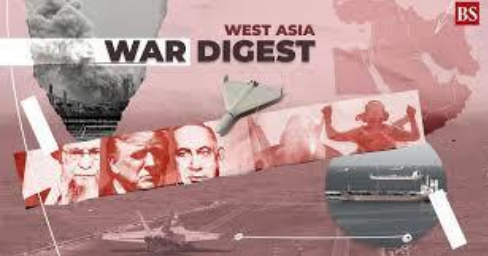
Context: The escalation of the West Asia war, marked by the U.S. sinking of the Iranian warship IRIS Dena on March 4, 2026, and the assassination of Iran’s Supreme Leader, has directly impacted South Asian security and economic stability. India faces the dual challenge of managing its \'strategic autonomy\' while addressing the vulnerabilities of its 10 million-strong diaspora and maritime interests in the Indian Ocean. • Diaspora and Human Security: Approximately 25 million South Asians (including 10 million Indians) reside in West Asia. The conflict threatens their safety and the steady flow of remittances. Furthermore, Indians constitute 15% of global seafarers, many of whom are currently at risk near the weaponized Strait of Hormuz. • Economic Disruptions and Energy Security: The war has triggered shortages in daily necessities, fuel, and fertilizers across South Asia. India is facing urgent requests for petrol and diesel from Bangladesh, Sri Lanka, and the Maldives, necessitating an \'all-of-region\' approach to avoid the supply chain failures seen during the 2021 pandemic. • Diplomatic Balancing Act: India’s initial posture—perceived as tilted toward the U.S.-Israel axis— contrasts with the immediate condemnations issued by neighbors like Pakistan, Bangladesh, and the Maldives. Restoring the \'traditional balance\' is essential to maintain India\'s role as a trusted mediator and a neutral power in regional fault lines. • Maritime Security and Net Security Provider: The unilateral U.S. strike on IRIS Dena in the Indian Ocean challenges India\'s status as the \'Net Security Provider.\' It highlights the need for India to strengthen indigenous maritime coalitions like the Indian Ocean Rim Association (IORA) and the Colombo Security Conclave. • Regional Political Shifts: Economic distress fueled by global conflicts has contributed to youth-led political changes in the neighborhood, notably the Gen-Z-led government in Nepal. India must adapt its \'Neighborhood First\' policy to engage with new leaders who are less beholden to traditional diplomatic ties. • Global Leadership Roles: As the current Chair of the Quad and the upcoming host of the 2026 BRICS Summit, India must leverage these platforms to forge a consensus that highlights South Asian economic and security concerns amidst the North-South geopolitical divide. Key Definitions and Legal Provisions • Net Security Provider: A nation that addresses the security concerns of other countries in its region by providing training, equipment, and maritime surveillance, and by leading humanitarian assistance and disaster relief (HADR). • Section 122 of the Trade Act (U.S.): Though primarily a trade tool, it signifies the broader trend of U.S. unilateralism currently affecting global maritime and economic \'status quo.\' • Article 51 of the UN Charter: Concerns the inherent right of individual or collective self-defense if an armed attack occurs, a point of frequent debate regarding recent strikes in West Asia. • Article 253 of the Indian Constitution: Empowers Parliament to make laws for implementing international treaties/agreements, critical for India\'s upcoming roles in Quad and BRICS. Additional Key Points • Strategic Autonomy: India’s ability to exercise its own foreign policy without being pressured by other powerful nations or blocs, currently tested by the U.S.-Iran confrontation. • Information Fusion Centre (IFC-IOR): An Indian initiative based in Gurugram that plays a vital role in tracking merchant shipping and maritime security threats in real-time. • Youth Disaffection: The survey notes that unemployed and underemployed youth in South Asia are increasingly driving political mandates, forcing a shift toward more domestic-centric foreign policies. Conclusion The migration of the West Asia conflict into the Indian Ocean theater marks a turning point for Indian diplomacy. To safeguard its interests, New Delhi must transition from a reactive stance to a proactive balancing act. By prioritizing regional energy security and reinforcing maritime cooperation platforms, India can mitigate the \'push factors\' of global instability while preserving its strategic influence in a rapidly polarizing world. UPSC Relevance • GS Paper II: India and its neighborhood- relations; Bilateral, regional and global groupings and agreements involving India and/or affecting India’s interests; Effect of policies and politics of developed and developing countries on India’s interests, Indian diaspora. • GS Paper III: Security challenges and their management in border areas; Linkages of organized crime with terrorism; Maritime security. • Mains Perspective: Analyze the impact of West Asian instability on India’s \'Extended Neighborhood\' policy; Discuss the challenges to India’s role as a \'Net Security Provider\' in the face of major power unilateralism.


Address : 506, 3rd EYE THREE (III), Opp. Induben Khakhrawala, Girish Cold Drink Cross Road, CG Road, Navrangpura, Ahmedabad, 380009.
Mobile : 8469231587 / 9586028957
Telephone : 079-40098991
E-mail: dics.upsc@gmail.com
Address: A-306, The Landmark, Urjanagar-1, Opp. Spicy Street, Kudasan – Por Road, Kudasan, Gandhinagar – 382421
Mobile : 9723832444 / 9723932444
E-mail: dics.gnagar@gmail.com
Address: 2nd Floor, 9 Shivali Society, L&T Circle, opp. Ratri Bazar, Karelibaugh, Vadodara, 390018
Mobile : 9725692037 / 9725692054
E-mail: dics.vadodara@gmail.com
Address: 403, Raj Victoria, Opp. Pal Walkway, Near Galaxy Circle, Pal, Surat-394510
Mobile : 8401031583 / 8401031587
E-mail: dics.surat@gmail.com
Address: 303,305 K 158 Complex Above Magson, Sindhubhavan Road Ahmedabad-380059
Mobile : 9974751177 / 8469231587
E-mail: dicssbr@gmail.com
Address: 57/17, 2nd Floor, Old Rajinder Nagar Market, Bada Bazaar Marg, Delhi-60
Mobile : 9104830862 / 9104830865
E-mail: dics.newdelhi@gmail.com