


Ahmedabad
(Head Office)Address : 506, 3rd EYE THREE (III), Opp. Induben Khakhrawala, Girish Cold Drink Cross Road, CG Road, Navrangpura, Ahmedabad, 380009.
Mobile : 8469231587 / 9586028957
Telephone : 079-40098991
E-mail: dics.upsc@gmail.com

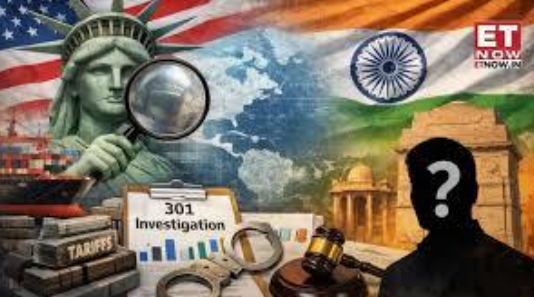
The recent invocation of Section 122 and Section 301 of the U.S. Trade Act of 1974 by the Trump administration marks a significant shift toward trade unilateralism. Following a U.S. Supreme Court ruling that limited executive authority on reciprocal tariffs, the administration has pivoted to \'temporary surcharges\' and investigative proceedings. These actions, targeting major economies including India, the EU, and China, challenge the established multilateral trading order under the World Trade Organization (WTO) and signal a period of intense \'geoeconomic\' friction. • Shift to Section 122 Surcharges: After judicial setbacks regarding direct tariffs, the U.S. invoked Section 122 to impose a 10% temporary surcharge (Feb-July 2026). Legally, this requires a genuine \'Balance of Payments\' (BOP) crisis, a claim currently contested by 24 U.S. states and viewed as inconsistent with international economic realities. • The Section 301 \'Weapon\': Section 301 allows the U.S. Trade Representative (USTR) to unilaterally investigate and penalize foreign trade practices deemed \'unjustifiable\' or \'discriminatory.\' While historically used to build WTO cases, it is now being utilized as a tool for punitive, unilateral tariffs. • Targeting India - Structural & Labor Allegations: The U.S. has initiated two Section 301 proceedings against India and others, alleging \'Structural Excess Capacity\' and \'Failure to Enforce Forced Labor Prohibitions.\' These investigations provide the U.S. with systemic leverage in ongoing bilateral trade negotiations. • Erosion of WTO Authority: The U.S., once the architect of the WTO\'s dispute settlement mechanism, is now its \'chief decimator.\' By blocking the appointment of members to the WTO Appellate Body, the U.S. has effectively rendered the multilateral \'court of appeal\' dysfunctional, allowing it to ignore adverse rulings. • The \'Big Stick\' Diplomacy: A 1999 WTO panel compared Section 301 to a \'big stick.\' While not ruled illegal then due to U.S. assurances of WTO conformity, the current abandonment of those assurances has turned the provision into a primary instrument of raw power advantage. • Call for Multilateral Revival: The crisis underscores the fragility of rule-based trade. For developing nations like India, the strategy must involve active legal participation in U.S. proceedings and building global coalitions to revive the strength of multilateral institutions. Definitions of Key Terms • Balance of Payments (BOP) Crisis: A situation where a country cannot pay for its essential imports or service its external debt, often characterized by a rapid decline in monetary reserves. • Unilateralism: An approach in international relations where a state acts without regard to the interests of other states or its obligations under international agreements. • Excess Capacity: A situation where a country\'s production capability significantly exceeds domestic and legitimate global demand, often leading to \'dumping\' of goods at low prices. • Reciprocal Tariffs: A trade policy where a country imposes tariffs on imports from another country at the same rate that the other country imposes on its exports. Constitutional and Legal Provisions • Section 301 of the Trade Act of 1974: A U.S. domestic law that grants the executive branch broad authority to enforce U.S. rights under trade agreements and respond to \'unfair\' foreign practices. • WTO Dispute Settlement Understanding (DSU): The international agreement that governs the resolution of trade conflicts between member nations. Article 23 of the DSU explicitly prohibits members from making unilateral determinations of violations. • Article 21 of the Indian Constitution: While primarily domestic, the \'Right to Life\' has been interpreted by Indian courts to include the right to a livelihood, which is directly impacted by international trade barriers affecting domestic industries. Important Keypoints for UPSC Mains • Multilateralism vs. Bilateralism: The U.S. move forces India into a corner where it must choose between a \'mutually beneficial\' bilateral trade deal under pressure or standing for a weakened multilateral system. • Impact on \'Make in India\': Allegations of \'excess capacity\' could be used to target India\'s manufacturing incentives (like PLI schemes), framing them as \'distortive\' trade practices. • Digital Trade & Labor Standards: The U.S. frequently uses Section 301 to push for its own standards on labor and digital commerce, which often conflict with the developmental priorities of emerging economies. Conclusion The \'Double-Engine\' of U.S. trade policy—legal surcharges and unilateral investigations—represents a departure from the \'Rule of Law\' to the \'Rule of Power.\' For India, the path forward involves a sophisticated mix of legal defense in U.S. courts and proactive leadership at the WTO. Trade can no longer be viewed in isolation; it is now a front in the larger battle for global strategic autonomy. UPSC Relevance • GS Paper II (International Relations): Effect of policies and politics of developed and developing countries on India’s interests; Important International institutions (WTO) and their structure. • GS Paper III (Economy): Effects of liberalization on the economy; Changes in industrial policy and their effects on industrial growth; International trade.


Address : 506, 3rd EYE THREE (III), Opp. Induben Khakhrawala, Girish Cold Drink Cross Road, CG Road, Navrangpura, Ahmedabad, 380009.
Mobile : 8469231587 / 9586028957
Telephone : 079-40098991
E-mail: dics.upsc@gmail.com
Address: A-306, The Landmark, Urjanagar-1, Opp. Spicy Street, Kudasan – Por Road, Kudasan, Gandhinagar – 382421
Mobile : 9723832444 / 9723932444
E-mail: dics.gnagar@gmail.com
Address: 2nd Floor, 9 Shivali Society, L&T Circle, opp. Ratri Bazar, Karelibaugh, Vadodara, 390018
Mobile : 9725692037 / 9725692054
E-mail: dics.vadodara@gmail.com
Address: 403, Raj Victoria, Opp. Pal Walkway, Near Galaxy Circle, Pal, Surat-394510
Mobile : 8401031583 / 8401031587
E-mail: dics.surat@gmail.com
Address: 303,305 K 158 Complex Above Magson, Sindhubhavan Road Ahmedabad-380059
Mobile : 9974751177 / 8469231587
E-mail: dicssbr@gmail.com
Address: 57/17, 2nd Floor, Old Rajinder Nagar Market, Bada Bazaar Marg, Delhi-60
Mobile : 9104830862 / 9104830865
E-mail: dics.newdelhi@gmail.com