


Ahmedabad
(Head Office)Address : 506, 3rd EYE THREE (III), Opp. Induben Khakhrawala, Girish Cold Drink Cross Road, CG Road, Navrangpura, Ahmedabad, 380009.
Mobile : 8469231587 / 9586028957
Telephone : 079-40098991
E-mail: dics.upsc@gmail.com

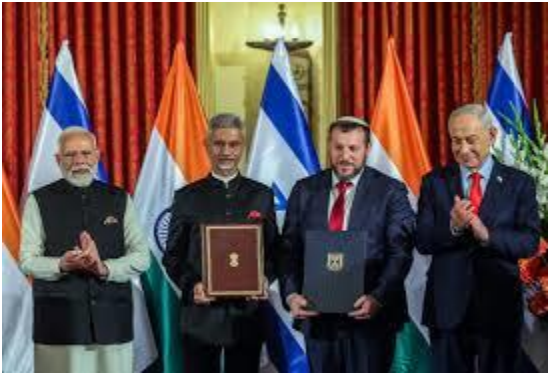
In a landmark diplomatic shift during Prime Minister Narendra Modi’s visit to Tel Aviv in February 2026, India and Israel have officially elevated their relationship from a \'Strategic Partnership\' to a \'Special Strategic Partnership\'. The visit resulted in 17 high-impact agreements, signaling a deepened commitment to defense co-production, technological integration, and regional stability in West Asia. Key Highlights and Summary • Strategic Elevation: The bilateral ties have been upgraded to a \'Special Strategic Partnership\', reflecting a transition from a buyer-seller relationship to one of deep co-development and shared geopolitical goals. • Economic Integration: Both nations agreed to fast-track the long-pending Bilateral Free Trade Agreement (FTA), aimed at diversifying trade beyond the traditional diamond and defense sectors into services and high-tech manufacturing. • Defense and \'Make in India\': A new roadmap was established for the joint development and production of military hardware under the framework of Transfer of Technology (ToT), moving beyond simple procurement to co-innovation. • Emerging Technology Frontier: A \'Critical and Emerging Technologies Partnership\' was launched, focusing on Artificial Intelligence (AI), Quantum Computing, and securing supply chains for critical minerals essential for green energy. • Digital Diplomacy: The adoption of India’s Unified Payments Interface (UPI) in Israel was finalized, facilitating seamless cross-border transactions for tourists, students, and businesses, further integrating the two economies. • Regional Stability and Peace: Prime Minister Modi underscored that India\'s security is intrinsically linked to West Asian stability, reiterating support for a peaceful resolution in Gaza while maintaining a firm, zero-tolerance stance against global terrorism. Constitutional and Legal Provisions • Article 51 (DPSP): Directs the State to promote international peace and security and maintain just and honorable relations between nations, forming the bedrock of India\'s engagement with Israel. • Article 73: Specifies that the executive power of the Union extends to matters with respect to which Parliament has power to make laws, including the signing and implementation of international treaties and agreements. • Unlawful Activities (Prevention) Act (UAPA): Both nations collaborate under legal frameworks to combat transnational terrorism, sharing intelligence and best practices for internal security. • The Patents Act, 1970: Crucial for the 17 new agreements, particularly in AI and Biotechnology, ensuring intellectual property rights (IPR) protection for joint innovations. Key Definitions • Special Strategic Partnership: A top-tier diplomatic designation implying a high degree of mutual trust, frequent high-level exchanges, and collaboration on sensitive sectors like defense, intelligence, and nuclear energy. • Transfer of Technology (ToT): The process of sharing skills, knowledge, and manufacturing methods from one partner (Israel) to another (India) to ensure the recipient can produce the technology independently. • Critical Minerals: Non-fuel mineral materials (e.g., Lithium, Cobalt) that are essential to the economic or national security of a country and have a supply chain vulnerable to disruption. Additional Important Keypoints The partnership also expanded into \'Agri-Tech\' with the announcement of new \'Villages of Excellence\' across India, utilizing Israeli water-recycling and precision farming techniques. Furthermore, the collaboration on \'Maritime Heritage\' aims to leverage Israel’s expertise in underwater archaeology to preserve India\'s coastal history. Conclusion: The 2026 visit marks the \'de-hyphenation\' of India\'s West Asia policy reaching its maturity. By balancing a special bond with Israel while advocating for humanitarian peace in Gaza, India has positioned itself as a credible mediator and a technological powerhouse. The fast-tracking of the FTA and the integration of UPI suggest that the partnership is now moving from the barracks to the marketplace and the digital cloud. UPSC Relevance • GS Paper II: Bilateral, regional, and global groupings and agreements involving India (I2U2, IMEC); Effect of policies and politics of developed countries on India\'s interests. • GS Paper III: Science and Technology (AI, Quantum, UPI); Security Challenges (Terrorism, Defense co-production); Achievement of Indians in science & technology. • IR Strategy: India’s ‘Link West’ policy and the strategic balance in the Middle East amidst the US-Iran standoff.


Address : 506, 3rd EYE THREE (III), Opp. Induben Khakhrawala, Girish Cold Drink Cross Road, CG Road, Navrangpura, Ahmedabad, 380009.
Mobile : 8469231587 / 9586028957
Telephone : 079-40098991
E-mail: dics.upsc@gmail.com
Address: A-306, The Landmark, Urjanagar-1, Opp. Spicy Street, Kudasan – Por Road, Kudasan, Gandhinagar – 382421
Mobile : 9723832444 / 9723932444
E-mail: dics.gnagar@gmail.com
Address: 2nd Floor, 9 Shivali Society, L&T Circle, opp. Ratri Bazar, Karelibaugh, Vadodara, 390018
Mobile : 9725692037 / 9725692054
E-mail: dics.vadodara@gmail.com
Address: 403, Raj Victoria, Opp. Pal Walkway, Near Galaxy Circle, Pal, Surat-394510
Mobile : 8401031583 / 8401031587
E-mail: dics.surat@gmail.com
Address: 303,305 K 158 Complex Above Magson, Sindhubhavan Road Ahmedabad-380059
Mobile : 9974751177 / 8469231587
E-mail: dicssbr@gmail.com
Address: 57/17, 2nd Floor, Old Rajinder Nagar Market, Bada Bazaar Marg, Delhi-60
Mobile : 9104830862 / 9104830865
E-mail: dics.newdelhi@gmail.com