



Ahmedabad
(Head Office)Address : 506, 3rd EYE THREE (III), Opp. Induben Khakhrawala, Girish Cold Drink Cross Road, CG Road, Navrangpura, Ahmedabad, 380009.
Mobile : 8469231587 / 9586028957
Telephone : 079-40098991
E-mail: dics.upsc@gmail.com

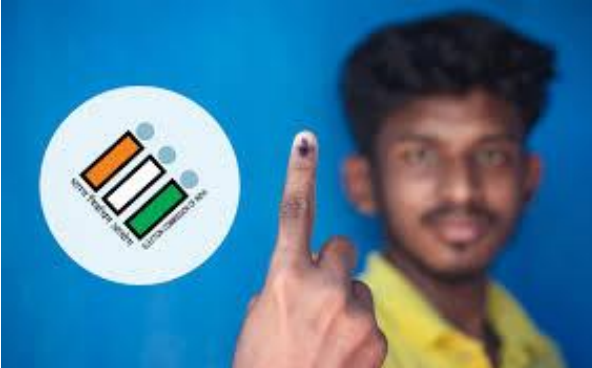
The conduct of periodic elections is the bedrock of Indian democracy. As several States and Union Territories head to the polls in 2026, the Election Commission of India (ECI) faces the dual task of managing massive logistical scales while safeguarding the sanctity of the vote against modern threats like deepfakes and the \'4M\' challenges. Core Summary of Election Management • Scale and Logistics: India’s electoral machinery is unparalleled, involving over 25 lakh officials for a 17.4 crore electorate across 2.19 lakh polling stations. This ensures a ratio of one official for every 70 electors, reaching even the most remote terrains such as the Varusanad hills. • The 4M Challenge: The ECI has declared a \'war\' on four primary threats: Money (inducements), Muscle (violence/intimidation), Misinformation (fake news/deepfakes), and Model Code of Conduct (MCC) violations. • Neutrality and Oversight: Under Section 28A of the Representation of the People Act, 1951, all election officials are deemed to be on deputation to the ECI, ensuring their legal allegiance is to the Commission rather than state governments during the poll period. • Curbing Inducements: There is a rising trend of \'promise bazaars\' and freebies. Seizures of illicit cash, liquor, and drugs have seen a massive spike, with over 10,000 crore worth of material seized during the 2024 general elections—nearly triple the 2019 figures. • Technological & Ethical Safeguards: Innovations such as 24/7 live webcasting of polling stations, home-voting facilities for citizens over 85 years, and a voluntary code of ethics for social media are being deployed to enhance transparency and inclusivity. • Phased Management: A reduction in polling phases (notably in volatile regions like West Bengal) indicates maturing security movement and election management, aiming to balance safety with administrative efficiency. Constitutional and Legal Provisions • Article 324: Grants the ECI the power of superintendence, direction, and control of elections. It is the fountainhead of the ECI’s authority to ensure free and fair polls. • Article 325 & 326: Ensure no person is ineligible for inclusion in electoral rolls on grounds of religion, race, caste, or sex, and grant adult suffrage (Right to Vote) to every citizen not less than 18 years of age. • Section 28A, Representation of the People Act (RPA), 1951: Legally binds officials involved in election work to the ECI, making them subject to its disciplinary control to prevent local political interference. • Model Code of Conduct (MCC): A set of guidelines issued by the ECI to regulate the conduct of political parties and candidates. While not statutory, it gains \'teeth\' through the ECI’s power under Article 324. Definitions of Key Terms • Special Intensive Revision (SIR): A rigorous process of updating electoral rolls to remove \'ASD\' (Absent, Shifted, Deceased) voters, thereby increasing the accuracy of turnout percentages and preventing proxy voting. • Horizontal vs. Vertical Issues: In the context of the 4Ms, \'Muscle\' power is a vertical/physical threat, while \'Misinformation\' acts as a horizontal/digital threat that permeates the entire social fabric simultaneously • SVEEP (Systematic Voters’ Education and Electoral Participation): The flagship program of the ECI for voter education, spreading awareness and promoting voter literacy in India. Conclusion While the logistical success of Indian elections is a global benchmark, the qualitative challenge remains significant. The shift from \'Muscle power\' to \'Money and Misinformation\' requires a transition in election management—from physical policing to digital and fiscal auditing. Ultimately, the integrity of the process rests on \'civic resistance\'—the ability of the voter to make a moral choice independent of inducements or polarized narratives. UPSC Relevance • GS Paper II: Appointment to various Constitutional posts, powers, functions, and responsibilities of various Constitutional Bodies (ECI); Salient features of the Representation of the People’s Act. • Governance: Role of technology in elections, transparency, and accountability. • Ethics (GS Paper IV): The moral responsibility of the voter and the ethical conduct of civil servants during election duties.


Address : 506, 3rd EYE THREE (III), Opp. Induben Khakhrawala, Girish Cold Drink Cross Road, CG Road, Navrangpura, Ahmedabad, 380009.
Mobile : 8469231587 / 9586028957
Telephone : 079-40098991
E-mail: dics.upsc@gmail.com
Address: A-306, The Landmark, Urjanagar-1, Opp. Spicy Street, Kudasan – Por Road, Kudasan, Gandhinagar – 382421
Mobile : 9723832444 / 9723932444
E-mail: dics.gnagar@gmail.com
Address: 2nd Floor, 9 Shivali Society, L&T Circle, opp. Ratri Bazar, Karelibaugh, Vadodara, 390018
Mobile : 9725692037 / 9725692054
E-mail: dics.vadodara@gmail.com
Address: 403, Raj Victoria, Opp. Pal Walkway, Near Galaxy Circle, Pal, Surat-394510
Mobile : 8401031583 / 8401031587
E-mail: dics.surat@gmail.com
Address: 303,305 K 158 Complex Above Magson, Sindhubhavan Road Ahmedabad-380059
Mobile : 9974751177 / 8469231587
E-mail: dicssbr@gmail.com
Address: 57/17, 2nd Floor, Old Rajinder Nagar Market, Bada Bazaar Marg, Delhi-60
Mobile : 9104830862 / 9104830865
E-mail: dics.newdelhi@gmail.com