


Ahmedabad
(Head Office)Address : 506, 3rd EYE THREE (III), Opp. Induben Khakhrawala, Girish Cold Drink Cross Road, CG Road, Navrangpura, Ahmedabad, 380009.
Mobile : 8469231587 / 9586028957
Telephone : 079-40098991
E-mail: dics.upsc@gmail.com

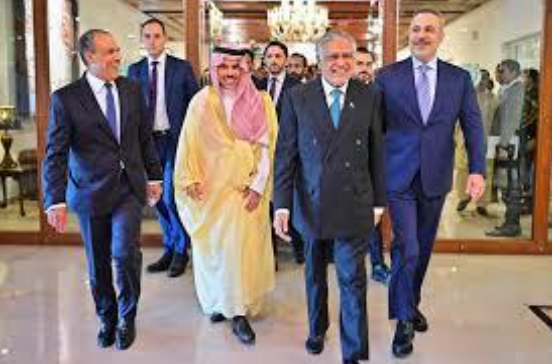
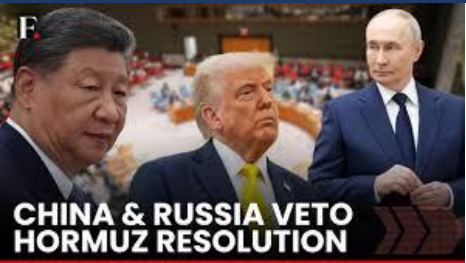
The recent multilateral meeting in Islamabad involving the Foreign Ministers of Saudi Arabia, Türkiye, Egypt, and Pakistan marks a significant, albeit preliminary, attempt to mediate the ongoing conflict in West Asia. This diplomatic push, complemented by Pakistan’s engagements with Iran and China, underscores a regional desire for stability. However, the path to a lasting ceasefire remains obstructed by diverging strategic objectives of major powers, a lack of mutual trust, and the complex challenge of enforcing international mandates in a highly polarized environment. Core Summary of the Geopolitical Dynamics • Multilateral Mediation Efforts: Pakistan has emerged as a focal point for regional diplomacy, coordinating with Middle Eastern powers and China to explore de-escalation strategies and humanitarian aid delivery. • Diverging Strategic Objectives: A primary obstacle to peace is the lack of a clear \'win\' state; while the U.S. shifts goals between regime change and maritime control of the Strait of Hormuz, Israel focuses on neutralizing Iran’s long-term strike capabilities. • The Enforcement Dilemma: A credible ceasefire requires a neutral force capable of providing security guarantees, likely necessitating a United Nations mandate to bypass the legal and political \'illegality\' of the current hostilities. • Bypassing the UNSC: Historical precedents, such as the 1956 \'Uniting for Peace\' resolution during the Suez Crisis, suggest that the UN General Assembly can authorize peacekeeping when the Security Council is paralyzed, though this requires strong backing from a major power. • Troop Contributors and Funding: Potential peacekeepers could be drawn from regional powers like Egypt, Türkiye, and Pakistan, with the initiative likely being funded by Gulf nations and supported by the \'Global South.\' • Role of Strategic Trust: Deep-seated suspicions remain a barrier; Iran’s distrust of mediators—some of whom have past or ongoing conflicts with Tehran—complicates the acceptance of any third-party peace plan. Key Definitions • Strait of Hormuz: A critical maritime chokepoint between the Persian Gulf and the Gulf of Oman, essential for global energy supplies and a focal point of US-Iran tensions. • Uniting for Peace Resolution (Resolution 377A): A UN mechanism that allows the General Assembly to recommend collective measures, including the use of armed force, if the Security Council fails to exercise its primary responsibility for international peace. • Strategic Mutual Defence Agreement: A bilateral treaty (like the 2025 Saudi-Pakistan pact) where signatories commit to military assistance in the event of an attack on either party. Constitutional & Legal Frameworks • United Nations Charter (Chapter VII): Governs the UNSC\'s power to maintain peace; however, as seen in West Asia, the veto power often leads to a \'field unoccupied by law,\' necessitating alternative legal routes like Resolution 377. • Article 51 of the UN Charter: Recognizes the inherent right of individual or collective self-defense if an armed attack occurs, a provision frequently invoked by various actors in the current conflict to justify military operations. • India’s Constitutional Mandate (Article 51): A Directive Principle of State Policy (DPSP) that obligates the Indian State to \'promote international peace and security\' and \'maintain just and honorable relations between nations.\' Additional Important Keypoints • China\'s Five-Point Plan: Beijing’s diplomatic entry focuses on humanitarian corridors and \'persuasion\' without direct security commitments, reflecting its cautious approach to global military entanglements. • Economic Pressure: The crisis has hit Southeast Asia and India\'s neighbors hard through an energy crisis, creating a shared interest in the \'Global South\' to push for an end to the war. • The \'No Kings\' Protest: Highlighting internal domestic pressures in the U.S., showing that while not directly anti-war, large-scale domestic unrest can influence a nation\'s long-term military endurance. Conclusion The West Asia crisis has moved beyond a bilateral conflict into a regional and global stability threat. While the Islamabad talks represent a \'tiny step,\' a breakthrough depends on the U.S. and Iran reaching a point of \'exhaustion\' or finding a face-saving exit. For mediation to succeed, it must move beyond rhetoric to a UNbacked peacekeeping framework. The historical \'Suez model\' provides a potential roadmap for the General Assembly to act where the Security Council has failed, provided there is a unified global push for peace. UPSC Relevance • GS Paper II (International Relations): Crucial for \'Bilateral, regional and global groupings,\' \'Effect of policies of developed countries on India’s interests,\' and the \'Role of the UN.\' • GS Paper II (Polity): Links to Article 51 of the DPSP and India’s foreign policy traditionalism.


Address : 506, 3rd EYE THREE (III), Opp. Induben Khakhrawala, Girish Cold Drink Cross Road, CG Road, Navrangpura, Ahmedabad, 380009.
Mobile : 8469231587 / 9586028957
Telephone : 079-40098991
E-mail: dics.upsc@gmail.com
Address: A-306, The Landmark, Urjanagar-1, Opp. Spicy Street, Kudasan – Por Road, Kudasan, Gandhinagar – 382421
Mobile : 9723832444 / 9723932444
E-mail: dics.gnagar@gmail.com
Address: 2nd Floor, 9 Shivali Society, L&T Circle, opp. Ratri Bazar, Karelibaugh, Vadodara, 390018
Mobile : 9725692037 / 9725692054
E-mail: dics.vadodara@gmail.com
Address: 403, Raj Victoria, Opp. Pal Walkway, Near Galaxy Circle, Pal, Surat-394510
Mobile : 8401031583 / 8401031587
E-mail: dics.surat@gmail.com
Address: 303,305 K 158 Complex Above Magson, Sindhubhavan Road Ahmedabad-380059
Mobile : 9974751177 / 8469231587
E-mail: dicssbr@gmail.com
Address: 57/17, 2nd Floor, Old Rajinder Nagar Market, Bada Bazaar Marg, Delhi-60
Mobile : 9104830862 / 9104830865
E-mail: dics.newdelhi@gmail.com