






Ahmedabad
(Head Office)Address : 506, 3rd EYE THREE (III), Opp. Induben Khakhrawala, Girish Cold Drink Cross Road, CG Road, Navrangpura, Ahmedabad, 380009.
Mobile : 8469231587 / 9586028957
Telephone : 079-40098991
E-mail: dics.upsc@gmail.com

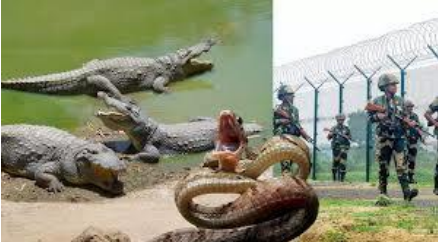
• Innovative Border Management Initiative: The Border Security Force (BSF) is exploring the feasibility of using reptiles, specifically crocodiles and snakes, as a biological deterrent in vulnerable riverine gaps along the 4,096.7 km border with Bangladesh to curb infiltration and smuggling. • Addressing Gaps in Physical Fencing: While 2,954.56 km of the sanctioned 3,326.14 km border has been fenced, approximately 371 km remains unfenced due to difficult terrain, including hills, valleys, and flood-prone riverine stretches where traditional physical barriers are technically unfeasible. • Strategic Shift to Non-Physical Barriers: This move aligns with broader Home Ministry directives to seek unconventional and technological solutions (Comprehensive Integrated Border Management System - CIBMS) for areas where the topography prevents the construction of permanent structures. • Operational and Ethical Challenges: Internal communications highlight significant hurdles, including the procurement of reptiles, the potential risk to local civilian populations residing along the riverine stretches, and the unpredictability of animal behavior during seasonal floods. • Terrain-Specific Security Risks: The eastern border\'s topography makes it highly susceptible to illegal migration and anti-national activities. The \'swim or sink\' approach seeks to leverage the natural ecosystem to create a psychological and physical barrier in the absence of floodlit fences. • Comprehensive Border Illumination: Alongside these feasibility studies, the Government of India continues the phase-wise construction of physical fences illuminated by floodlights to ensure 24/7 surveillance in accessible regions. Key Definitions • Riverine Border: A border defined by a river or passing through marshy, water-logged terrain where the boundary is often fluid and difficult to demarcate with permanent fences. • Infiltration: The unauthorized entry of individuals or groups across a sovereign border for illegal migration, smuggling, or insurgent activities. • Non-Physical Barrier: Security solutions that do not rely on fences or walls, instead utilizing technology (sensors, cameras, radars) or, in this experimental case, biological deterrents. Constitutional and Legal Provisions • Article 355 of the Constitution: Mandates the Union to protect every State against external aggression and internal disturbance, providing the legal basis for central forces like the BSF to secure international borders. • Border Security Force Act, 1968: Governs the constitution and regulation of the BSF, outlining its duties in ensuring the security of the borders of India and for matters connected therewith. • The Wildlife Protection Act, 1972: This poses a significant legal challenge to the plan, as the capture, transport, and deployment of crocodiles and snakes (protected species) for security purposes must comply with strict conservation and ethical guidelines. • Seventh Schedule (List I - Union List): Entry 2 (Naval, military and air forces; any other armed forces of the Union) gives the Central Government exclusive jurisdiction over border security. Additional Key Points • Technological Integration: The BSF is increasingly relying on the \'Bold-QIT\' (Border Electronically Dominated QRT Interception Technique) to monitor riverine areas where physical presence is difficult. • Human Rights Concerns: Experts suggest that using biological deterrents could lead to international scrutiny regarding the treatment of migrants and the safety of innocent border-dwellers. • Ecological Impact: Introducing high concentrations of predatory reptiles into specific riverine pockets could disrupt the local food chain and biodiversity balance. Conclusion The proposal to deploy crocodiles and snakes represents a desperate search for solutions in the face of India’s most complex topographical border challenge. While the psychological deterrent value is high, the legal, ethical, and operational risks—particularly the safety of Indian citizens in border villages—remain substantial. A balanced approach would likely see these biological ideas remain experimental, with the ultimate focus shifting toward high-tech \'Smart Fencing\' and CIBMS. UPSC Relevance • GS Paper III: Security challenges and their management in border areas; Role of external state and non-state actors in creating challenges to internal security. • GS Paper II: Statutory, regulatory and various quasi-judicial bodies (Role of the BSF and Ministry of Home Affairs). • Prelims: Mapping of the India-Bangladesh border (West Bengal, Assam, Meghalaya, Tripura, Mizoram), Wildlife Protection Act schedules, and BSF jurisdictional updates.


Address : 506, 3rd EYE THREE (III), Opp. Induben Khakhrawala, Girish Cold Drink Cross Road, CG Road, Navrangpura, Ahmedabad, 380009.
Mobile : 8469231587 / 9586028957
Telephone : 079-40098991
E-mail: dics.upsc@gmail.com
Address: A-306, The Landmark, Urjanagar-1, Opp. Spicy Street, Kudasan – Por Road, Kudasan, Gandhinagar – 382421
Mobile : 9723832444 / 9723932444
E-mail: dics.gnagar@gmail.com
Address: 2nd Floor, 9 Shivali Society, L&T Circle, opp. Ratri Bazar, Karelibaugh, Vadodara, 390018
Mobile : 9725692037 / 9725692054
E-mail: dics.vadodara@gmail.com
Address: 403, Raj Victoria, Opp. Pal Walkway, Near Galaxy Circle, Pal, Surat-394510
Mobile : 8401031583 / 8401031587
E-mail: dics.surat@gmail.com
Address: 303,305 K 158 Complex Above Magson, Sindhubhavan Road Ahmedabad-380059
Mobile : 9974751177 / 8469231587
E-mail: dicssbr@gmail.com
Address: 57/17, 2nd Floor, Old Rajinder Nagar Market, Bada Bazaar Marg, Delhi-60
Mobile : 9104830862 / 9104830865
E-mail: dics.newdelhi@gmail.com