






Ahmedabad
(Head Office)Address : 506, 3rd EYE THREE (III), Opp. Induben Khakhrawala, Girish Cold Drink Cross Road, CG Road, Navrangpura, Ahmedabad, 380009.
Mobile : 8469231587 / 9586028957
Telephone : 079-40098991
E-mail: dics.upsc@gmail.com

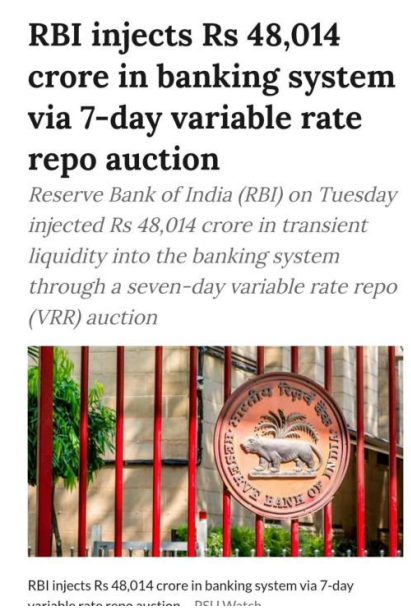
• Liquidity Infusion: The Reserve Bank of India (RBI) injected ₹55,837 crore into the banking system through a three-day Variable Rate Repo (VRR) auction to address transient liquidity deficits. • Auction Dynamics: Although the RBI notified an intake of up to ₹1 trillion, the actual injection was significantly lower, with funds being disbursed at a cut-off and weighted average rate of 5.26%. • Drivers of Deficit: The recent tightening of liquidity is primarily attributed to massive outflows from the banking system due to quarterly advance tax payments by corporations and individuals. • Monetary Policy Tool: The VRR serves as a \'fine-tuning\' operation under the Liquidity Adjustment Facility (LAF) to ensure that the Inter-Bank Call Money Rate remains aligned with the Repo Rate. • Market Impact: Such injections are crucial to prevent a spike in short-term interest rates, ensuring that banks have sufficient funds to meet their lending requirements and statutory obligations. • Transition from Surplus: This move highlights the shifting nature of banking liquidity, which has moved from a surplus state to a \'deficit mode\' due to seasonal factors and tax-related outflows. Key Definitions • Liquidity Adjustment Facility (LAF): A tool used by the RBI that allows banks to borrow money through repurchase agreements (repos) or to make loans to the RBI through reverse repo agreements. • Variable Rate Repo (VRR): An auction-based mechanism where the RBI lends money to banks for short durations at interest rates determined by the bidding process, rather than a fixed repo rate. • Advance Tax: A system where taxpayers pay their income tax in installments throughout the year instead of a lump sum at the end, often leading to temporary liquidity drains in the banking sector. • Cut-off Rate: The lowest interest rate at which the RBI decides to accept bids in a repo auction; any bids below this rate are typically rejected. Constitutional and Legal Provisions • RBI Act, 1934: Grants the Reserve Bank the statutory mandate to regulate the monetary system and maintain price stability while keeping in mind the objective of growth. • Section 45-ZB: Provides for the constitution of the Monetary Policy Committee (MPC) which determines the policy interest rate (Repo Rate) required to achieve the inflation target. • Banking Regulation Act, 1949: Empowers the RBI to monitor the liquidity health of commercial banks and mandate requirements like the Statutory Liquidity Ratio (SLR) and Cash Reserve Ratio (CRR). • Article 246: While indirect, this constitutional provision relates to the Union List (List I), giving Parliament the exclusive power to legislate on matters of \'Banking\' and \'Currency, coinage and legal tender.\' Additional Keypoints • Calibration of Bids: The fact that banks only took up roughly 56% of the notified ₹1 trillion suggests that while liquidity is tight, the demand for high-cost overnight or short-term funds is being cautiously managed by commercial banks. • Call Money Rate: The RBI’s primary objective in VRR operations is to keep the Weighted Average Call Rate (WACR) close to the policy repo rate of 6.50% (or the prevailing rate). • Government Spending Linkage: Liquidity often eases when the government starts spending the tax collections back into the economy through various developmental projects and salaries. • Strategic Buffer: Banks utilize VRR auctions to avoid dipping into their Marginal Standing Facility (MSF), which is a more expensive \'emergency\' window for borrowing. Conclusion The RBI’s intervention through the VRR auction underscores its role as the \'Lender of Last Resort\' and its commitment to proactive liquidity management. By addressing the temporary vacuum created by tax outflows, the central bank prevents volatility in the money markets. This balancing act is vital for maintaining a stable interest rate environment, which is a prerequisite for sustained economic investment and credit growth in the Indian economy. UPSC Relevance • GS Paper III: Indian Economy and issues relating to planning, mobilization of resources, growth, and development; Monetary Policy and the role of the RBI. • Economic Survey & Budget: Understanding the impact of fiscal cycles (like tax payments) on monetary liquidity. • Prelims Focus: Specific instruments like VRR, VRRR, Repo, Reverse Repo, and the operation of the Liquidity Adjustment Facility (LAF).


Address : 506, 3rd EYE THREE (III), Opp. Induben Khakhrawala, Girish Cold Drink Cross Road, CG Road, Navrangpura, Ahmedabad, 380009.
Mobile : 8469231587 / 9586028957
Telephone : 079-40098991
E-mail: dics.upsc@gmail.com
Address: A-306, The Landmark, Urjanagar-1, Opp. Spicy Street, Kudasan – Por Road, Kudasan, Gandhinagar – 382421
Mobile : 9723832444 / 9723932444
E-mail: dics.gnagar@gmail.com
Address: 2nd Floor, 9 Shivali Society, L&T Circle, opp. Ratri Bazar, Karelibaugh, Vadodara, 390018
Mobile : 9725692037 / 9725692054
E-mail: dics.vadodara@gmail.com
Address: 403, Raj Victoria, Opp. Pal Walkway, Near Galaxy Circle, Pal, Surat-394510
Mobile : 8401031583 / 8401031587
E-mail: dics.surat@gmail.com
Address: 303,305 K 158 Complex Above Magson, Sindhubhavan Road Ahmedabad-380059
Mobile : 9974751177 / 8469231587
E-mail: dicssbr@gmail.com
Address: 57/17, 2nd Floor, Old Rajinder Nagar Market, Bada Bazaar Marg, Delhi-60
Mobile : 9104830862 / 9104830865
E-mail: dics.newdelhi@gmail.com