


Ahmedabad
(Head Office)Address : 506, 3rd EYE THREE (III), Opp. Induben Khakhrawala, Girish Cold Drink Cross Road, CG Road, Navrangpura, Ahmedabad, 380009.
Mobile : 8469231587 / 9586028957
Telephone : 079-40098991
E-mail: dics.upsc@gmail.com

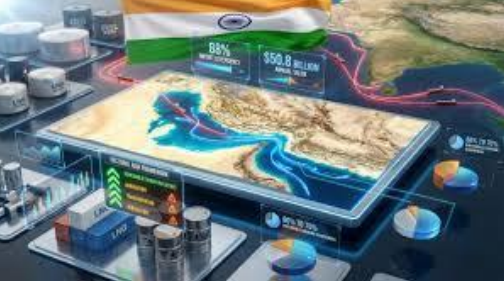
Key Summary Points • Energy Sovereignty: India is successfully mitigating energy shortages despite heightened geopolitical volatility in West Asia, primarily by diversifying supply routes and ramping up domestic output. • Strategic LPG Management: To reduce dependency on the vulnerable Strait of Hormuz—which currently accounts for a significant portion of India’s 65% LPG import share—the government has directed refineries to maximize domestic LPG production by diverting propane and butane. • Domestic Production Surge: Policy interventions are projected to increase domestic LPG production by 25%, specifically earmarked for household consumption to shield citizens from global price shocks. • Macroeconomic Stability: The Indian economy demonstrates \'positional strength,\' having successfully navigated a \'polycrisis\' involving the COVID-19 pandemic, the Russia-Ukraine conflict, and global inflationary spikes. • Atmanirbharta as a Shield: The Self-Reliance initiative is positioned not just as an industrial policy, but as a strategic buffer that insulates the domestic market from de-globalization trends and supply chain breakdowns. • Fiscal Authorization: Parliament has approved the second batch of Supplementary Demands for Grants, totaling ₹2 trillion, providing the necessary fiscal headroom for additional government spending this fiscal year. Constitutional & Legal Framework • Article 114: Relates to the Appropriation Bill, which gives the government the legal authority to withdraw funds from the Consolidated Fund of India after the passage of the Demands for Grants. • Article 115: Governs Supplementary, Additional, or Excess Grants. These are presented when the amount authorized by the Appropriation Act for the current financial year is found to be insufficient for the needs of that year. • Essential Commodities Act, 1955: Provides the legal basis for the government to regulate the production, supply, and distribution of energy resources like LPG to ensure equitable availability. Key Definitions • Strait of Hormuz: A narrow, strategically vital waterway between the Persian Gulf and the Gulf of Oman; it is the world’s most important oil transit chokepoint. • Supplementary Demands for Grants: The additional expenditure required by the government over and above the amount for which Parliamentary approval was obtained during the Budget session. • De-globalization: A process of diminishing interdependence and integration between certain units around the world, typically characterized by increased trade barriers and localized supply chains. Additional Strategic Observations The government\'s directive to petrochemical complexes to divert Propane, Butane, and Propylene for LPG production highlights a shift toward \'Integrated Refinery-Petrochemical\' models. This flexibility allows India to prioritize fuel security over industrial chemical exports during global energy crunches. Conclusion India’s current economic trajectory is defined by a transition from passive consumption to active strategic management of global risks. By leveraging domestic refinery capacity and maintaining fiscal discipline through authorized supplementary spending, the state is reinforcing the \'Atmanirbhar\' framework to ensure that global \'troubled waters\' do not translate into domestic energy poverty. UPSC Relevance • GS Paper II: Functions and responsibilities of the Union; Parliament and State Legislatures (Structure, functioning, and conduct of business—specifically the Budgetary process and Articles 112–117). • GS Paper III: Indian Economy (Issues relating to planning, mobilization of resources, and growth); Infrastructure (Energy); and Security (Internal and External threats linked to energy dependency). • Prelims: Strategic Chokepoints (Geography), Appropriation Bills vs. Finance Bills, and LPG import statistics.


Address : 506, 3rd EYE THREE (III), Opp. Induben Khakhrawala, Girish Cold Drink Cross Road, CG Road, Navrangpura, Ahmedabad, 380009.
Mobile : 8469231587 / 9586028957
Telephone : 079-40098991
E-mail: dics.upsc@gmail.com
Address: A-306, The Landmark, Urjanagar-1, Opp. Spicy Street, Kudasan – Por Road, Kudasan, Gandhinagar – 382421
Mobile : 9723832444 / 9723932444
E-mail: dics.gnagar@gmail.com
Address: 2nd Floor, 9 Shivali Society, L&T Circle, opp. Ratri Bazar, Karelibaugh, Vadodara, 390018
Mobile : 9725692037 / 9725692054
E-mail: dics.vadodara@gmail.com
Address: 403, Raj Victoria, Opp. Pal Walkway, Near Galaxy Circle, Pal, Surat-394510
Mobile : 8401031583 / 8401031587
E-mail: dics.surat@gmail.com
Address: 303,305 K 158 Complex Above Magson, Sindhubhavan Road Ahmedabad-380059
Mobile : 9974751177 / 8469231587
E-mail: dicssbr@gmail.com
Address: 57/17, 2nd Floor, Old Rajinder Nagar Market, Bada Bazaar Marg, Delhi-60
Mobile : 9104830862 / 9104830865
E-mail: dics.newdelhi@gmail.com