







Ahmedabad
(Head Office)Address : 506, 3rd EYE THREE (III), Opp. Induben Khakhrawala, Girish Cold Drink Cross Road, CG Road, Navrangpura, Ahmedabad, 380009.
Mobile : 8469231587 / 9586028957
Telephone : 079-40098991
E-mail: dics.upsc@gmail.com

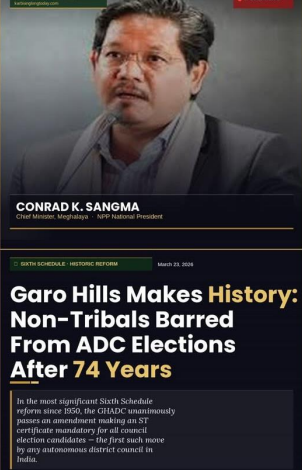
The Garo Hills Autonomous District Council (GHADC) in Meghalaya has passed a landmark amendment to its electoral rules, mandating that only members belonging to Scheduled Tribes (ST) are eligible to contest council elections. This resolution ends a 70-year-old practice that allowed non-tribal participation, following intense ethnic tensions and long-standing demands from indigenous communities for greater protection of their sociopolitical rights. Key Summary Points • Historic Policy Shift: For over seven decades, the GHADC allowed non-tribals to contest elections; the new amendment strictly restricts candidacy to those possessing a valid Scheduled Tribe certificate. • Response to Ethnic Unrest: The move follows significant civil unrest and protests in the Garo Hills, which resulted in two fatalities and led the state government to defer the elections originally scheduled for April 10. • Extension of Council Tenure: To facilitate these legislative changes, the state government extended the GHADC\'s tenure by six months, allowing the executive committee to align council rules with public sentiment. • Focus on Self-Governance: Chief Minister Conrad K. Sangma termed the resolution a \'historic milestone,\' emphasizing that the change reinforces the primary objective of the Sixth Schedule— protecting tribal identity. • Political Stability vs. Public Demand: The amendment highlights the delicate balance between maintaining inclusive democratic norms and addressing the \'son of the soil\' sentiments prevalent in North-East India’s autonomous regions. Key Definitions • Autonomous District Council (ADC): Administrative bodies constituted under the Sixth Schedule of the Indian Constitution that possess legislative, judicial, and executive powers over specific tribal areas. • Sixth Schedule: A special provision in the Constitution (Articles 244(2) and 275(1)) designed to provide autonomy to tribal populations in Assam, Meghalaya, Tripura, and Mizoram. • Scheduled Tribe (ST) Certificate: An official document issued by state authorities certifying an individual\'s membership in a tribe notified under Article 342 of the Constitution. Constitutional & Legal Provisions • Article 244(2): Specifies that the provisions of the Sixth Schedule shall apply to the administration of tribal areas in the State of Meghalaya. • Sixth Schedule (Paragraph 2): Empowers the Governor to constitute District Councils and allows these councils to make rules regarding the term of office, procedure for conduct of business, and the qualifications for being elected as members. • Article 19(5): Allows the State to impose reasonable restrictions on the fundamental right to move freely or reside in any part of India for the protection of the interests of any Scheduled Tribe. • The Meghalaya Interpretation Act: Often used alongside council rules to define the scope of legislative amendments within the state\'s autonomous frameworks. Conclusion The exclusion of non-tribals from contesting GHADC polls represents a significant tightening of ethnic boundaries within the constitutional framework of the Sixth Schedule. While the move aims to preserve the purity of tribal self-rule and quell local unrest, it also raises broader questions about the rights of long-term nontribal residents in these protected zones. The legal sustainability of this amendment may eventually be tested against the principle of universal adult franchise and equal opportunity. UPSC Relevance • GS Paper II: Functions and responsibilities of the Union and the States, issues and challenges pertaining to the federal structure, and devolution of powers and finances up to local levels and challenges therein. • GS Paper II: Statutory, regulatory, and various quasi-judicial bodies; Special provisions for North-East states and the Sixth Schedule. • GS Paper I: Regionalism, communalism, and secularism; Social empowerment and the impact of ethnic identity on Indian polity.


Address : 506, 3rd EYE THREE (III), Opp. Induben Khakhrawala, Girish Cold Drink Cross Road, CG Road, Navrangpura, Ahmedabad, 380009.
Mobile : 8469231587 / 9586028957
Telephone : 079-40098991
E-mail: dics.upsc@gmail.com
Address: A-306, The Landmark, Urjanagar-1, Opp. Spicy Street, Kudasan – Por Road, Kudasan, Gandhinagar – 382421
Mobile : 9723832444 / 9723932444
E-mail: dics.gnagar@gmail.com
Address: 2nd Floor, 9 Shivali Society, L&T Circle, opp. Ratri Bazar, Karelibaugh, Vadodara, 390018
Mobile : 9725692037 / 9725692054
E-mail: dics.vadodara@gmail.com
Address: 403, Raj Victoria, Opp. Pal Walkway, Near Galaxy Circle, Pal, Surat-394510
Mobile : 8401031583 / 8401031587
E-mail: dics.surat@gmail.com
Address: 303,305 K 158 Complex Above Magson, Sindhubhavan Road Ahmedabad-380059
Mobile : 9974751177 / 8469231587
E-mail: dicssbr@gmail.com
Address: 57/17, 2nd Floor, Old Rajinder Nagar Market, Bada Bazaar Marg, Delhi-60
Mobile : 9104830862 / 9104830865
E-mail: dics.newdelhi@gmail.com