




Ahmedabad
(Head Office)Address : 506, 3rd EYE THREE (III), Opp. Induben Khakhrawala, Girish Cold Drink Cross Road, CG Road, Navrangpura, Ahmedabad, 380009.
Mobile : 8469231587 / 9586028957
Telephone : 079-40098991
E-mail: dics.upsc@gmail.com

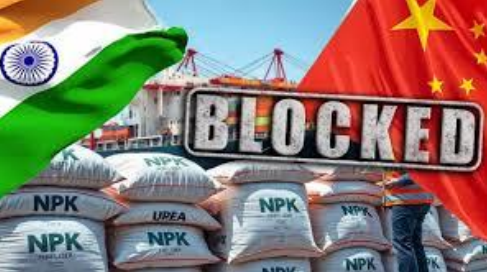
China, one of the world\'s largest exporters of mineral fertilizers, has moved to curb its overseas shipments to stabilize domestic prices and ensure food security for its own farming sector. Coming at a time when the West Asia conflict has already strained global supply chains and logistics, these restrictions pose a significant challenge to agrarian economies like India, which are heavily dependent on imported soil nutrients. • Domestic Priority over Exports: China shipped over $13 billion worth of fertilizers in 2025, but the current curbs reflect a shift toward protectionism, aimed at insulating Chinese farmers from high global prices. • West Asia Conflict Linkage: The restrictions exacerbate an existing global shortage caused by the war in West Asia, which has disrupted the production and maritime transit of key raw materials like phosphate and potash. • Impact on Global Prices: As a dominant supplier of Urea and Diammonium Phosphate (DAP), China’s exit from the spot market is likely to trigger a price surge, increasing the \'Input Cost\' for farmers worldwide. • India’s Vulnerability: India is the world’s largest importer of urea and significantly relies on Chinese DAP. Any prolonged restriction could threaten the Kharif and Rabi sowing cycles if alternative sources are not secured. • Geopolitical Supply Chain Risk: This move highlights the risks of \'Over-dependence\' on a single geographical source for critical agricultural inputs, pushing nations toward diversifying their supply chains. • Fiscal Burden on Subsidies: For countries like India, higher global fertilizer prices directly translate into a ballooning \'Fertilizer Subsidy\' bill, potentially straining the fiscal deficit targets of the Union Budget. Key Definitions • DAP (Diammonium Phosphate): A highly concentrated phosphorus fertilizer frequently used in India; it is critical for root development and early plant growth. • Urea: The most widely used nitrogenous fertilizer in India, providing the essential element for chlorophyll synthesis and vegetative growth. • Export Quotas/Restrictions: Non-tariff barriers used by governments to limit the quantity of a specific commodity leaving the country, usually to ensure domestic availability. • Input Cost: The total expenditure incurred by a farmer on seeds, water, electricity, and fertilizers to produce a crop. Constitutional & Legal Provisions • Essential Commodities Act, 1955: Empowers the Indian government to regulate the price and distribution of fertilizers to ensure they are available to farmers at affordable rates during global supply shocks. • Article 39(b): A Directive Principle of State Policy (DPSP) which mandates that the State shall direct its policy toward ensuring that the ownership and control of the material resources of the community are so distributed as best to subserve the common good. • Fertilizer (Inorganic, Organic or Mixed) (Control) Order, 1985: Issued under the Essential Commodities Act, it regulates the quality, price, and distribution of fertilizers within India. Additional Strategic Keypoints • Alternative Sourcing: India is actively exploring \'Long-term Offtake Agreements\' with nations like Morocco (for Rock Phosphate), Jordan, and Canada (for Potash) to reduce reliance on China. • Aatmanirbhar Fertilizers: The government is reviving closed urea units (e.g., Ramagundam, Talcher, Sindri) and promoting Nano Urea to reduce the physical import volume. • The \'China Plus One\' Strategy: This development underscores the necessity for India to apply the \'China Plus One\' logic to agricultural inputs, encouraging domestic production and multi-country partnerships. Conclusion China’s decision to restrict fertilizer exports is a reminder of the fragility of global commodity markets during geopolitical instability. While India has managed its stocks through strategic reserves and diplomatic outreach, the long-term solution lies in achieving \'Nutrient Security\' through domestic manufacturing and promoting alternative fertilizers like Neem-coated Urea and Bio-fertilizers. UPSC Relevance • GS Paper II: International Relations (Effect of policies of developed and developing countries on India\'s interests; India-China trade dynamics). • GS Paper III: Economic Development (Issues related to direct and indirect farm subsidies; Food security; Supply chain management). • Prelims: Major fertilizer producing regions, components of Fertilizers (NPK ratio), and statutory bodies governing fertilizer prices in India.


Address : 506, 3rd EYE THREE (III), Opp. Induben Khakhrawala, Girish Cold Drink Cross Road, CG Road, Navrangpura, Ahmedabad, 380009.
Mobile : 8469231587 / 9586028957
Telephone : 079-40098991
E-mail: dics.upsc@gmail.com
Address: A-306, The Landmark, Urjanagar-1, Opp. Spicy Street, Kudasan – Por Road, Kudasan, Gandhinagar – 382421
Mobile : 9723832444 / 9723932444
E-mail: dics.gnagar@gmail.com
Address: 2nd Floor, 9 Shivali Society, L&T Circle, opp. Ratri Bazar, Karelibaugh, Vadodara, 390018
Mobile : 9725692037 / 9725692054
E-mail: dics.vadodara@gmail.com
Address: 403, Raj Victoria, Opp. Pal Walkway, Near Galaxy Circle, Pal, Surat-394510
Mobile : 8401031583 / 8401031587
E-mail: dics.surat@gmail.com
Address: 303,305 K 158 Complex Above Magson, Sindhubhavan Road Ahmedabad-380059
Mobile : 9974751177 / 8469231587
E-mail: dicssbr@gmail.com
Address: 57/17, 2nd Floor, Old Rajinder Nagar Market, Bada Bazaar Marg, Delhi-60
Mobile : 9104830862 / 9104830865
E-mail: dics.newdelhi@gmail.com