







Ahmedabad
(Head Office)Address : 506, 3rd EYE THREE (III), Opp. Induben Khakhrawala, Girish Cold Drink Cross Road, CG Road, Navrangpura, Ahmedabad, 380009.
Mobile : 8469231587 / 9586028957
Telephone : 079-40098991
E-mail: dics.upsc@gmail.com

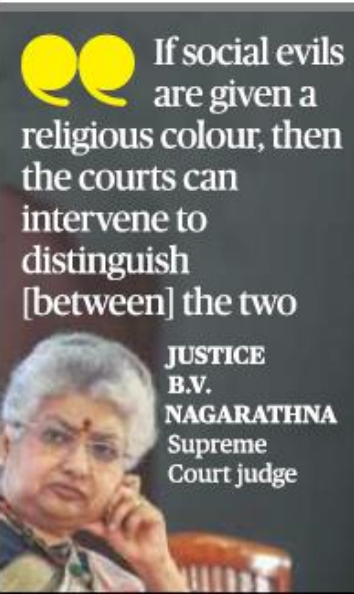
A nine-judge Constitution Bench of the Supreme Court, led by Chief Justice Surya Kant, has commenced hearings on a landmark reference stemming from the 2018 Sabarimala verdict. The proceedings aim to establish a definitive \'judicial policy\' regarding the intersection of individual fundamental rights and collective denominational freedoms. Central to the debate is the \'Essential Religious Practices\' (ERP) doctrine, with the Court examining whether judicial intervention is necessary to excise social ills that are often shielded under the garb of religious tradition. While the Union government advocates for legislative-led reform to protect denominational autonomy under Article 26, the judiciary is scrutinizing its own role as a guardian against discriminatory practices that may violate the principles of equality and dignity. • Revisiting the 2018 Verdict: The Bench is reviewing the legal questions raised by the 2018 judgment, which initially allowed women of menstruating age into the Sabarimala shrine, sparking a debate on the limits of judicial reach into faith. • Doctrine of Essentiality: Justice B.V. Nagarathna emphasized that \'social ills\' cannot be granted constitutional protection by merely branding them as essential religious practices, signaling a potential tightening of the ERP test. • Legislature vs. Judiciary: The Union government argued that religious reform should primarily be driven by the legislature rather than the courts, asserting that judicial \'intrusion\' may infringe upon the free exercise of religious freedoms. • Constitutional Morality: The hearing seeks to balance the \'Liberty of Worship\' mentioned in the Preamble with Article 14 (Equality) and Article 21 (Dignity), determining if individual rights override a religious denomination’s right to manage its affairs. • Scope of the Reference: Unlike a standard appeal, this ninejudge bench is tasked with evolving a broad judicial policy for all constitutional courts to follow when dealing with Articles 25 and 26. • Article 25 vs. Article 26: A key point of contention is whether the individual’s right to freedom of religion (Article 25) should be subordinate to or harmonize with the rights of a \'religious denomination\' (Article 26) to maintain its unique traditions. Key Definitions & Legal Concepts • Essential Religious Practices (ERP) Doctrine: A judicial test evolved by the SC (starting with the Shirur Mutt case) to determine which aspects of a religion are integral to it and thus protected under the Constitution. • Religious Denomination: A collection of individuals having a common faith, a common organization, and designated by a distinctive name, enjoying autonomy under Article 26. • Constitutional Morality: The principle that the interpretation of the Constitution must be guided by core values like justice, liberty, equality, and fraternity, rather than popular or social morality. • Reference Jurisdiction: A process where a smaller bench refers significant questions of law to a larger bench for a definitive and authoritative pronouncement. Constitutional & Legal Provisions • Article 25: Guarantees freedom of conscience and the right freely to profess, practice, and propagate religion, subject to public order, morality, and health. • Article 25(2)(b): Specifically empowers the State to make laws providing for social welfare and reform or the throwing open of Hindu religious institutions of a public character to all classes and sections of Hindus. • Article 26: Grants every religious denomination the right to establish and maintain institutions and manage its own affairs in matters of religion. • Article 13: Declares that all laws inconsistent with or in derogation of the fundamental rights shall be void, which the Court uses to test religious customs against Part III of the Constitution. Additional Key Points for Examination • Gender Justice: The presence of Justice B.V. Nagarathna is significant as the Court addresses whether biological factors like menstruation can be used as a basis for exclusion under the guise of \'custom.\' • Judicial Overreach vs. Activism: This case is a primer on the debate over whether the judiciary is encroaching upon the domain of the legislature (separation of powers) by initiating religious reforms. • Universal Impact: The \'judicial policy\' evolved here will not only affect Sabarimala but also other pending issues, such as the entry of women into mosques and the practice of female genital mutilation (FGM) in certain communities. Conclusion The review by the nine-judge bench represents a defining moment for Indian secularism. It moves beyond the specific rituals of a single shrine to address the foundational question: Can a \'denomination\' claim immunity from the constitutional values of equality and non-discrimination? By distinguishing \'social evils\' from \'genuine faith,\' the Court seeks to ensure that religious freedom does not become a sanctuary for regressive practices, while simultaneously respecting the pluralistic fabric of Indian society. UPSC Relevance • GS Paper II (Polity & Governance): Indian Constitution—historical underpinnings, evolution, features, and significant provisions; Separation of powers between various organs; Judiciary’s role in social reform. • GS Paper I (Social Issues): Secularism; Communalism; Social empowerment of women and religious barriers.


Address : 506, 3rd EYE THREE (III), Opp. Induben Khakhrawala, Girish Cold Drink Cross Road, CG Road, Navrangpura, Ahmedabad, 380009.
Mobile : 8469231587 / 9586028957
Telephone : 079-40098991
E-mail: dics.upsc@gmail.com
Address: A-306, The Landmark, Urjanagar-1, Opp. Spicy Street, Kudasan – Por Road, Kudasan, Gandhinagar – 382421
Mobile : 9723832444 / 9723932444
E-mail: dics.gnagar@gmail.com
Address: 2nd Floor, 9 Shivali Society, L&T Circle, opp. Ratri Bazar, Karelibaugh, Vadodara, 390018
Mobile : 9725692037 / 9725692054
E-mail: dics.vadodara@gmail.com
Address: 403, Raj Victoria, Opp. Pal Walkway, Near Galaxy Circle, Pal, Surat-394510
Mobile : 8401031583 / 8401031587
E-mail: dics.surat@gmail.com
Address: 303,305 K 158 Complex Above Magson, Sindhubhavan Road Ahmedabad-380059
Mobile : 9974751177 / 8469231587
E-mail: dicssbr@gmail.com
Address: 57/17, 2nd Floor, Old Rajinder Nagar Market, Bada Bazaar Marg, Delhi-60
Mobile : 9104830862 / 9104830865
E-mail: dics.newdelhi@gmail.com