







Ahmedabad
(Head Office)Address : 506, 3rd EYE THREE (III), Opp. Induben Khakhrawala, Girish Cold Drink Cross Road, CG Road, Navrangpura, Ahmedabad, 380009.
Mobile : 8469231587 / 9586028957
Telephone : 079-40098991
E-mail: dics.upsc@gmail.com

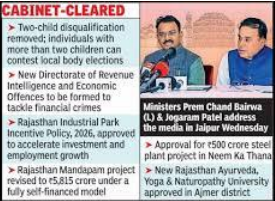
• Legislative Amendment: The Rajasthan Assembly passed the Rajasthan Panchayati Raj (Amendment) Bill, 2026, to scrap the 1995 provision that disqualified candidates with more than two children from contesting local body elections. • Modification of Eligibility: The Bill specifically amends Section 19 of the Rajasthan Panchayati Raj Act, 1994, removing a long-standing barrier for individuals seeking to lead village panchayats and urban local bodies. • Demographic Rationale: The state government justified the move by citing a significant decline in the Total Fertility Rate (TFR) from 3.6 in the 1990s to the current 2.0, arguing that the restrictive \'population control measure\' is no longer relevant. • Inclusivity in Governance: The \'Statement of Objects and Reasons\' highlights that the norm excluded many capable leaders with a vision for rural development, thereby limiting the democratic pool of candidates in grassroots governance. • Political Contention: The opposition has questioned the reversal, citing concerns over a potential lack of population awareness in rural areas and alleging that the government is delaying pending panchayat polls despite High Court orders. • Socio-Economic Factors: Government representatives attributed the success in population stabilization to increased women’s literacy, better healthcare access, and general social change, rather than just electoral disqualification. Key Definitions • Total Fertility Rate (TFR): The average number of children that would be born to a woman over her lifetime if she were to experience the current age-specific fertility rates through her reproductive years. • Panchayati Raj Institutions (PRIs): A system of local self-government in India introduced by the 73rd Constitutional Amendment Act, 1992, to build democracy at the grassroots level. • Voice Vote: A parliamentary procedure where the presiding officer asks the members to say \'Aye\' or \'No\' to a proposal, and the result is determined based on the volume of the responses. Constitutional & Legal Provisions • Article 243-F: Deals with the disqualifications for membership in a Panchayat. It states that a person shall be disqualified if he is so disqualified by or under any law made by the Legislature of the State. • 73rd Constitutional Amendment Act, 1992: Granted constitutional status to PRIs. While it provides a basic framework, it leaves the specifics of election eligibility and disqualifications to the respective State Legislatures. • Article 243-K: Mandates the State Election Commission to conduct elections to the Panchayats. • Directive Principles of State Policy (Article 40): Mandates the State to organize village panchayats and endow them with such powers and authority as may be necessary to enable them to function as units of self-government. Additional Important Keypoints • Historical Context: The two-child norm was a part of \'coercive\' population policies adopted by several Indian states in the 1990s to meet national family planning goals. • Judicial Perspective: In the past (e.g., Javed v. State of Haryana, 2003), the Supreme Court upheld the constitutionality of the two-child norm as a reasonable restriction to promote family planning. • Current Trend: Rajasthan joins other states that have recently reviewed or relaxed such norms in light of the National Family Health Survey (NFHS-5) data showing India’s TFR falling below the replacement level of 2.1. Conclusion The removal of the two-child norm in Rajasthan marks a significant shift from coercive population control to a more inclusive approach to grassroots democracy. By acknowledging the drop in fertility rates through social development rather than legislative restriction, the state is expanding the democratic space for rural leadership, though the move remains debated regarding its long-term impact on population awareness. UPSC Relevance • GS Paper II: Functions and responsibilities of the Union and the States, issues and challenges pertaining to the federal structure, devolution of powers and finances up to local levels and challenges therein; Salient features of the Representation of People\'s Act. • GS Paper I: Population and associated issues; Social empowerment. • Prelims: 73rd and 74th Amendments, State Election Commission powers, and TFR data from NFHS


Address : 506, 3rd EYE THREE (III), Opp. Induben Khakhrawala, Girish Cold Drink Cross Road, CG Road, Navrangpura, Ahmedabad, 380009.
Mobile : 8469231587 / 9586028957
Telephone : 079-40098991
E-mail: dics.upsc@gmail.com
Address: A-306, The Landmark, Urjanagar-1, Opp. Spicy Street, Kudasan – Por Road, Kudasan, Gandhinagar – 382421
Mobile : 9723832444 / 9723932444
E-mail: dics.gnagar@gmail.com
Address: 2nd Floor, 9 Shivali Society, L&T Circle, opp. Ratri Bazar, Karelibaugh, Vadodara, 390018
Mobile : 9725692037 / 9725692054
E-mail: dics.vadodara@gmail.com
Address: 403, Raj Victoria, Opp. Pal Walkway, Near Galaxy Circle, Pal, Surat-394510
Mobile : 8401031583 / 8401031587
E-mail: dics.surat@gmail.com
Address: 303,305 K 158 Complex Above Magson, Sindhubhavan Road Ahmedabad-380059
Mobile : 9974751177 / 8469231587
E-mail: dicssbr@gmail.com
Address: 57/17, 2nd Floor, Old Rajinder Nagar Market, Bada Bazaar Marg, Delhi-60
Mobile : 9104830862 / 9104830865
E-mail: dics.newdelhi@gmail.com