



Ahmedabad
(Head Office)Address : 506, 3rd EYE THREE (III), Opp. Induben Khakhrawala, Girish Cold Drink Cross Road, CG Road, Navrangpura, Ahmedabad, 380009.
Mobile : 8469231587 / 9586028957
Telephone : 079-40098991
E-mail: dics.upsc@gmail.com

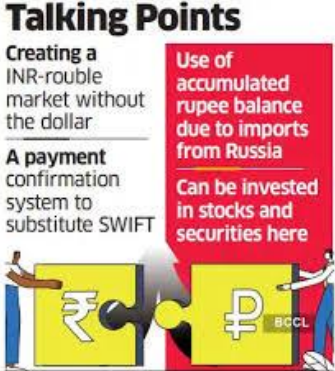
The Reserve Bank of India (RBI) is currently evaluating mechanisms to allow Russian entities to utilize their significant rupee holdings—accumulated primarily through energy exports—within the Indian domestic economy. This move follows the surge in bilateral trade post-2022, which has created a structural challenge where Russia holds vast amounts of Indian Rupee (INR) with limited avenues for repatriation or reinvestment due to global sanctions and trade deficits. • Trade Asymmetry: Since the onset of the Russia-Ukraine conflict, India’s imports from Russia (largely discounted crude oil) have skyrocketed, while Indian exports have not kept pace, leading to a \'Rupee Kitty\' estimated at billions of dollars sitting in Special Vostro Accounts. • Productive Reinvestment: The RBI is exploring ways to channel these stagnant funds into Indian infrastructure projects, government securities (G-Secs), or equity markets, effectively converting a trade liability into domestic investment. • Vostro Account Mechanism: The Rupee Vostro Account (SRVA) system allows foreign banks to hold INR in Indian banks to settle international trade, aiming to bypass the SWIFT ban and reduce dependence on the US Dollar. • Currency Internationalization: This initiative is part of a broader RBI strategy to promote the \'Internationalization of the Rupee,\' encouraging bilateral trade settlements in local currencies to mitigate exchange rate volatility and geopolitical risks. • Sanction Compliance: A major hurdle for the RBI is ensuring that any reinvestment or fund utilization does not trigger secondary sanctions from Western nations, particularly the US and EU, against Indian financial institutions. • Diversification of Settlement: Beyond the Rupee, both nations have experimented with Dirhams (UAE) and Yuan (China), but the RBI’s current focus is on making the INR a viable, \'circular\' currency for the Russian trade surplus. Key Definitions • Vostro Account: An account that a domestic bank holds on behalf of a foreign bank in the domestic bank’s currency (e.g., a Russian bank holding INR in an Indian bank). • Special Rupee Vostro Account (SRVA): A specific category of Vostro account authorized by the RBI for settling international trade in Indian Rupees. • Currency Internationalization: The process where a national currency is increasingly used and held outside its country of origin for trade, investment, and as a reserve currency. • Secondary Sanctions: Penalties imposed by one country (e.g., USA) on entities or individuals from a third country (e.g., India) for doing business with a sanctioned nation (e.g., Russia). Constitutional & Legal Provisions • Foreign Exchange Management Act (FEMA), 1999: The primary legislation governing foreign exchange transactions in India; the RBI issues circulars under this Act to regulate Vostro accounts and trade settlements. • Article 246 (Union List): \'Banking\' (Entry 45) and \'Foreign Exchange\' (Entry 36) fall under the exclusive jurisdiction of the Parliament, giving the Central Government and RBI the legal mandate to frame these policies. • RBI Act, 1934: Grants the Reserve Bank the authority to manage the nation\'s foreign exchange reserves and act as the regulator of the financial system. Additional Strategic Keypoints • Investment Avenues: Potential sectors for Russian investment include the \'Make in India\' initiatives, defense manufacturing joint ventures, and the National Infrastructure Pipeline (NIP). • The \'Oil-to-Investment\' Loop: By reinvesting oil revenues back into India, Russia maintains its market share while India benefits from long-term capital inflows, offsetting the current account impact. • Rupee-Rouble Arrangement: While the old Cold War-era mechanism was phased out, the current efforts represent a \'2.0 version\' tailored for a digital, globalized financial era. Conclusion The RBI’s assessment of the \'Rupee Kitty\' represents a pragmatic approach to a complex geopolitical and economic puzzle. If successful, channelling these funds into the Indian economy could solve Russia\'s liquidity issue while providing India with a stable source of investment. However, the success of this plan hinges on navigating the delicate balance between Indo-Russian strategic ties and India’s integration with the Western financial system. UPSC Relevance • GS Paper II: International Relations (India-Russia bilateral relations; Impact of global sanctions on India’s strategic autonomy). • GS Paper III: Indian Economy (Mobilization of resources; Banking and Monetary Policy; External Sector and International Trade). • Prelims: Understanding Vostro vs. Nostro accounts, FEMA regulations, and the role of RBI in currency internationalization.


Address : 506, 3rd EYE THREE (III), Opp. Induben Khakhrawala, Girish Cold Drink Cross Road, CG Road, Navrangpura, Ahmedabad, 380009.
Mobile : 8469231587 / 9586028957
Telephone : 079-40098991
E-mail: dics.upsc@gmail.com
Address: A-306, The Landmark, Urjanagar-1, Opp. Spicy Street, Kudasan – Por Road, Kudasan, Gandhinagar – 382421
Mobile : 9723832444 / 9723932444
E-mail: dics.gnagar@gmail.com
Address: 2nd Floor, 9 Shivali Society, L&T Circle, opp. Ratri Bazar, Karelibaugh, Vadodara, 390018
Mobile : 9725692037 / 9725692054
E-mail: dics.vadodara@gmail.com
Address: 403, Raj Victoria, Opp. Pal Walkway, Near Galaxy Circle, Pal, Surat-394510
Mobile : 8401031583 / 8401031587
E-mail: dics.surat@gmail.com
Address: 303,305 K 158 Complex Above Magson, Sindhubhavan Road Ahmedabad-380059
Mobile : 9974751177 / 8469231587
E-mail: dicssbr@gmail.com
Address: 57/17, 2nd Floor, Old Rajinder Nagar Market, Bada Bazaar Marg, Delhi-60
Mobile : 9104830862 / 9104830865
E-mail: dics.newdelhi@gmail.com