







Ahmedabad
(Head Office)Address : 506, 3rd EYE THREE (III), Opp. Induben Khakhrawala, Girish Cold Drink Cross Road, CG Road, Navrangpura, Ahmedabad, 380009.
Mobile : 8469231587 / 9586028957
Telephone : 079-40098991
E-mail: dics.upsc@gmail.com

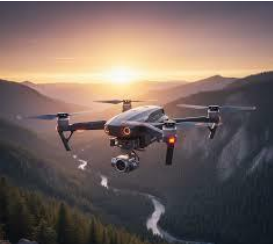
The Ministry of Civil Aviation has proposed a comprehensive ₹1,800 crore incentive scheme to transform India into a global drone hub by 2030. The following points highlight the strategic importance and core components of this initiative for the Indian economy and security: • Strategic Decoupling from Imports: The primary objective of \'Mission Drone Shakti\' is to reduce heavy reliance on imported components, particularly from China. Currently, many smaller domestic players import over 50% of their parts, including flight controllers, motors, and sensors. • Structured Financial Outlay: The proposed ₹1,800 crore allocation over five years is strategically divided: approximately ₹600 crore is dedicated to Research and Development (R&D), while the remaining ₹1,200 crore supports manufacturing and sales-linked incentives. • Value-Addition Linked Incentives: Mirroring the Production Linked Incentive (PLI) model, benefits will be calculated based on \'domestic value addition.\' This ensures that only companies contributing to the local supply chain—manufacturing airframes, propellers, and lithium-polymer batteries—receive fiscal support. • Inter-Ministerial Coordination: Recognizing the multi-sectoral utility of Unmanned Aerial Vehicles (UAVs), 12 ministries are collaborating to integrate drone usage in agriculture (spraying/mapping), logistics, infrastructure inspection, and border surveillance. • Focus on MSMEs and Scalability: While large entities like Adani Defence and Tata Advanced Systems lead the market, the scheme aims to provide \'economies of scale\' to smaller manufacturers. This seeks to prevent market monopolization and foster a robust, competitive component ecosystem. • Projected Market Growth: With the domestic drone market expected to touch ₹1.66 trillion by FY28, this scheme acts as a catalyst to move from a ₹4,500 crore current valuation to a global leadership position in both manufacturing and services. Key Definitions • Remotely Piloted Aircraft System (RPAS): The technical term for drones, encompassing the aircraft, the ground control station, and the terrestrial or satellite data link. • Domestic Value Addition: The difference between the net sales turnover and the cost of imported raw materials/components, used as a metric to measure indigenization. • Bharat Drone Stack: A flagship platform and network of indigenous component manufacturers aimed at creating a standardized, \'made-in-India\' technology stack for UAVs. Constitutional & Legal Provisions • Union List (Entry 29): \'Airways; aircraft and air navigation; provision of aerodromes...\' gives the Central Government exclusive power to legislate on drone-related matters. • Drone Rules, 2021: The foundational legal framework that liberalized drone operations in India by reducing requisite forms and types of fees, while establishing \'Green Zones\' for flight without prior permission. • DGFT Import Policy: The Directorate General of Foreign Trade (DGFT) has previously imposed bans on the import of foreign drones (with exceptions for R&D and defense) to provide a \'protective wall\' for domestic manufacturers. Conclusion Mission Drone Shakti represents a leap from the initial ₹120 crore PLI scheme toward a mature industrial policy. By prioritizing R&D and critical component manufacturing (the \'brain\' and \'heart\' of the drone), India is moving beyond mere assembly to true technological sovereignty. Success will depend on ensuring that the 70% indigenization seen in top-tier players trickles down to the entire grassroots ecosystem. UPSC Relevance GS Paper III: Science and Technology- developments and their applications and effects in everyday life; Indigenization of technology and developing new technology; IT & Computers. GS Paper II: Government policies and interventions for development in various sectors and issues arising out of their design and implementation. Prelims Focus: Mission Drone Shakti, PLI Scheme for Drones, Drone Rules 2021 (Green/Yellow/Red zones), and the role of the Quality Council of India (QCI) in drone certification.


Address : 506, 3rd EYE THREE (III), Opp. Induben Khakhrawala, Girish Cold Drink Cross Road, CG Road, Navrangpura, Ahmedabad, 380009.
Mobile : 8469231587 / 9586028957
Telephone : 079-40098991
E-mail: dics.upsc@gmail.com
Address: A-306, The Landmark, Urjanagar-1, Opp. Spicy Street, Kudasan – Por Road, Kudasan, Gandhinagar – 382421
Mobile : 9723832444 / 9723932444
E-mail: dics.gnagar@gmail.com
Address: 2nd Floor, 9 Shivali Society, L&T Circle, opp. Ratri Bazar, Karelibaugh, Vadodara, 390018
Mobile : 9725692037 / 9725692054
E-mail: dics.vadodara@gmail.com
Address: 403, Raj Victoria, Opp. Pal Walkway, Near Galaxy Circle, Pal, Surat-394510
Mobile : 8401031583 / 8401031587
E-mail: dics.surat@gmail.com
Address: 303,305 K 158 Complex Above Magson, Sindhubhavan Road Ahmedabad-380059
Mobile : 9974751177 / 8469231587
E-mail: dicssbr@gmail.com
Address: 57/17, 2nd Floor, Old Rajinder Nagar Market, Bada Bazaar Marg, Delhi-60
Mobile : 9104830862 / 9104830865
E-mail: dics.newdelhi@gmail.com