






Ahmedabad
(Head Office)Address : 506, 3rd EYE THREE (III), Opp. Induben Khakhrawala, Girish Cold Drink Cross Road, CG Road, Navrangpura, Ahmedabad, 380009.
Mobile : 8469231587 / 9586028957
Telephone : 079-40098991
E-mail: dics.upsc@gmail.com

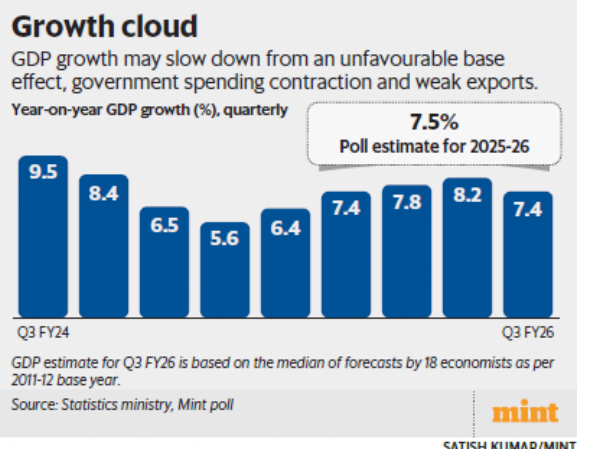
India\'s Gross Domestic Product (GDP) growth for the third quarter (October-December) of FY26 is projected to moderate to 7.4%, down from 8.2% in the preceding quarter. While festive demand and GST-related benefits provided a cushion, the deceleration highlights the impact of fiscal consolidation and global headwinds on the domestic economy. Key Highlights of the Economic Outlook • Growth Moderation: The expected growth rate of 7.4% marks a sequential slowdown attributed to an unfavorable base effect and a contraction in government capital expenditure. • Fiscal Drag: A significant reduction in central government capital spending and subdued revenue expenditure by state governments have acted as primary dampeners on domestic demand. • External Headwinds: Weakness in merchandise exports persists as a major challenge, reflecting sluggish global demand and geopolitical disruptions affecting trade routes. • Consumption Resilience: Sustained momentum in festive-season demand and targeted GST rate cuts helped offset some of the structural slowdown in other sectors. • Revised Projections: Economists project a full-year growth of 7.5% for FY26, slightly more optimistic than the Reserve Bank of India’s (RBI) estimate of 7.3%. • Base Year Transition: The upcoming data release will transition the GDP base year from 2011-12 to 2022-23, a technical overhaul likely to cause a revision in historical and current growth figures. Important Definitions • Gross Domestic Product (GDP): The total monetary value of all finished goods and services produced within a country\'s borders in a specific time period. • Base Effect: The distortion in a current period\'s growth figures caused by an unusually low or high level of the same variable in the corresponding period of the previous year. • Capital Expenditure (Capex): Funds used by a government to acquire, upgrade, and maintain physical assets such as property, plants, or infrastructure; it has a high multiplier effect on the economy. • First Advance Estimates (FAE): The first official estimate of GDP for a financial year, released by the Ministry of Statistics and Programme Implementation (MoSPI) before the fiscal year ends. Constitutional and Legal Provisions • Article 112: Mandates the presentation of the Annual Financial Statement (Budget), which outlines the government\'s estimated receipts and expenditure, directly influencing GDP through fiscal policy. • FRBM Act, 2003: The Fiscal Responsibility and Budget Management Act sets targets for the government to reduce fiscal deficits; spending cuts mentioned in the poll often stem from attempts to align with these legal mandates. • Article 246A: Grants the power to make laws with respect to Goods and Services Tax (GST); changes in these rates are used as a fiscal tool to stimulate or cool down consumption. • Collection of Statistics Act, 2008: Provides the legal framework for the government to collect socioeconomic data, including the census and surveys required for GDP base year revisions. Additional Key Insights • The Multiplier Effect: While government spending cuts help in fiscal consolidation, they can lead to a short-term reduction in \'crowding in\' private investment, as seen in the Q3 projections. • Base Year Realignment: Moving the base year to 2022-23 is crucial to capturing the structural changes in the Indian economy post-pandemic, including the rise of the digital economy and new manufacturing hubs. • GVA vs. GDP: While GDP measures the demand side, Gross Value Added (GVA) provides a picture from the supply side; economists often look at both to identify whether growth is led by taxes or actual production increases. Conclusion The projected moderation in Q3 GDP growth serves as a reminder of the delicate balance between fiscal prudence and economic stimulus. While private consumption remains a sturdy pillar, the contraction in public spending and export volatility necessitate a more diversified growth strategy. The upcoming base year revision will be a landmark event, providing a more accurate \'mirror\' to India’s evolving economic landscape and potentially altering the narrative on India\'s growth trajectory. UPSC Relevance • GS Paper III: Indian Economy and issues relating to planning, mobilization of resources, growth, development, and employment; Government Budgeting. • Mains Focus: Analyzing the impact of fiscal consolidation on economic growth and the significance of updating economic indices like the GDP base year. • Prelims Focus: Components of GDP, the role of MoSPI and CSO, concepts of base effect, and the relationship between Capex and GVA.


Address : 506, 3rd EYE THREE (III), Opp. Induben Khakhrawala, Girish Cold Drink Cross Road, CG Road, Navrangpura, Ahmedabad, 380009.
Mobile : 8469231587 / 9586028957
Telephone : 079-40098991
E-mail: dics.upsc@gmail.com
Address: A-306, The Landmark, Urjanagar-1, Opp. Spicy Street, Kudasan – Por Road, Kudasan, Gandhinagar – 382421
Mobile : 9723832444 / 9723932444
E-mail: dics.gnagar@gmail.com
Address: 2nd Floor, 9 Shivali Society, L&T Circle, opp. Ratri Bazar, Karelibaugh, Vadodara, 390018
Mobile : 9725692037 / 9725692054
E-mail: dics.vadodara@gmail.com
Address: 403, Raj Victoria, Opp. Pal Walkway, Near Galaxy Circle, Pal, Surat-394510
Mobile : 8401031583 / 8401031587
E-mail: dics.surat@gmail.com
Address: 303,305 K 158 Complex Above Magson, Sindhubhavan Road Ahmedabad-380059
Mobile : 9974751177 / 8469231587
E-mail: dicssbr@gmail.com
Address: 57/17, 2nd Floor, Old Rajinder Nagar Market, Bada Bazaar Marg, Delhi-60
Mobile : 9104830862 / 9104830865
E-mail: dics.newdelhi@gmail.com