


Ahmedabad
(Head Office)Address : 506, 3rd EYE THREE (III), Opp. Induben Khakhrawala, Girish Cold Drink Cross Road, CG Road, Navrangpura, Ahmedabad, 380009.
Mobile : 8469231587 / 9586028957
Telephone : 079-40098991
E-mail: dics.upsc@gmail.com

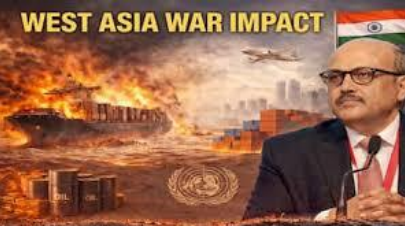
• Strategic Crisis Management: The Union Government has constituted seven empowered groups of officials and experts to proactively assess and counteract the socio-economic fallout of the escalating conflict in West Asia. • Functional Areas of Focus: These groups are tasked with monitoring critical sectors including energy (petrol, diesel, LNG), food security (fertilizers, essential commodities), macroeconomics (inflation, exchange rate volatility), and logistics (supply chain resilience). • Policy Precedent: The structure follows the \'Empowered Groups\' model successfully utilized during the COVID-19 pandemic, emphasizing a cross-departmental, mission-mode approach to handle national emergencies. • Supply Chain Vulnerability: A primary focus is the Strait of Hormuz, a global maritime chokepoint through which 20% of world oil and gas passes; any disruption here directly threatens India’s energy security, as the country imports approximately 85% of its crude requirements. • Inflationary Safeguards: The groups will implement strategies to manage \'imported inflation\' caused by depreciating rupee values and rising input costs, ensuring that domestic availability of essential goods remains stable. • Integrated Governance: Led by senior secretaries (including External Affairs, Economic Affairs, and Petroleum), these teams are authorized to formulate time-bound implementation plans and identify alternative import sources to reduce external dependencies. Key Definitions • Strait of Hormuz: A narrow waterway between the Persian Gulf and the Gulf of Oman; it is considered the world\'s most important oil transit chokepoint. • Imported Inflation: A general rise in prices in a country because of an increase in the cost of imported products, often driven by currency depreciation or global commodity price spikes. • Empowered Group of Officers (EGO): A specialized committee granted the authority to take quick, executive decisions across multiple ministries to bypass traditional bureaucratic delays during crises. • Strategic Reserves: Emergency stockpiles of crude oil maintained by a country to ensure energy security during supply disruptions or wars. Constitutional and Legal Provisions • Article 73: Specifies the extent of the executive power of the Union, which allows the Centre to take necessary administrative actions for the management of national interests. • Allocation of Business Rules, 1961: Provides the legal framework for the government to create committees and groups of secretaries to coordinate work between different ministries. • Essential Commodities Act, 1955: Empowers the government to control the production, supply, and distribution of specific commodities to prevent hoarding and ensure fair pricing during global supply shocks. • Disaster Management Act, 2005: While primarily for natural disasters, its principles of coordinated response and \'empowered\' decision-making often inform the administrative structure of these crisis groups. Additional Keypoints • The \'Chokepoint\' Risk: With Iran\'s influence over the Strait of Hormuz, India faces a double-edged sword of high procurement costs and potential physical blockage of tankers. • Fiscal Impact: High oil prices widen the Current Account Deficit (CAD) and put pressure on the fiscal deficit due to increased subsidies on fertilizers and LPG. • Rupee Volatility: External shocks lead to capital outflow, weakening the rupee, which in turn makes all dollar-denominated imports more expensive for Indian industries. • Alternative Sourcing: One of the core mandates is \'de-risking\' by identifying suppliers outside the immediate conflict zone to improve the resilience of the national energy basket. Conclusion The establishment of these seven empowered groups signifies a shift toward \'anticipatory governance.\' By treating the West Asia crisis with the same institutional rigor as a pandemic, the government aims to insulate the Indian economy from external shocks. The success of this initiative will depend on the speed of policy calibration regarding strategic reserves and the ability to maintain the delicate balance between managing inflation and sustaining industrial growth during global volatility. UPSC Relevance • GS Paper II: Statutory, regulatory and various quasi-judicial bodies; Government policies and interventions for development. • GS Paper III: Indian Economy and issues relating to planning, mobilization of resources, and growth; Energy Security; Effects of liberalization on the economy. • International Relations: Effect of policies and politics of developed and developing countries on India\'s interests; Indian Diaspora (security of Indians in West Asia).


Address : 506, 3rd EYE THREE (III), Opp. Induben Khakhrawala, Girish Cold Drink Cross Road, CG Road, Navrangpura, Ahmedabad, 380009.
Mobile : 8469231587 / 9586028957
Telephone : 079-40098991
E-mail: dics.upsc@gmail.com
Address: A-306, The Landmark, Urjanagar-1, Opp. Spicy Street, Kudasan – Por Road, Kudasan, Gandhinagar – 382421
Mobile : 9723832444 / 9723932444
E-mail: dics.gnagar@gmail.com
Address: 2nd Floor, 9 Shivali Society, L&T Circle, opp. Ratri Bazar, Karelibaugh, Vadodara, 390018
Mobile : 9725692037 / 9725692054
E-mail: dics.vadodara@gmail.com
Address: 403, Raj Victoria, Opp. Pal Walkway, Near Galaxy Circle, Pal, Surat-394510
Mobile : 8401031583 / 8401031587
E-mail: dics.surat@gmail.com
Address: 303,305 K 158 Complex Above Magson, Sindhubhavan Road Ahmedabad-380059
Mobile : 9974751177 / 8469231587
E-mail: dicssbr@gmail.com
Address: 57/17, 2nd Floor, Old Rajinder Nagar Market, Bada Bazaar Marg, Delhi-60
Mobile : 9104830862 / 9104830865
E-mail: dics.newdelhi@gmail.com