







Ahmedabad
(Head Office)Address : 506, 3rd EYE THREE (III), Opp. Induben Khakhrawala, Girish Cold Drink Cross Road, CG Road, Navrangpura, Ahmedabad, 380009.
Mobile : 8469231587 / 9586028957
Telephone : 079-40098991
E-mail: dics.upsc@gmail.com

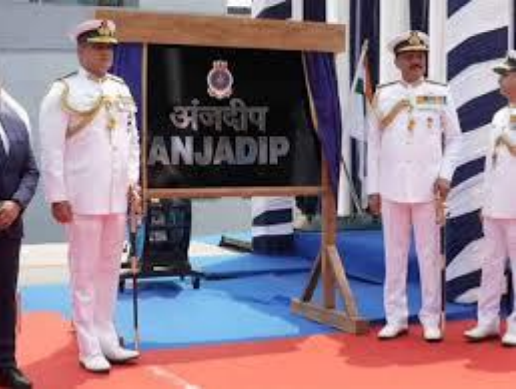
The Indian Navy officially commissioned INS Anjadip, the fourth vessel of the Anti-Submarine Warfare Shallow Water Craft (ASW-SWC) project, at Chennai Port on February 27, 2026. Named after the strategic island off Karwar, this indigenously built warship marks a significant leap in India\'s \'Dolphin Hunting\' capabilities within the littoral zones. Core Summary of the Commissioning • Strategic Induction: INS Anjadip is the fourth in a series of eight ASW-SWC ships, joining predecessors like INS Arnala and INS Androth to enhance the Navy\'s sub-surface detection capabilities in shallow waters. • Operational Role: Specially designed for the \'littoral zone\' (coastal waters), the vessel is tasked with detecting, tracking, and neutralizing enemy submarines, protecting maritime trade routes and vital coastal infrastructure. • Technical Specifications: The 77-meter-long ship displaces 1400 tons and features an advanced Combat Management System (CMS) integrated with a modern ASW suite, including hull-mounted sonars and lightweight torpedoes. • Indigenous Prowess: Reflecting the \'Atmanirbhar Bharat\' vision, the ship boasts over 80% indigenous content, encompassing its design, construction by GRSE and L&T, and critical defense electronics. • Command and Control: The vessel has been placed under the operational and administrative control of the Flag Officer Commanding, Tamil Nadu and Puducherry Naval Area, focusing on the security of the Bay of Bengal region. • Tactical Significance: As a \'Dolphin Hunter,\' it fills the critical gap between large destroyers and smaller patrol craft, providing high-speed, sustained response capabilities in complex coastal environments. Key Definitions • Anti-Submarine Warfare (ASW): A branch of underwater warfare that uses surface warships, aircraft, or other submarines to find, track, and deter or destroy enemy submarines. • Littoral Zone: The part of a sea, lake, or river that is close to the shore. In naval terms, it refers to coastal regions where specialized \'shallow water\' vessels are required due to depth constraints. • Combat Management System (CMS): The \'brain\' of the ship that integrates data from all sensors (radars, sonars) and weapons to provide a unified tactical picture for the commander. Constitutional and Legal Provisions • Article 51(A): Fundamental Duties, specifically Clause (d), which mandates citizens to defend the country and render national service. Strengthening the Navy is a state function that enables this duty. • Union List (Seventh Schedule): Entry 2 specifies \'Naval, military and air forces; any other armed forces of the Union\' as the exclusive domain of the Parliament. • Territorial Waters, Continental Shelf, EEZ and Other Maritime Zones Act, 1976: Provides the legal framework for India’s sovereignty over its territorial waters (12 nautical miles) and sovereign rights in the EEZ (200 nautical miles), which INS Anjadip will help enforce. Additional Key Points • The \'Arnala\' Class: INS Anjadip belongs to the Arnala class of ships, intended to replace the aging Abhay-class ASW corvettes of the Indian Navy. • Maritime Domain Awareness (MDA): The induction of these crafts is crucial for MDA, especially given the increasing presence of foreign conventional and nuclear-powered submarines in the Indian Ocean Region (IOR). • Coastal Security Architecture: Post-26/11, India has revamped its coastal security; the ASW-SWC project is a key component in preventing sub-surface infiltrations that could target offshore oil rigs or nuclear plants. • Collaborative Shipbuilding: The project showcases a successful Public-Private Partnership (PPP) model, with Garden Reach Shipbuilders & Engineers (GRSE) collaborating with Larsen & Toubro (L&T) for construction. Conclusion: The commissioning of INS Anjadip is a testament to the Indian Navy\'s transition from a \'Buyer’s Navy\' to a \'Builder’s Navy.\' By securing the shallow waters where large combatants struggle to operate, this vessel ensures that India’s maritime frontiers remain \'Abhedya\' (Impenetrable), safeguarding the nation\'s economic and strategic interests in the IOR. UPSC Relevance: • GS Paper III: Internal Security (Coastal Security); Science and Technology (Indigenization of technology); Role of external state and non-state actors in creating challenges to internal security. • GS Paper II: Government policies and interventions for development in various sectors. • Prelims: Specific ship names (Anjadip, Arnala), the location of the commissioning (Chennai), and the concept of ASW-SWC.


Address : 506, 3rd EYE THREE (III), Opp. Induben Khakhrawala, Girish Cold Drink Cross Road, CG Road, Navrangpura, Ahmedabad, 380009.
Mobile : 8469231587 / 9586028957
Telephone : 079-40098991
E-mail: dics.upsc@gmail.com
Address: A-306, The Landmark, Urjanagar-1, Opp. Spicy Street, Kudasan – Por Road, Kudasan, Gandhinagar – 382421
Mobile : 9723832444 / 9723932444
E-mail: dics.gnagar@gmail.com
Address: 2nd Floor, 9 Shivali Society, L&T Circle, opp. Ratri Bazar, Karelibaugh, Vadodara, 390018
Mobile : 9725692037 / 9725692054
E-mail: dics.vadodara@gmail.com
Address: 403, Raj Victoria, Opp. Pal Walkway, Near Galaxy Circle, Pal, Surat-394510
Mobile : 8401031583 / 8401031587
E-mail: dics.surat@gmail.com
Address: 303,305 K 158 Complex Above Magson, Sindhubhavan Road Ahmedabad-380059
Mobile : 9974751177 / 8469231587
E-mail: dicssbr@gmail.com
Address: 57/17, 2nd Floor, Old Rajinder Nagar Market, Bada Bazaar Marg, Delhi-60
Mobile : 9104830862 / 9104830865
E-mail: dics.newdelhi@gmail.com