


Ahmedabad
(Head Office)Address : 506, 3rd EYE THREE (III), Opp. Induben Khakhrawala, Girish Cold Drink Cross Road, CG Road, Navrangpura, Ahmedabad, 380009.
Mobile : 8469231587 / 9586028957
Telephone : 079-40098991
E-mail: dics.upsc@gmail.com

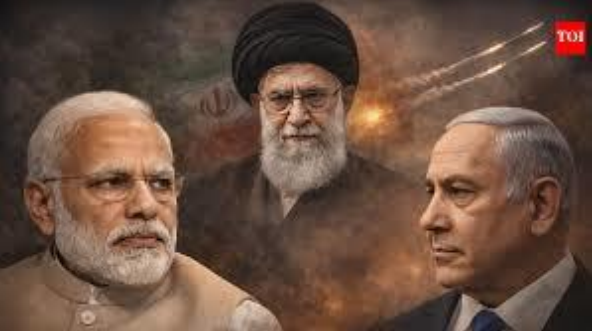
Core Summary of the Debate • Strategic Pragmatism vs. Civilizational Ties: The current debate centers on India\'s response to the Israeli-American military action against Iran, contrasting the government\'s \'cold calculation\' of national interest against critics who view the stance as a departure from long-standing ties with Tehran. • National Interest as the Primary Driver: Foreign policy remains an instrument to protect sovereignty and economic well-being. The government’s current tilt is seen as a move to prioritize relations with the US (largest trading partner and technology provider) and the Gulf states (home to 10 million Indians and a key energy source). • Controversy over Diplomatic Protocol: Specific criticism has been directed at the decision not to formally condole the assassination of Iran’s Supreme Leader, Ayatollah Ali Khamenei, at the highest level, which some interpret as a \'weak-kneed\' surrender to Western pressure. • Consistency in \'Selfish\' Policy: Despite ideological shifts between ruling parties, the fundamental objective remains \'Nehruvian\' in its essence—essentially \'selfish\' and anchored in the pursuit of national interest, as once articulated by Jawaharlal Nehru in his correspondence with Einstein. • Limits of Strategic Autonomy: While \'Strategic Autonomy\' is the preferred label, the author argues that the government missed opportunities to demonstrate independence, such as through higher-level diplomatic gestures toward Iran without compromising its core security interests. • Timing of Diplomatic Engagements: The Prime Minister’s visit to Israel (February 2026) just days before the escalation against Iran is highlighted as a moment where ideological affinity and geopolitical timing intersected, signaling India’s bet on the USIsraeli coalition. Key Definitions • Strategic Autonomy: The ability of a state to pursue its national interests and adopt its preferred foreign policy without being constrained by other states. • Sui Generis Interests: Interests that are unique or of their own kind, such as the fundamental duty to defend a nation\'s territorial integrity. • Ideological Orientation: The set of beliefs or political philosophies of a ruling party that may influence—but ideally should not dictate—long-term foreign policy. Constitutional & Legal Provisions • Article 51 (Directive Principles of State Policy): Mandates the State to promote international peace and security and maintain just and honorable relations between nations. • Article 73: Extends the executive power of the Union to all matters with respect to which Parliament has the power to make laws, including \'Foreign Affairs\' (Entry 10, List I). • Article 253: Empowers Parliament to make any law for the whole or any part of the territory of India for implementing any treaty, agreement, or convention with any other country. Additional Important Keypoints • The Gulf Factor: With nearly 10 million Indians in the Gulf sending back billions in remittances, any policy shift must account for the stability of the GCC (Gulf Cooperation Council) countries. • Energy Chokepoints: Iran\'s decision to allow Indian oil tankers safe passage through the Strait of Hormuz underscores the \'graciousness\' of Tehran despite India\'s perceived tilt, highlighting the fragility of energy security. • The Realist Paradigm: The author notes that in a democracy, the government must explain its rationale to the people, as foreign policy decisions, even if unpopular, must be objective and calculated. Conclusion The ongoing conflict in West Asia has forced India into a difficult balancing act, testing the limits of its \'Strategic Autonomy.\' While the government appears to have aligned with the US-Israeli axis based on trade and technology dependencies, the lack of traditional diplomatic empathy toward Iran risks long-term \'civilizational\' friction. Ultimately, the debate highlights that while labels like \'autonomy\' are fashionable, the core of Indian foreign policy remains a pragmatic, and at times \'selfish,\' pursuit of national survival and growth. UPSC Relevance • General Studies II: India and its neighborhood-relations; Bilateral, regional and global groupings and agreements involving India and/or affecting India’s interests; Effect of policies and politics of developed and developing countries on India’s interests. • Political Science Optional: Principles of Indian Foreign Policy; India’s relations with the USA and West Asia; Challenges to Strategic Autonomy.


Address : 506, 3rd EYE THREE (III), Opp. Induben Khakhrawala, Girish Cold Drink Cross Road, CG Road, Navrangpura, Ahmedabad, 380009.
Mobile : 8469231587 / 9586028957
Telephone : 079-40098991
E-mail: dics.upsc@gmail.com
Address: A-306, The Landmark, Urjanagar-1, Opp. Spicy Street, Kudasan – Por Road, Kudasan, Gandhinagar – 382421
Mobile : 9723832444 / 9723932444
E-mail: dics.gnagar@gmail.com
Address: 2nd Floor, 9 Shivali Society, L&T Circle, opp. Ratri Bazar, Karelibaugh, Vadodara, 390018
Mobile : 9725692037 / 9725692054
E-mail: dics.vadodara@gmail.com
Address: 403, Raj Victoria, Opp. Pal Walkway, Near Galaxy Circle, Pal, Surat-394510
Mobile : 8401031583 / 8401031587
E-mail: dics.surat@gmail.com
Address: 303,305 K 158 Complex Above Magson, Sindhubhavan Road Ahmedabad-380059
Mobile : 9974751177 / 8469231587
E-mail: dicssbr@gmail.com
Address: 57/17, 2nd Floor, Old Rajinder Nagar Market, Bada Bazaar Marg, Delhi-60
Mobile : 9104830862 / 9104830865
E-mail: dics.newdelhi@gmail.com