





Ahmedabad
(Head Office)Address : 506, 3rd EYE THREE (III), Opp. Induben Khakhrawala, Girish Cold Drink Cross Road, CG Road, Navrangpura, Ahmedabad, 380009.
Mobile : 8469231587 / 9586028957
Telephone : 079-40098991
E-mail: dics.upsc@gmail.com

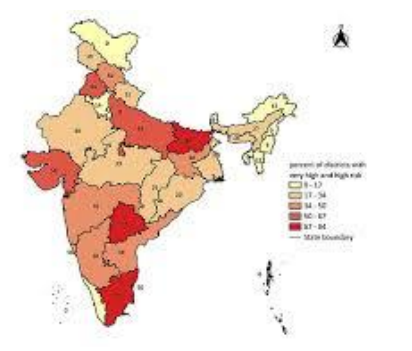
• Redefining Disaster Risk Metrics: The 16th Finance Commission (FC-16) has introduced a transformative multiplicative Disaster Risk Index (DRI) defined as $DRI = Hazard \times Exposure \times Vulnerability$. This marks a shift from the 15th Finance Commission’s additive model, correctly theorizing that risk only exists when a natural hazard intersects with an exposed and fragile population. • Paradox of Odisha’s Funding Decline: Despite being India’s most disaster-prone state with the highest hazard score (12), Odisha has faced the steepest reduction in its funding share—a decline of 1.57 percentage points. This paradox stems from the DRI\'s operational design, where low population scores negate high hazard risks, effectively penalizing states that have successfully managed mortality but remain geographically vulnerable. • The \'Exposure\' Measurement Crisis: The primary structural flaw lies in using a state\'s total population as a surrogate for \'Exposure.\' Scientifically, exposure refers to the population specifically located within hazard zones (e.g., coastal belts or floodplains). By using total headcount, the formula disproportionately favors demographically large, inland states like Uttar Pradesh and Bihar over smaller, high-risk coastal states like Odisha and Kerala. • Vulnerability vs. Fiscal Capacity: The current formula equates \'Vulnerability\' with the inverse of per capita Net State Domestic Product (NSDP). This metric measures fiscal capacity (the ability to pay) rather than physical or social vulnerability (the quality of housing or health infrastructure). Consequently, wealthier states with high disaster histories, such as Kerala, receive lower vulnerability scores, ignoring the multidimensional nature of climate risk. • Impact on Cooperative Federalism: The revised allocation has caused 20 states to lose their relative share of disaster funding. This creates a \'funding-gap\' for states most vulnerable to climate change, such as the Himalayan and coastal regions, potentially undermining the long-term sustainability of their highly successful \'zero-casualty\' disaster management models. • Proposed Institutional Reforms: Experts suggest transitioning to a \'State Disaster Vulnerability Index\' curated by the National Disaster Management Authority (NDMA). This should incorporate granular data such as the share of kutcha housing, crop insurance penetration, and the density of health facilities in high-hazard districts to move beyond simple headcounts to true risk assessment. Key Definitions and Technical Frameworks Disaster Risk Index (DRI): A mathematical representation of risk calculated as $Risk = Hazard \times Exposure \times Vulnerability$. Exposure (IPCC Definition): The presence of people, livelihoods, species or ecosystems, environmental functions, services, and resources, infrastructure, or economic, social, or cultural assets in places and settings that could be adversely affected. Net State Domestic Product (NSDP): The total value of all finished goods and services produced within a state; used by the FC as a proxy for a state\'s economic resilience. SDRF & SDMF: The State Disaster Response Fund (80%) and State Disaster Mitigation Fund (20%). The FC-16 recommends a total corpus of ₹2,04,401 crore for these funds for 2026-31. Multiplicative vs. Additive Model: In an additive model ($H + E + V$), each factor contributes independently; in a multiplicative model, if any factor is zero, the total risk is zero, emphasizing the interdependence of the variables. Conclusion While the 16th Finance Commission’s move toward a risk-based scientific formula is theoretically sound, its reliance on total population as a proxy for exposure has turned a disaster index into a demographic headcount. This structural bias risks de-incentivizing states that have invested heavily in disaster resilience. To safeguard India’s climate future, the allocation logic must evolve to recognize \'population-at-risk\' rather than \'population-at-large,\' ensuring that the most vulnerable geographies are not left fiscally stranded. UPSC Relevance GS Paper II (Governance & Polity): Directly relates to \'Functions and responsibilities of the Union and the States\' and the \'Role of the Finance Commission\' as a balancing wheel of fiscal federalism under Article 280


Address : 506, 3rd EYE THREE (III), Opp. Induben Khakhrawala, Girish Cold Drink Cross Road, CG Road, Navrangpura, Ahmedabad, 380009.
Mobile : 8469231587 / 9586028957
Telephone : 079-40098991
E-mail: dics.upsc@gmail.com
Address: A-306, The Landmark, Urjanagar-1, Opp. Spicy Street, Kudasan – Por Road, Kudasan, Gandhinagar – 382421
Mobile : 9723832444 / 9723932444
E-mail: dics.gnagar@gmail.com
Address: 2nd Floor, 9 Shivali Society, L&T Circle, opp. Ratri Bazar, Karelibaugh, Vadodara, 390018
Mobile : 9725692037 / 9725692054
E-mail: dics.vadodara@gmail.com
Address: 403, Raj Victoria, Opp. Pal Walkway, Near Galaxy Circle, Pal, Surat-394510
Mobile : 8401031583 / 8401031587
E-mail: dics.surat@gmail.com
Address: 303,305 K 158 Complex Above Magson, Sindhubhavan Road Ahmedabad-380059
Mobile : 9974751177 / 8469231587
E-mail: dicssbr@gmail.com
Address: 57/17, 2nd Floor, Old Rajinder Nagar Market, Bada Bazaar Marg, Delhi-60
Mobile : 9104830862 / 9104830865
E-mail: dics.newdelhi@gmail.com