







Ahmedabad
(Head Office)Address : 506, 3rd EYE THREE (III), Opp. Induben Khakhrawala, Girish Cold Drink Cross Road, CG Road, Navrangpura, Ahmedabad, 380009.
Mobile : 8469231587 / 9586028957
Telephone : 079-40098991
E-mail: dics.upsc@gmail.com

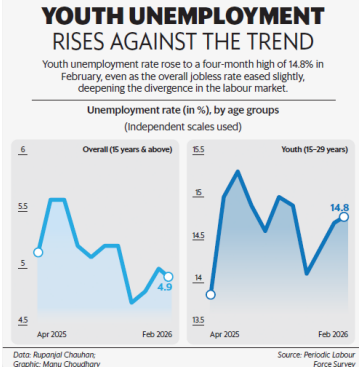
The latest data from the Periodic Labour Force Survey (PLFS) indicates a significant divergence in the Indian labour market for February 2026. While the overall unemployment rate for the general population (15 years and above) has shown signs of easing, the youth unemployment rate has surged to a four-month high of 14.8%. This trend highlights a structural mismatch where broader economic recovery is not translating into adequate job creation for the younger demographic. • Widening Gap: The unemployment rate for the 15-29 age group rose to 14.8% in February 2026, contrasting with the overall jobless rate which remained significantly lower (hovering between 4.5% and 6% as per independent scales). • Structural Mismatch: The data suggests a \'jobless growth\' scenario for the youth, where industrial and service sector expansion may be favoring experienced workers or automation over fresh entrants. • Four-Month Peak: This rise marks the highest level of youth joblessness since late 2025, signaling that seasonal employment or recent policy interventions have yet to stabilize the entry-level job market. • Divergent Trends: While the overall economy shows resilience, the \'youth bulge\' in India\'s population faces barriers such as skill gaps and a lack of high-quality formal sector opportunities. • Sectoral Impact: The rise is particularly concerning for the \'educated unemployed\' category, where individuals with degrees are finding it harder to secure roles that match their qualifications compared to informal or low-skill labor. Key Definitions • Youth Unemployment Rate: The percentage of the unemployed population within the 15-29 age group relative to the total labour force in that same age bracket. • Periodic Labour Force Survey (PLFS): An initiative by the National Sample Survey Office (NSSO) to estimate key employment and unemployment indicators (like Worker Population Ratio, Labour Force Participation Rate) at shorter time intervals. • Labour Force Participation Rate (LFPR): The percentage of persons in the labour force (working or seeking work) in the total population. Constitutional & Legal Provisions • Article 41 (DPSP): Directs the State to ensure the \'Right to Work\' within the limits of its economic capacity and development. • Article 39: Mandates the State to direct its policy toward securing that citizens, men and women equally, have the right to an adequate means of livelihood. • National Youth Policy, 2014: Focuses on empowering youth through education, skill development, and entrepreneurship to maximize the \'Demographic Dividend.\' • Code on Wages, 2019: Aims to universalize the provisions of minimum wages and timely payment of wages, which impacts the attractiveness of formal employment for youth. Conclusion The rising trend of youth unemployment amidst a stabilizing overall jobless rate is a red flag for India\'s demographic transition. Without targeted vocational training, credit ease for startups, and laborintensive manufacturing growth, the potential demographic dividend risks turning into a \'demographic disaster.\' Addressing the divergence requires moving beyond aggregate data to solve the specific bottlenecks faced by first-time job seekers. UPSC Relevance • GS Paper III: Indian Economy and issues relating to planning, mobilization of resources, growth, development, and employment; Inclusive growth and issues arising from it. • GS Paper I: Social Issues (Population and associated issues, Poverty and developmental issues). • Mains Perspective: Analyze the factors contributing to the divergence between youth and general unemployment rates in India. Discuss the effectiveness of schemes like PM-Kushal Yuva Yojana and PM-SVANidhi in bridging this gap.


Address : 506, 3rd EYE THREE (III), Opp. Induben Khakhrawala, Girish Cold Drink Cross Road, CG Road, Navrangpura, Ahmedabad, 380009.
Mobile : 8469231587 / 9586028957
Telephone : 079-40098991
E-mail: dics.upsc@gmail.com
Address: A-306, The Landmark, Urjanagar-1, Opp. Spicy Street, Kudasan – Por Road, Kudasan, Gandhinagar – 382421
Mobile : 9723832444 / 9723932444
E-mail: dics.gnagar@gmail.com
Address: 2nd Floor, 9 Shivali Society, L&T Circle, opp. Ratri Bazar, Karelibaugh, Vadodara, 390018
Mobile : 9725692037 / 9725692054
E-mail: dics.vadodara@gmail.com
Address: 403, Raj Victoria, Opp. Pal Walkway, Near Galaxy Circle, Pal, Surat-394510
Mobile : 8401031583 / 8401031587
E-mail: dics.surat@gmail.com
Address: 303,305 K 158 Complex Above Magson, Sindhubhavan Road Ahmedabad-380059
Mobile : 9974751177 / 8469231587
E-mail: dicssbr@gmail.com
Address: 57/17, 2nd Floor, Old Rajinder Nagar Market, Bada Bazaar Marg, Delhi-60
Mobile : 9104830862 / 9104830865
E-mail: dics.newdelhi@gmail.com