




Ahmedabad
(Head Office)Address : 506, 3rd EYE THREE (III), Opp. Induben Khakhrawala, Girish Cold Drink Cross Road, CG Road, Navrangpura, Ahmedabad, 380009.
Mobile : 8469231587 / 9586028957
Telephone : 079-40098991
E-mail: dics.upsc@gmail.com

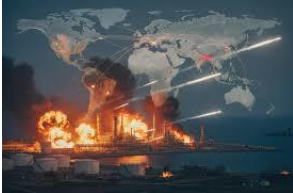
• Escalation of Regional Conflict: Following US and Israeli strikes on Iran in February 2026, the conflict has expanded into a systematic targeting of civilian and industrial assets across the United Arab Emirates (UAE), Bahrain, and Kuwait. Iran justifies these strikes by accusing Gulf nations of facilitating US military operations from their soil. • Targeting Critical Energy Hubs: Recent drone and missile salvos have caused \'severe\' material damage to Kuwaiti petrochemical facilities and the Ruwais Industrial City in the UAE. These attacks aim at the economic heart of the Gulf, disrupting oil processing, storage, and export capabilities that are vital to global energy stability. • Threat to Life-Sustainment Systems: Beyond oil, Iran has targeted power plants and water desalination facilities. For desert-bound Gulf states, the shutdown of electricity generating units and desalination plants represents a transition from tactical warfare to a humanitarian crisis, as these nations rely almost entirely on such infrastructure for potable water. • Chokepoint Neutralization: The effective closure of the Strait of Hormuz, combined with the physical destruction of storage tanks (such as Bapco Energies in Bahrain), has convulsed global markets. As a critical transit point for 1/5th of the world\'s liquid petroleum, any disruption here triggers immediate volatility in global crude prices. • Air Defence and Interception Challenges: While the UAE has reported successful interceptions of several missiles, falling debris has still managed to ignite multiple fires at petrochemical plants. This highlights the limitations of current air defence systems against highvolume, \'swarming\' drone and missile tactics in dense industrial zones. • Geopolitical Realignment: The denial by Gulf states regarding US military usage of their territory suggests a breakdown in regional communication. The shift toward targeting \'aluminium industries\' and state-owned energy subsidiaries signals Iran\'s intent to inflict maximum financial pain on US allies in the region. Key Definitions • Strait of Hormuz: A narrow waterway between the Gulf of Oman and the Persian Gulf; it is the world\'s most important oil chokepoint. • Desalination Plants: Industrial facilities that remove salt and minerals from seawater to produce fresh water, essential for the survival of arid Gulf nations. • Petrochemical Hub: An industrial complex where chemical products are derived from petroleum or natural gas for use in plastics, fertilizers, and synthetics. Constitutional and Legal Provisions • UN Charter Article 51: Pertains to the inherent right of individual or collective self-defence if an armed attack occurs; Iran and its neighbors are increasingly invoking this to justify their respective military postures. • UNCLOS (UN Convention on the Law of the Sea): Specifically Part III, which governs \'Straits Used for International Navigation.\' Iran\'s closure of the Strait of Hormuz challenges the \'Right of Transit Passage\' established under international maritime law. • Geneva Conventions (Protocol I): Prohibits attacks on objects indispensable to the survival of the civilian population, such as drinking water installations and supplies (relevant to the targeting of desalination plants). Additional Key Points • Economic Contagion: The \'material damage\' reported by the Kuwait Petroleum Corporation has a cascading effect on global supply chains, increasing the cost of raw materials for industries worldwide. • Environmental Risk: Attacks on storage tanks and petrochemical plants create high risks of oil spills and toxic atmospheric pollution, affecting the delicate marine ecosystem of the Persian Gulf. • Asymmetric Warfare: The use of low-cost drones to damage multi-billion dollar infrastructure demonstrates the effectiveness of asymmetric tactics in modern West Asian conflicts. Conclusion The targeted destruction of Gulf energy and water infrastructure marks a dangerous phase in the West Asia war. By moving beyond military targets to hit desalination plants and petrochemical hubs, the conflict threatens the fundamental survival mechanisms of Gulf states. The disruption of the Strait of Hormuz ensures that this is no longer a regional skirmish but a global economic crisis, demanding urgent international diplomatic intervention to prevent a total energy collapse. UPSC Relevance • GS Paper II: India and its neighborhood-relations; Effect of policies and politics of developed and developing countries on India’s interests (Energy Security and Diaspora in the Gulf). • GS Paper III: Infrastructure: Energy, Ports, and Water; Security challenges and their management in border areas; Linkages of organized crime with terrorism. • Prelims: Mapping of the Strait of Hormuz, Persian Gulf, and locations like Ruwais (UAE); International maritime laws (UNCLOS); and India\'s energy import dependency


Address : 506, 3rd EYE THREE (III), Opp. Induben Khakhrawala, Girish Cold Drink Cross Road, CG Road, Navrangpura, Ahmedabad, 380009.
Mobile : 8469231587 / 9586028957
Telephone : 079-40098991
E-mail: dics.upsc@gmail.com
Address: A-306, The Landmark, Urjanagar-1, Opp. Spicy Street, Kudasan – Por Road, Kudasan, Gandhinagar – 382421
Mobile : 9723832444 / 9723932444
E-mail: dics.gnagar@gmail.com
Address: 2nd Floor, 9 Shivali Society, L&T Circle, opp. Ratri Bazar, Karelibaugh, Vadodara, 390018
Mobile : 9725692037 / 9725692054
E-mail: dics.vadodara@gmail.com
Address: 403, Raj Victoria, Opp. Pal Walkway, Near Galaxy Circle, Pal, Surat-394510
Mobile : 8401031583 / 8401031587
E-mail: dics.surat@gmail.com
Address: 303,305 K 158 Complex Above Magson, Sindhubhavan Road Ahmedabad-380059
Mobile : 9974751177 / 8469231587
E-mail: dicssbr@gmail.com
Address: 57/17, 2nd Floor, Old Rajinder Nagar Market, Bada Bazaar Marg, Delhi-60
Mobile : 9104830862 / 9104830865
E-mail: dics.newdelhi@gmail.com