





Ahmedabad
(Head Office)Address : 506, 3rd EYE THREE (III), Opp. Induben Khakhrawala, Girish Cold Drink Cross Road, CG Road, Navrangpura, Ahmedabad, 380009.
Mobile : 8469231587 / 9586028957
Telephone : 079-40098991
E-mail: dics.upsc@gmail.com

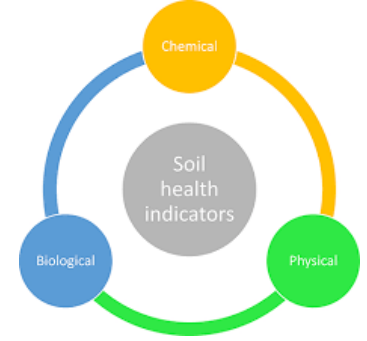
• Nutrient Profile Trends: Recent data from the Soil and Land Use Survey of India (at scales of 1:50,000 and 1:10,000) indicates that while Indian soils are generally sufficient in Potassium, there is significant variability in Nitrogen and Phosphorus levels across regions. • Micronutrient Deficiencies: Critical deficiencies in Zinc are prominently observed in Bihar, Uttar Pradesh, and Odisha, while levels of Iron and Boron exhibit high variability across the country, necessitating region-specific interventions. • Soil Health Card (SHC) Progress: Since its inception in 2014-15, the Soil Health and Fertility Scheme has generated 25.89crore cards, providing farmers with crop-wise recommendations for nutrients and fertilizers to improve productivity and soil quality. • Integrated Nutrient Management (INM): The Indian Council of Agricultural Research (ICAR) advocates for a balanced approach combining inorganic fertilizers with organic sources such as manure and bio-fertilizers to prevent soil degradation and improve fertility. • Institutional Capacity Building: Over 7.17lakh demonstration programs have been conducted, supported by a network of 70,002 trained \'Krishi Sakhis\' and the \'School Soil Health Programme\' to inculcate soil conservation values in students and provide advisories. • Natural Farming Initiatives: The National Mission on Natural Farming (NMNF) promotes livestockintegrated farming and biomass mulching to enhance soil organic content, improve soil structure, and increase water-holding capacity. Key Definitions • Soil Health Card (SHC): A printed report given to farmers containing the status of their soil with respect to 12 parameters (Macro-nutrients, Secondary-nutrient, Micro-nutrients, and Physical parameters). • Integrated Nutrient Management (INM): The maintenance of soil fertility and plant nutrient supply to an optimum level for sustaining the desired crop productivity through optimization of the benefits from all possible sources of organic, inorganic, and biological components. • Bio-fertilizers: Substances which contain living microorganisms which, when applied to seeds, plant surfaces, or soil, colonize the rhizosphere or the interior of the plant and promote growth by increasing the supply or availability of primary nutrients. Constitutional & Legal Provisions • Article 48: Directive Principle of State Policy (DPSP) which mandates the State to organize agriculture and animal husbandry on modern and scientific lines. • Entry 14, State List (Schedule VII): Agriculture, including agricultural education and research, protection against pests and prevention of plant diseases. • Environment Protection Act, 1986: Provides a broad framework for the protection and improvement of the environment, which includes soil as a vital natural resource subject to pollution and degradation laws. • Fertiliser Control Order (FCO), 1985: Regulates the quality, distribution, and price of fertilizers in India, ensuring that only soilappropriate inputs are marketed to farmers. Additional Key Points for Examination • The NPK Ratio: The ideal N:P:K ratio for Indian soils is generally considered 4:2:1; however, current consumption patterns are often skewed toward Nitrogen (Urea), leading to soil acidification and nutrient imbalance. • Natural Farming vs. Organic Farming: While both avoid synthetic chemicals, Natural Farming (under NMNF) emphasizes on-farm inputs like Jivamrit and Bijamrit and livestock integration, whereas Organic Farming may rely on off-farm organic certified inputs. • Digital Extension: Platforms like ATMA (Agricultural Technology Management Agency) and KVKs (Krishi Vigyan Kendras) serve as the bridge between scientific soil research and actual field application. Conclusion The status of soil health in India reflects a complex mosaic of nutrient sufficiency and localized deficiencies. The government’s shift from high-input chemical farming toward Integrated Nutrient Management and Natural Farming underscores an urgent need to restore soil biology. By leveraging Digital Public Infrastructure and grassroots workers like Krishi Sakhis, the strategy aims to make soil health a community-led movement, ensuring long-term food security and climate resilience for Indian agriculture. UPSC Relevance • GS Paper III: Issues related to direct and indirect farm subsidies; Public Distribution System; Technology missions; Economics of animal-rearing; Land reforms in India; Conservation, environmental pollution and degradation. • GS Paper II: Welfare schemes for vulnerable sections of the population; Issues relating to the management of Social Sector/Services relating to Health and Education. • Prelims Link: Parameters of the Soil Health Card; Difference between Macro and Micronutrients; Agencies involved (ICAR, DAC&FW); Objectives of the National Mission on Natural Farming.


Address : 506, 3rd EYE THREE (III), Opp. Induben Khakhrawala, Girish Cold Drink Cross Road, CG Road, Navrangpura, Ahmedabad, 380009.
Mobile : 8469231587 / 9586028957
Telephone : 079-40098991
E-mail: dics.upsc@gmail.com
Address: A-306, The Landmark, Urjanagar-1, Opp. Spicy Street, Kudasan – Por Road, Kudasan, Gandhinagar – 382421
Mobile : 9723832444 / 9723932444
E-mail: dics.gnagar@gmail.com
Address: 2nd Floor, 9 Shivali Society, L&T Circle, opp. Ratri Bazar, Karelibaugh, Vadodara, 390018
Mobile : 9725692037 / 9725692054
E-mail: dics.vadodara@gmail.com
Address: 403, Raj Victoria, Opp. Pal Walkway, Near Galaxy Circle, Pal, Surat-394510
Mobile : 8401031583 / 8401031587
E-mail: dics.surat@gmail.com
Address: 303,305 K 158 Complex Above Magson, Sindhubhavan Road Ahmedabad-380059
Mobile : 9974751177 / 8469231587
E-mail: dicssbr@gmail.com
Address: 57/17, 2nd Floor, Old Rajinder Nagar Market, Bada Bazaar Marg, Delhi-60
Mobile : 9104830862 / 9104830865
E-mail: dics.newdelhi@gmail.com