






Ahmedabad
(Head Office)Address : 506, 3rd EYE THREE (III), Opp. Induben Khakhrawala, Girish Cold Drink Cross Road, CG Road, Navrangpura, Ahmedabad, 380009.
Mobile : 8469231587 / 9586028957
Telephone : 079-40098991
E-mail: dics.upsc@gmail.com

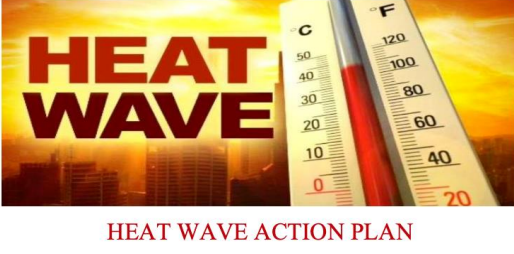
The escalating frequency of extreme heat events in India, particularly in urban centers like Delhi, has necessitated the formulation of Heat Action Plans (HAPs). Despite projections of record-breaking temperatures and an early onset of the \'heat season\' (March–July), administrative delays and a focus on short-term relief over long-term structural resilience remain significant challenges. Key Summary Points • Institutional Delay in Planning: Despite the India Meteorological Department (IMD) recording 35.7°C in early March—the highest in 50 years for that period—critical Heat Action Plans are often delayed, missing the window for pre-summer preparation. • Short-term vs. Long-term Measures: Current interventions are skewed toward immediate relief, such as ORS distribution and water supply, while long-term strategies like \'cool roofs\' and urban greening remain in pilot stages or suffer from poor implementation. • Cool Roof Technology: This entails using solarreflective paints or tiles to deflect radiation. While effective for reducing indoor temperatures in heat-stressed areas like slums, it requires periodic maintenance (every 12–18 months) and large-scale application to be impactful. • Labor and Vulnerable Groups: There is a significant implementation gap in protecting outdoor laborers. Recommendations to shift working hours and provide shaded resting areas often lack the legal teeth or executive will to force employer compliance. • Data and Accountability Deficit: While most states have drafted HAPs, there is nearly zero public data on the progress of these goals, leading to a lack of accountability for missed targets and stalled projects. • Urban Heat Island Effect: Extensive concretization and the lack of tree cover in densely populated clusters exacerbate heat stress, requiring localized \'heat hotspot\' identification and targeted shading interventions. Key Definitions • Heatwave: A period of abnormally high temperatures, more than the normal maximum temperature, occurring during the summer season. In India, it is declared when the maximum temperature reaches at least 40°C for Plains and at least 30°C for Hilly regions. • Cool Roofs: Passive cooling architectural interventions using high albedo materials to reflect more sunlight and absorb less heat than a standard roof. • Heat Action Plan (HAP): A comprehensive framework involving early warning systems, public awareness, and inter-agency coordination to reduce health risks from heat. Constitutional & Legal Provisions • Article 21: The Right to Life includes the right to a healthy environment and protection from lifethreatening climatic conditions. • Disaster Management Act, 2005: Provides the legal framework for the NDMA and SDMAs to prepare and implement plans for disaster mitigation, which now includes heatwaves as a notified disaster in several states. • Directive Principles (Article 48A): Mandates the State to protect and improve the environment. • Occupational Safety, Health and Working Conditions Code, 2020: Contains provisions for the health and safety of workers, which can be invoked to regulate outdoor work during peak heat. Conclusion The transition from reactive to proactive heat management is no longer optional. While the NDMA’s involvement provides a structural template, the success of HAPs depends on localized implementation, mandatory \'cool roofing\' in urban planning, and strict accountability for labor safety. Without a shift toward long-term urban cooling and transparent data tracking, cities will remain ill-equipped to handle the intensifying climate reality. UPSC Relevance • GS Paper I: Geographical features and their location-changes in critical geographical features (including water-bodies and ice-caps) and in flora and fauna and the effects of such changes (Urban Heat Islands). • GS Paper II: Government policies and interventions for development in various sectors; Statutory, regulatory, and various quasi-judicial bodies (NDMA/SDMA). • GS Paper III: Disaster and disaster management; Environmental pollution and degradation.


Address : 506, 3rd EYE THREE (III), Opp. Induben Khakhrawala, Girish Cold Drink Cross Road, CG Road, Navrangpura, Ahmedabad, 380009.
Mobile : 8469231587 / 9586028957
Telephone : 079-40098991
E-mail: dics.upsc@gmail.com
Address: A-306, The Landmark, Urjanagar-1, Opp. Spicy Street, Kudasan – Por Road, Kudasan, Gandhinagar – 382421
Mobile : 9723832444 / 9723932444
E-mail: dics.gnagar@gmail.com
Address: 2nd Floor, 9 Shivali Society, L&T Circle, opp. Ratri Bazar, Karelibaugh, Vadodara, 390018
Mobile : 9725692037 / 9725692054
E-mail: dics.vadodara@gmail.com
Address: 403, Raj Victoria, Opp. Pal Walkway, Near Galaxy Circle, Pal, Surat-394510
Mobile : 8401031583 / 8401031587
E-mail: dics.surat@gmail.com
Address: 303,305 K 158 Complex Above Magson, Sindhubhavan Road Ahmedabad-380059
Mobile : 9974751177 / 8469231587
E-mail: dicssbr@gmail.com
Address: 57/17, 2nd Floor, Old Rajinder Nagar Market, Bada Bazaar Marg, Delhi-60
Mobile : 9104830862 / 9104830865
E-mail: dics.newdelhi@gmail.com