







Ahmedabad
(Head Office)Address : 506, 3rd EYE THREE (III), Opp. Induben Khakhrawala, Girish Cold Drink Cross Road, CG Road, Navrangpura, Ahmedabad, 380009.
Mobile : 8469231587 / 9586028957
Telephone : 079-40098991
E-mail: dics.upsc@gmail.com

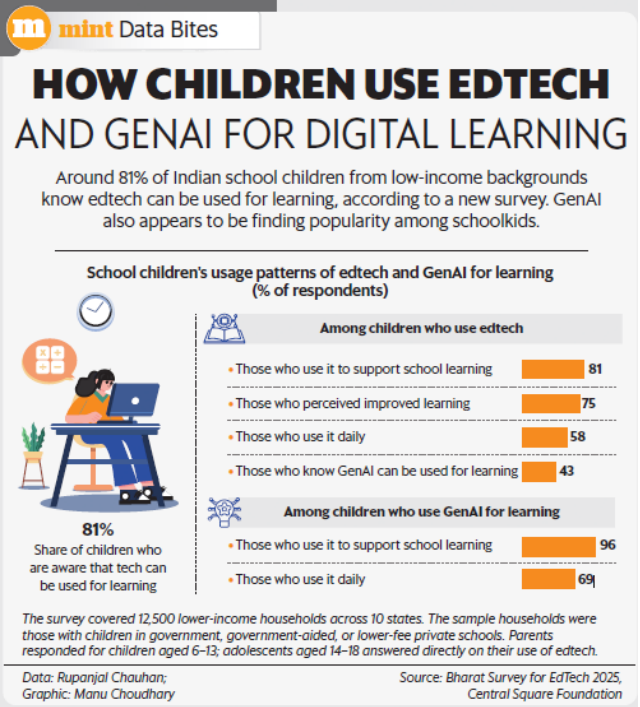
The \'Bharat Survey for EdTech 2025\' by the Central Square Foundation provides critical insights into the digital learning landscape among India’s socio-economically marginalized sections. The report highlights a significant shift in how students from government and low-fee private schools are leveraging technology, particularly Generative AI (GenAI), to supplement formal classroom education. Key Highlights of the Survey • High Digital Awareness: Approximately 81% of children from low-income backgrounds are aware that technology serves as a tool for learning, indicating the successful penetration of digital literacy. • Support for Formal Schooling: Among EdTech users, 81% utilize these platforms specifically to support their school curriculum, rather than just for extracurricular activities. • Perceived Learning Outcomes: A substantial 75% of EdTech users reported a perceived improvement in their learning levels, underscoring the potential of digital tools to bridge the quality gap. • Rapid GenAI Integration: Among the subset of students aware of GenAI, a staggering 96% use it to support school-related learning, showing a higher adoption rate for curriculum support than traditional EdTech. • Usage Frequency: While 58% of EdTech users engage with digital tools daily, the daily engagement for GenAI is even higher at 69%, indicating its role as a persistent learning assistant. • Demographic Reach: The survey covers 12,500 households across 10 states, focusing on students aged 6–18 in government and budget-private schools, making it a representative dataset for \'Bharat.\' Important Definitions • EdTech (Educational Technology): The practice of introducing IT tools into the classroom to create a more engaging, inclusive, and individualized learning experience. • GenAI (Generative AI): A type of Artificial Intelligence capable of generating text, images, or other media in response to prompts, increasingly used by students for doubt-solving and content summarization. • Digital Divide: The gap between demographics and regions that have access to modern information and communications technology and those that don\'t or have restricted access. • Lower-fee Private Schools (LFPS): Budget-friendly private educational institutions that cater to lowincome families who seek alternatives to government schooling. Constitutional and Legal Provisions • Article 21A: The Right to Education (RTE) Act, 2009, mandates free and compulsory education; the integration of EdTech is now seen as a modern necessity to fulfill the \'quality\' aspect of this right. • National Education Policy (NEP) 2020: Emphasizes the integration of technology in all levels of education, advocating for a dedicated unit for the development of digital infrastructure and content. • PM eVIDYA: A comprehensive initiative under the Atmanirbhar Bharat Abhiyaan which unifies all efforts related to digital/online/on-air education to enable multi-mode access. • National Digital Education Architecture (NDEAR): A blueprint to achieve a \'Digital First\' approach in education, supporting teaching and learning activities and educational planning. Additional Key Insights • Transformation of Doubts: GenAI is shifting the \'doubt-solving\' mechanism from human-dependent (teachers/tutors) to algorithm-dependent, providing 24/7 assistance to students without access to private coaching. • Socio-Economic Mobility: The high adoption rate in low-income groups suggests that digital tools are being viewed as a \'great equalizer\' to compete with students from affluent backgrounds. • The Fatigue Factor: Despite high awareness, the fact that only 58% use EdTech daily suggests barriers like device sharing, data costs, or screen fatigue remain relevant. Conclusion The data from the Bharat Survey for EdTech 2025 challenges the notion that advanced technology like GenAI is restricted to elite urban populations. The high awareness and usage rates among low-income households signify a \'bottom-up\' digital revolution. However, for this to result in actual learning gains, the state must ensure that the digital infrastructure is inclusive and that the content is regulated to maintain pedagogical standards. UPSC Relevance • GS Paper II: Social Justice—Issues relating to development and management of Social Sector/Services relating to Education and Human Resources. • GS Paper III: Science and Technology—Developments and their applications and effects in everyday life; Awareness in the fields of IT and Computers. • Mains Perspective: The role of technology in achieving Sustainable Development Goal 4 (Quality Education) and the challenges of the digital divide in rural India.


Address : 506, 3rd EYE THREE (III), Opp. Induben Khakhrawala, Girish Cold Drink Cross Road, CG Road, Navrangpura, Ahmedabad, 380009.
Mobile : 8469231587 / 9586028957
Telephone : 079-40098991
E-mail: dics.upsc@gmail.com
Address: A-306, The Landmark, Urjanagar-1, Opp. Spicy Street, Kudasan – Por Road, Kudasan, Gandhinagar – 382421
Mobile : 9723832444 / 9723932444
E-mail: dics.gnagar@gmail.com
Address: 2nd Floor, 9 Shivali Society, L&T Circle, opp. Ratri Bazar, Karelibaugh, Vadodara, 390018
Mobile : 9725692037 / 9725692054
E-mail: dics.vadodara@gmail.com
Address: 403, Raj Victoria, Opp. Pal Walkway, Near Galaxy Circle, Pal, Surat-394510
Mobile : 8401031583 / 8401031587
E-mail: dics.surat@gmail.com
Address: 303,305 K 158 Complex Above Magson, Sindhubhavan Road Ahmedabad-380059
Mobile : 9974751177 / 8469231587
E-mail: dicssbr@gmail.com
Address: 57/17, 2nd Floor, Old Rajinder Nagar Market, Bada Bazaar Marg, Delhi-60
Mobile : 9104830862 / 9104830865
E-mail: dics.newdelhi@gmail.com