







Ahmedabad
(Head Office)Address : 506, 3rd EYE THREE (III), Opp. Induben Khakhrawala, Girish Cold Drink Cross Road, CG Road, Navrangpura, Ahmedabad, 380009.
Mobile : 8469231587 / 9586028957
Telephone : 079-40098991
E-mail: dics.upsc@gmail.com

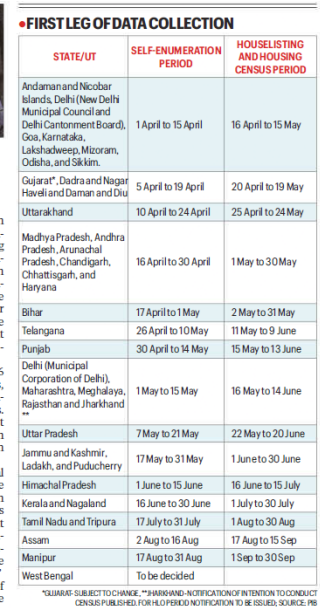
Registrar General and Census Commissioner Mritunjay Kumar Narayan has announced the commencement of Census 2027, a landmark exercise that will integrate caste enumeration during its second phase. This decennial exercise, delayed from 2021, is structured in a two-pronged manner to capture the evolving socio-economic and demographic profile of the nation. • Two-Phase Implementation: The exercise begins on April 1, 2026. Phase 1 (April to September 2026) covers House-listing and Housing Census (HLO), focusing on housing conditions and household assets. Phase 2, known as Population Enumeration (PE), will capture demographic, socio-cultural, and economic parameters, including migration, fertility, and caste. • Self-Enumeration Feature: For the first time, a 15-day window for digital self-enumeration has been introduced preceding the house-to-house operations. This allows citizens to submit data digitally, enhancing accuracy and reducing the burden on designated enumerators. • Data Confidentiality and Legal Shield: Under the Census Act, 1948, all individual data collected remains strictly confidential. It cannot be shared with any organization, accessed under the Right to Information (RTI) Act, or used as evidence in a court of law. No documents are required to be collected from citizens during the exercise. • Scope and Coverage: Census 2027 will cover all 36 States and UTs, spanning 784 districts, over 5,100 statutory towns, and nearly 6.4 lakh villages. The first set of data results is expected to be available by late 2027. • NPR and State Compliance: While the update of the National Population Register (NPR) remains undecided, the Centre has urged states like West Bengal to fulfill the legal requirement of publishing Census notifications. The HLO phase for most states is scheduled to be completed by September 2026. • Socio-Political Significance: The decision by the Cabinet Committee on Political Affairs (CCPA) to include caste in the second phase addresses a long-standing demand for updated data to refine reservation policies and social justice schemes, moving beyond the 1931 caste data benchmarks. Key Definitions • Registrar General and Census Commissioner (RGCC): An officer of the rank of Joint Secretary to the Government of India, responsible for conducting the decennial Census and the registration of births and deaths. • House-listing and Housing Census (HLO): The first step of the Census where houses are identified, numbered, and details regarding amenities (water, electricity, etc.) and assets are collected. • Population Enumeration (PE): The second stage where detailed data on individuals (age, sex, literacy, occupation, caste, etc.) is recorded. Constitutional and Legal Provisions • Article 246 (Union List - Entry 69): The conduct of the Census is a Union subject under the Seventh Schedule of the Constitution. Only the Central Government has the authority to conduct this exercise. • Census Act, 1948: Provides the legal framework for the Census. It mandates that every person is legally bound to answer questions truly, while also providing a guarantee of confidentiality for the information provided. • Census Rules, 1990: Outlines the procedural aspects, including the appointment of census officers and the specific duties of enumerators. Conclusion Census 2027 is more than a mere head-count; it is a vital tool for evidence-based policymaking. The inclusion of caste enumeration represents a shift toward \'targeted governance,\' allowing the state to identify specific sub-groups that have lagged in the development process. However, the success of this mammoth task depends on federal cooperation and the public\'s trust in the data’s confidentiality. UPSC Relevance • GS Paper I (Society): Crucial for topics like \'Population and Associated Issues\' and \'Caste as a social institution.\' The data will redefine the understanding of social stratification in India. • GS Paper II (Governance): Relevant for \'Mechanisms, Laws, Institutions and Bodies constituted for the protection and betterment of vulnerable sections.\' Census data is the bedrock for the Delimitation Commission and the allocation of parliamentary seats. • GS Paper III (Economy): Essential for planning resource allocation and evaluating the impact of schemes like PMAY (Housing) based on HLO data.


Address : 506, 3rd EYE THREE (III), Opp. Induben Khakhrawala, Girish Cold Drink Cross Road, CG Road, Navrangpura, Ahmedabad, 380009.
Mobile : 8469231587 / 9586028957
Telephone : 079-40098991
E-mail: dics.upsc@gmail.com
Address: A-306, The Landmark, Urjanagar-1, Opp. Spicy Street, Kudasan – Por Road, Kudasan, Gandhinagar – 382421
Mobile : 9723832444 / 9723932444
E-mail: dics.gnagar@gmail.com
Address: 2nd Floor, 9 Shivali Society, L&T Circle, opp. Ratri Bazar, Karelibaugh, Vadodara, 390018
Mobile : 9725692037 / 9725692054
E-mail: dics.vadodara@gmail.com
Address: 403, Raj Victoria, Opp. Pal Walkway, Near Galaxy Circle, Pal, Surat-394510
Mobile : 8401031583 / 8401031587
E-mail: dics.surat@gmail.com
Address: 303,305 K 158 Complex Above Magson, Sindhubhavan Road Ahmedabad-380059
Mobile : 9974751177 / 8469231587
E-mail: dicssbr@gmail.com
Address: 57/17, 2nd Floor, Old Rajinder Nagar Market, Bada Bazaar Marg, Delhi-60
Mobile : 9104830862 / 9104830865
E-mail: dics.newdelhi@gmail.com