






Ahmedabad
(Head Office)Address : 506, 3rd EYE THREE (III), Opp. Induben Khakhrawala, Girish Cold Drink Cross Road, CG Road, Navrangpura, Ahmedabad, 380009.
Mobile : 8469231587 / 9586028957
Telephone : 079-40098991
E-mail: dics.upsc@gmail.com

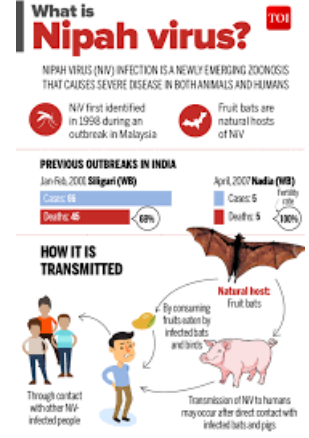
The Kerala Health Department has issued a proactive seasonal alert against the Nipah Virus (NiV) spanning from April to September 2026. This cyclical surveillance strategy follows a pattern of recurring outbreaks observed since 2018, specifically targeting the high-risk districts of Kozhikode, Malappuram, Palakkad, and Thrissur. The alert emphasizes early detection, community awareness, and specialized protocols for pediatric safety to mitigate the impact of this high-fatality zoonotic disease. • Seasonal Recurrence: Epidemiological data from Kerala indicates that the virus typically becomes active during a specific six-month window (April–September), coinciding with the breeding and foraging seasons of fruit bats, the primary reservoirs. • Geographic Hotspots: Surveillance is intensified in the \'Northern Corridor\' (Kozhikode and Malappuram), which has historically been the epicenter of NiV clusters due to high bat density and human-wildlife interface. • Pediatric Focus: Special awareness campaigns are being integrated into school curriculums and childcare centers, as recent outbreaks have shown a concerning vulnerability among children to severe respiratory and neurological complications. • Zoonotic Transmission Pathway: The alert highlights the risk of \'spillover\' events caused by consuming fruits contaminated with bat saliva or urine (e.g., date palm sap or fallen guavas) and subsequent human-to-human transmission through close contact. • Integrated Disease Surveillance: The state is employing a \'One Health\' approach, coordinating between the departments of Health, Animal Husbandry, and Forest to monitor bat colonies and unexplained livestock deaths alongside human cases. • Containment Strategy: Standard Operating Procedures (SOPs) have been refreshed for healthcare workers, focusing on the use of high-grade Personal Protective Equipment (PPE) and the establishment of dedicated isolation wards to prevent nosocomial (hospital-acquired) infections. Definitions of Key Terms • Zoonosis: An infectious disease that is transmitted from non-human animals (usually vertebrates) to humans. • Case Fatality Rate (CFR): The proportion of people who die from a specified disease among all individuals diagnosed with the disease. For Nipah, the CFR is estimated between 40% to 75%. • One Health Approach: An integrated, unifying approach that aims to sustainably balance and optimize the health of people, animals, and ecosystems. Constitutional and Legal Provisions • Article 47 (DPSP): Mandates the State to regard the improvement of public health as among its primary duties. • Article 21: The Right to Life includes the right to health and a clean environment, as interpreted by the Supreme Court in various landmark judgments. • Seventh Schedule (Entry 6, State List): \'Public health and sanitation; hospitals and dispensaries\' are primarily State subjects, allowing Kerala to frame localized health alerts and SOPs. • Epidemic Diseases Act, 1897: Provides the legal framework for the government to take special measures and prescribe regulations to prevent the spread of dangerous epidemic diseases. Important Keypoints for Science & Technology • The Pathogen: Nipah Virus is a ribonucleic acid (RNA) virus of the family Paramyxoviridae, genus Henipavirus. It is closely related to the Hendra virus. • Natural Reservoir: Fruit bats of the Pteropodidae family, particularly the Pteropus genus, are the natural hosts. They do not show symptoms but shed the virus in secretions. • Clinical Presentation: In humans, NiV infection ranges from asymptomatic to acute respiratory infection and fatal encephalitis (inflammation of the brain). • Diagnostic Challenges: Early symptoms are non-specific (fever, headache, cough), requiring advanced molecular tests like Real-Time Polymerase Chain Reaction (RT-PCR) and Enzyme-Linked Immunosorbent Assay (ELISA) for confirmation. Conclusion The preemptive alert in Kerala signifies a shift from \'reactive\' to \'proactive\' disaster management in public health. While the state has developed a robust \'Kerala Model\' for containment, the recurring nature of Nipah underscores the need for a permanent biosafety laboratory (BSL-3 or BSL-4) in the region and continued research into vaccines, as there are currently no licensed drugs specifically for NiV. UPSC Relevance • GS Paper II (Governance/Health): Issues relating to development and management of Social Sector/Services relating to Health; Role of state governments in disease containment. • GS Paper III (Science & Technology): Awareness in the fields of Biotechnology; Issues relating to intellectual property rights (vaccine research); Zoonotic threats and their impact on internal security.


Address : 506, 3rd EYE THREE (III), Opp. Induben Khakhrawala, Girish Cold Drink Cross Road, CG Road, Navrangpura, Ahmedabad, 380009.
Mobile : 8469231587 / 9586028957
Telephone : 079-40098991
E-mail: dics.upsc@gmail.com
Address: A-306, The Landmark, Urjanagar-1, Opp. Spicy Street, Kudasan – Por Road, Kudasan, Gandhinagar – 382421
Mobile : 9723832444 / 9723932444
E-mail: dics.gnagar@gmail.com
Address: 2nd Floor, 9 Shivali Society, L&T Circle, opp. Ratri Bazar, Karelibaugh, Vadodara, 390018
Mobile : 9725692037 / 9725692054
E-mail: dics.vadodara@gmail.com
Address: 403, Raj Victoria, Opp. Pal Walkway, Near Galaxy Circle, Pal, Surat-394510
Mobile : 8401031583 / 8401031587
E-mail: dics.surat@gmail.com
Address: 303,305 K 158 Complex Above Magson, Sindhubhavan Road Ahmedabad-380059
Mobile : 9974751177 / 8469231587
E-mail: dicssbr@gmail.com
Address: 57/17, 2nd Floor, Old Rajinder Nagar Market, Bada Bazaar Marg, Delhi-60
Mobile : 9104830862 / 9104830865
E-mail: dics.newdelhi@gmail.com