




Ahmedabad
(Head Office)Address : 506, 3rd EYE THREE (III), Opp. Induben Khakhrawala, Girish Cold Drink Cross Road, CG Road, Navrangpura, Ahmedabad, 380009.
Mobile : 8469231587 / 9586028957
Telephone : 079-40098991
E-mail: dics.upsc@gmail.com

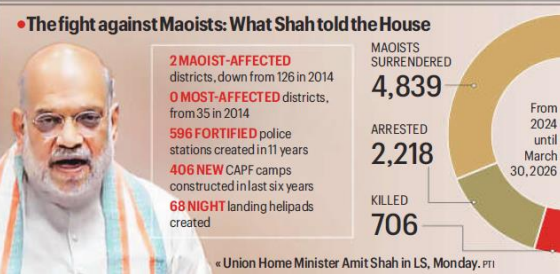
Union Home Minister Amit Shah addressed the Lok Sabha, announcing a near-total collapse of the Maoist organizational hierarchy. The government’s targeted operations over the past two years have successfully neutralized the top leadership of the Communist Party of India (Maoist), moving the nation toward the deadline of a \'Naxal-free India\' by March 31, 2026. • Strategic Decapitation of Leadership: Of the 21 Politburo and Central Committee members active at the start of 2024, 20 have been neutralized (12 killed, 7 surrendered, and 1 arrested). Dialogue is currently underway with the final absconding member, effectively dismantling the ideological and operational command structure of the movement. • Statistical Impact of Security Operations: In the last three years, security forces have killed 706 Maoists, arrested 2,218, and facilitated the surrender of over 4,800 cadres. This massive reduction in manpower indicates a breakdown in the recruitment and sustenance capabilities of Left-Wing Extremism (LWE). • The \'Three-Tool\' Strategy: The Union Government attributed this success to a coordinated \'Triad Power\' approach: Security (offensive operations), Dialogue (offering a path back to the mainstream), and Coordination (seamless intelligence sharing between Centre and States). • Policy Shift and Political Will: The Home Minister emphasized that while Central Armed Police Forces (CAPFs) existed prior to 2014, the decisive factor has been a \'clear policy and strong political will.\' The current doctrine follows a \'bullet-for-bullet\' response to violence while keeping rehabilitation doors open for those who lay down arms. • Shrinking of the Red Corridor: The \'Red Corridor,\' which once spanned 12 states, has seen a dramatic contraction. The restoration of the \'Rule of Law\' in these remote areas has allowed for the entry of administrative services and developmental infrastructure that were previously blocked by insurgents. • Rehabilitation and Surrender Policy: The government reiterated its commitment to the complete rehabilitation of surrendered cadres, aiming to reintegrate them into the socio-economic fabric of the country, provided they abandon the path of armed insurgency. Key Definitions • Left-Wing Extremism (LWE): Also known as Naxalism or Maoism, it is an armed insurgency led by the CPI (Maoist) aiming to overthrow the state through \'protracted people\'s war.\' • Red Corridor: A term used to describe the region in the eastern, central, and southern parts of India that experienced considerable LWE insurgency. • Politburo: The highest policy-making body within the CPI (Maoist) structure, responsible for strategic planning and ideological direction. Constitutional and Legal Provisions • Seventh Schedule (Article 246): While \'Public Order\' and \'Police\' are State subjects, the Centre derives authority to intervene and support through \'Entry 2A\' of the Union List (Deployment of armed forces of the Union). • Unlawful Activities (Prevention) Act (UAPA), 1967: The primary legal tool used to ban the CPI (Maoist) as a terrorist organization and prosecute its leadership for anti-national activities. • Article 355: Imposes a duty on the Union to protect every State against internal disturbance, justifying the deployment of CAPFs like the CRPF (COBRA unit) in LWE-affected regions. Conclusion The transition from a widespread insurgency to the \'dismantling of the central structure\' marks a historic shift in India’s internal security paradigm. While the operational core has been neutralized, the final challenge lies in ensuring that the administrative vacuum in formerly Maoist-held territories is filled with robust governance, education, and healthcare to prevent any resurgence of the movement. UPSC Relevance • GS Paper III (Internal Security): Direct relevance to the topic \'Linkages between development and spread of extremism\' and \'Role of external state and non-state actors in creating challenges to internal security.\' • GS Paper II (Governance): Analysis of the \'Centre-State Coordination\' in managing internal disturbances and the impact of the \'SAMADHAN\' doctrine. • Ethics (GS Paper IV): The dilemma of \'force vs. dialogue\' in internal conflict resolution and the ethical implications of rehabilitation for former insurgents.


Address : 506, 3rd EYE THREE (III), Opp. Induben Khakhrawala, Girish Cold Drink Cross Road, CG Road, Navrangpura, Ahmedabad, 380009.
Mobile : 8469231587 / 9586028957
Telephone : 079-40098991
E-mail: dics.upsc@gmail.com
Address: A-306, The Landmark, Urjanagar-1, Opp. Spicy Street, Kudasan – Por Road, Kudasan, Gandhinagar – 382421
Mobile : 9723832444 / 9723932444
E-mail: dics.gnagar@gmail.com
Address: 2nd Floor, 9 Shivali Society, L&T Circle, opp. Ratri Bazar, Karelibaugh, Vadodara, 390018
Mobile : 9725692037 / 9725692054
E-mail: dics.vadodara@gmail.com
Address: 403, Raj Victoria, Opp. Pal Walkway, Near Galaxy Circle, Pal, Surat-394510
Mobile : 8401031583 / 8401031587
E-mail: dics.surat@gmail.com
Address: 303,305 K 158 Complex Above Magson, Sindhubhavan Road Ahmedabad-380059
Mobile : 9974751177 / 8469231587
E-mail: dicssbr@gmail.com
Address: 57/17, 2nd Floor, Old Rajinder Nagar Market, Bada Bazaar Marg, Delhi-60
Mobile : 9104830862 / 9104830865
E-mail: dics.newdelhi@gmail.com