








Ahmedabad
(Head Office)Address : 506, 3rd EYE THREE (III), Opp. Induben Khakhrawala, Girish Cold Drink Cross Road, CG Road, Navrangpura, Ahmedabad, 380009.
Mobile : 8469231587 / 9586028957
Telephone : 079-40098991
E-mail: dics.upsc@gmail.com

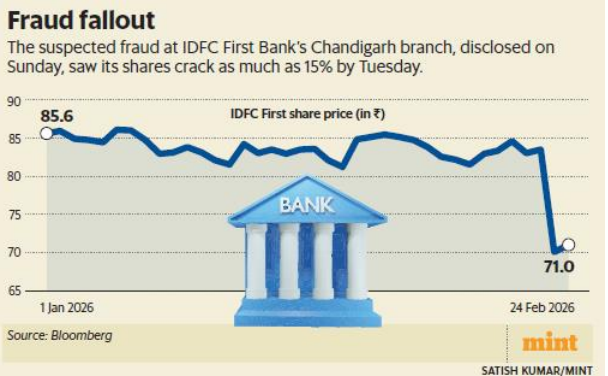
IDFC First Bank recently disclosed a suspected internal fraud involving the misappropriation of approximately ₹590 crore from Haryana government-linked accounts at its Chandigarh branch. While the Reserve Bank of India (RBI) has ruled out systemic risks, the incident underscores critical vulnerabilities in branch-level oversight and the security of public sector deposits in private banks. Key Highlights of the Case • Nature of the Fraud: The discrepancy involves nearly ₹590 crore, allegedly orchestrated by branch employees in connivance with external parties through unauthorized transfers to outside accounts. • Financial Impact: Although the fraud amount is comparable to the bank\'s quarterly profit (₹503 crore), the management maintains that the impact is manageable given their total deposit base of ₹2.82 trillion. • Immediate Regulatory Response: The RBI has categorized the event as an isolated operational failure rather than a systemic threat, though it continues to monitor the bank\'s liquidity and capital adequacy. • Accountability Measures: The bank has suspended involved staff, filed police complaints, and appointed KPMG for a forensic audit to trace the fund trail and identify procedural lapses. • Institutional Consequences: The Haryana government has de-empanelled IDFC First Bank for fresh deposits, a move that reflects a potential trust deficit and may trigger similar reviews by other state entities. • Liquidity Trends: Historical data from similar discrepancies at other private lenders suggests that such events often lead to a short-term dip in retail and small-business deposits due to dented depositor confidence. Important Definitions • Systemic Risk: The possibility that an event at the micro level of an individual bank could trigger instability or collapse across the entire financial system or market. • Forensic Audit: An examination and evaluation of a firm\'s or individual\'s financial records to derive evidence that can be used in a court of law or legal proceeding, typically used in cases of fraud or embezzlement. • De-empanelment: The process of removing an organization (in this case, a bank) from an official list of approved service providers or partners by a government or institutional body. • Lien-marking: A legal claim or a \'hold\' placed on a specific amount in a bank account, preventing the account holder from withdrawing those funds until a debt is settled or an investigation is cleared. Constitutional and Legal Provisions • Banking Regulation Act, 1949: Empowers the RBI to inspect banks, penalize mismanagement, and give directions to banking companies in the interest of the public or banking policy. • Prevention of Money Laundering Act (PMLA), 2002: Relevant in tracking the \'proceeds of crime\' if the fraudulently transferred funds were moved through multiple layers to hide their origin. • Indian Penal Code (IPC) / Bharatiya Nyaya Sanhita (BNS): Sections relating to criminal breach of trust by a public servant or banker, forgery, and cheating are typically invoked in such employee-led frauds. • RBI’s \'Fraud Risk Management\' Circulars: These guidelines mandate banks to report frauds above a certain threshold to the RBI within 21 days and conduct internal reviews of systemic loopholes. Additional Key Insights • Operational Risk Management: This incident highlights the \'Human Element\' in operational risk, showing that even with robust digital systems, manual overrides or collusion can bypass internal controls. • Public vs. Private Banking: The scam may accelerate the \'flight to safety,\' where government departments prefer parking surplus funds in Public Sector Banks (PSBs) despite potentially lower interest rates compared to private aggressive lenders. • Internal Audit Lapses: The fact that ₹490 crore was identified only through reconciliation suggests a delay in real-time monitoring of high-value government accounts. Conclusion The IDFC First Bank fraud is a stark reminder that as Indian banking scales and digitizes, the fundamental requirement of \'Internal Checks and Balances\' remains paramount. While the bank’s balance sheet may absorb the immediate financial shock, the long-term challenge lies in restoring institutional trust. For regulators, this event signals a need for tighter oversight on how private banks manage large-ticket government deposits to prevent localized \'rogue\' actions from affecting public exchequer funds. UPSC Relevance • GS Paper II: Governance—Transparency and accountability; Role of regulatory bodies (RBI). • GS Paper III: Indian Economy—Banking sector reforms, mobilization of resources, and issues relating to internal security (financial frauds). • Prelims: RBI’s regulatory powers under the Banking Regulation Act, definitions of systemic risk, and the functions of forensic audits in the financial sector.


Address : 506, 3rd EYE THREE (III), Opp. Induben Khakhrawala, Girish Cold Drink Cross Road, CG Road, Navrangpura, Ahmedabad, 380009.
Mobile : 8469231587 / 9586028957
Telephone : 079-40098991
E-mail: dics.upsc@gmail.com
Address: A-306, The Landmark, Urjanagar-1, Opp. Spicy Street, Kudasan – Por Road, Kudasan, Gandhinagar – 382421
Mobile : 9723832444 / 9723932444
E-mail: dics.gnagar@gmail.com
Address: 2nd Floor, 9 Shivali Society, L&T Circle, opp. Ratri Bazar, Karelibaugh, Vadodara, 390018
Mobile : 9725692037 / 9725692054
E-mail: dics.vadodara@gmail.com
Address: 403, Raj Victoria, Opp. Pal Walkway, Near Galaxy Circle, Pal, Surat-394510
Mobile : 8401031583 / 8401031587
E-mail: dics.surat@gmail.com
Address: 303,305 K 158 Complex Above Magson, Sindhubhavan Road Ahmedabad-380059
Mobile : 9974751177 / 8469231587
E-mail: dicssbr@gmail.com
Address: 57/17, 2nd Floor, Old Rajinder Nagar Market, Bada Bazaar Marg, Delhi-60
Mobile : 9104830862 / 9104830865
E-mail: dics.newdelhi@gmail.com