







Ahmedabad
(Head Office)Address : 506, 3rd EYE THREE (III), Opp. Induben Khakhrawala, Girish Cold Drink Cross Road, CG Road, Navrangpura, Ahmedabad, 380009.
Mobile : 8469231587 / 9586028957
Telephone : 079-40098991
E-mail: dics.upsc@gmail.com

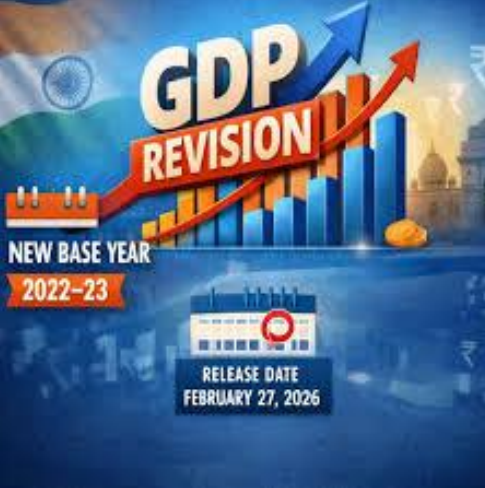
The Ministry of Statistics and Programme Implementation (MoSPI) recently released a new series of Gross Domestic Product (GDP) estimates, transitioning the base year from 2011-12 to 2022-23. This structural revision aims to align national accounts with contemporary economic realities, incorporating updated consumption patterns and more robust corporate data. • Updated Economic Scale: The new series estimates the Indian economy at current prices to be ₹318.07 lakh crore for FY 2024-25. Interestingly, these new aggregates are 3% to 4% lower than previous estimates, suggesting a more realistic recalibration of the economy\'s size. • Sectoral Composition: The share of Gross Value Added (GVA) remains dominated by the Tertiary (Services) sector at 52.9%, followed by Secondary (Industry) at 25.8% and Primary (Agriculture & Allied) at 21.4%. • Manufacturing Resilience: Despite global headwinds, the manufacturing sector shows high real GVA growth, recording 12.7% in 2023-24 and 9.3% in 2024-25, highlighting a robust recovery in industrial activity. • Methodological Shift in Corporate Sector: The series now segregates \'multi-activity enterprises\' by using revenue shares (MGT 7/7A data) to allocate GVA across specific business activities, rather than assigning the entire GVA to a single primary activity. • Unincorporated Sector Precision: For the first time, GVA for the Household/Unincorporated sector is derived using annual GVA per worker (GVAPW) from the Annual Survey of Unincorporated Sector Enterprises (ASUSE) alongside Periodic Labour Force Survey (PLFS) data. • Consumption Benchmarking: Private Final Consumption Expenditure (PFCE) for the base year has been directly mapped using the Household Consumption Expenditure Survey (HCES 2022-23), ensuring that the GDP figures reflect actual ground-level consumption. Key Definitions • Base Year: A representative year used as a benchmark for calculating real economic growth. It helps eliminate the effect of price inflation to track volume changes in production. • Gross Value Added (GVA): The measure of the value of goods and services produced in an area, industry, or sector of an economy. GVA = GDP + Subsidies on products – Taxes on products. • Double Deflation: A refined method where output and intermediate inputs are deflated separately using specific price indices to arrive at a more accurate real GVA. • Unincorporated Sector: Economic units (mostly households) that are not legally incorporated as separate entities, often forming a large part of India’s informal economy. Constitutional & Legal Provisions • Article 112 (Annual Financial Statement): While the Constitution mandates the presentation of the Budget, the GDP estimates serve as the foundational data for fiscal deficit targets and revenue projections mentioned therein. • Collection of Statistics Act, 2008: The legal framework under which MoSPI and the National Statistical Office (NSO) collect data from various industrial and household sources for national accounting. • National Strategy for Statistics: India’s commitment to aligning with the UN System of National Accounts (SNA 2008), which recommends periodic rebasing every 5 to 10 years. Additional Strategic Keypoints • LLP Coverage: The new series provides a more comprehensive coverage of Limited Liability Partnerships (LLPs) by directly integrating Ministry of Corporate Affairs (MCA) data. • State-Level Challenges: A critical challenge remains in \'GSVA allocation\'—dividing national corporate GVA among states. The series aims to improve this by utilizing GST data alongside the Annual Survey of Industries (ASI). • Mitigating Volatility: To address fluctuations in unincorporated sector data, the new methodology utilizes a \'three-year moving average\' for certain industry categories to ensure data stability. Conclusion The transition to the 2022-23 base year is a landmark step in Indian macroeconomics. By integrating high-frequency data like PLFS and ASUSE and refining corporate GVA allocation, the new series offers a more granular and transparent view of the economy. While challenges in state-level data (GSDP) and survey volatility persist, the use of GST and MCA databases ensures that India\'s economic reporting is moving toward international best practices. UPSC Relevance • GS Paper III: Indian Economy and issues relating to planning, mobilization of resources, growth, development, and employment. Inclusion of new methodologies like \'Double Deflation\' is a frequent topic in Mains. • Prelims: Conceptual understanding of GVA vs. GDP, the role of NSO/MoSPI, significance of rebasing, and the impact of HCES/PLFS on national accounts.


Address : 506, 3rd EYE THREE (III), Opp. Induben Khakhrawala, Girish Cold Drink Cross Road, CG Road, Navrangpura, Ahmedabad, 380009.
Mobile : 8469231587 / 9586028957
Telephone : 079-40098991
E-mail: dics.upsc@gmail.com
Address: A-306, The Landmark, Urjanagar-1, Opp. Spicy Street, Kudasan – Por Road, Kudasan, Gandhinagar – 382421
Mobile : 9723832444 / 9723932444
E-mail: dics.gnagar@gmail.com
Address: 2nd Floor, 9 Shivali Society, L&T Circle, opp. Ratri Bazar, Karelibaugh, Vadodara, 390018
Mobile : 9725692037 / 9725692054
E-mail: dics.vadodara@gmail.com
Address: 403, Raj Victoria, Opp. Pal Walkway, Near Galaxy Circle, Pal, Surat-394510
Mobile : 8401031583 / 8401031587
E-mail: dics.surat@gmail.com
Address: 303,305 K 158 Complex Above Magson, Sindhubhavan Road Ahmedabad-380059
Mobile : 9974751177 / 8469231587
E-mail: dicssbr@gmail.com
Address: 57/17, 2nd Floor, Old Rajinder Nagar Market, Bada Bazaar Marg, Delhi-60
Mobile : 9104830862 / 9104830865
E-mail: dics.newdelhi@gmail.com