


Ahmedabad
(Head Office)Address : 506, 3rd EYE THREE (III), Opp. Induben Khakhrawala, Girish Cold Drink Cross Road, CG Road, Navrangpura, Ahmedabad, 380009.
Mobile : 8469231587 / 9586028957
Telephone : 079-40098991
E-mail: dics.upsc@gmail.com

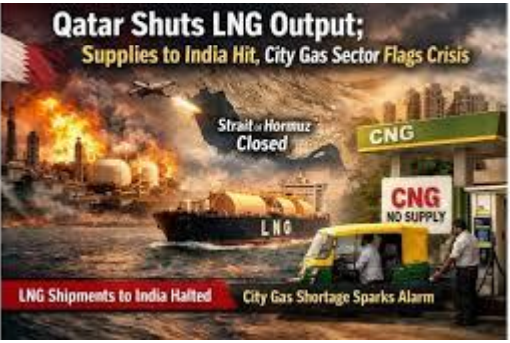
• Supply Disruption via Chokepoints: The escalation of the Iran-Israel conflict has crippled maritime transit through the Strait of Hormuz, a vital chokepoint handling 20% of global LNG trade, leading to an effective halt in gas shipments from Qatar to India. • Invocation of Force Majeure: India’s largest importer, Petronet LNG, and supplier QatarEnergy have invoked \'Force Majeure\' clauses, legally suspending contractual obligations due to \'acts of war\' that prevent safe vessel passage and halt production. • Impact on Energy Markets: The supply uncertainty triggered a massive sell-off in Indian energy stocks, with Petronet LNG plummeting nearly 12% and other major players like GAIL, IOCL, and BPCL witnessing significant valuation erosions. • Domestic Gas Rationing: In response to the anticipated shortfall, gas marketers have already commenced supply cuts of up to 40% for certain industrial sectors and City Gas Distribution (CGD) entities, potentially affecting CNG and piped natural gas (PNG) availability. • Vulnerability of LNG Infrastructure: Unlike crude oil, which India stockpiles for 6-8 weeks, LNG storage is technically complex and limited, making the domestic energy matrix highly sensitive to short-term disruptions in the Persian Gulf. • Geopolitical Countermeasures: To mitigate the crisis, Indian companies are scouting for spot cargoes from non-Gulf markets, while the US has signaled potential military and insurance support for merchant vessels to restore the flow of global energy supplies. Key Definitions • Force Majeure: A common contractual clause that frees both parties from liability or obligation when an extraordinary, unforeseeable event (e.g., war, natural disaster) beyond their control occurs. • Off-takers: Entities that agree to purchase a portion of a producer\'s future output (in this case, GAIL, IOCL, and BPCL purchasing gas from Petronet). • Strait of Hormuz: A narrow waterway between Oman and Iran connecting the Persian Gulf with the Gulf of Oman and the Arabian Sea; it is the world\'s most important oil and gas transit chokepoint. Constitutional & Legal Provisions • Essential Services Maintenance Act (ESMA): Provides the government power to ensure the delivery of essential services (like fuel and energy) during emergencies or disruptions. • Petroleum and Natural Gas Regulatory Board (PNGRB) Act, 2006: Legal framework regulating the refining, processing, storage, and distribution of petroleum and natural gas to protect the interests of consumers and entities. • Doctrine of Frustration (Section 56, Indian Contract Act, 1872): A legal principle where a contract becomes void if the performance of the act becomes impossible or unlawful due to an event the promisor could not prevent (the statutory equivalent of Force Majeure). Additional Key Points • Import Dependency: India imports roughly 50% of its natural gas requirements, with over half originating from Qatar and the UAE, emphasizing the risks of high geographical concentration in energy sourcing. • Strategic Petroleum Reserves (SPR) vs. LNG: While India has subterranean salt caverns for crude oil, it lacks equivalent large-scale strategic reserves for LNG, highlighting a critical gap in energy security planning. • Sectoral Ripple Effects: The CGD sector relies on imported LNG for 43% of its total demand; prolonged disruption could lead to inflationary pressures on transport and household cooking costs. Conclusion The current crisis underscores India’s acute vulnerability to geopolitical volatility in West Asia. While short-term measures like spot market purchases and domestic rationing may provide temporary relief, the situation necessitates a long-term strategic shift toward diversifying energy sources, increasing domestic production, and investing in advanced LNG storage technologies to insulate the economy from \'chokepoint politics.\' UPSC Relevance • GS Paper II: Effect of policies and politics of developed and developing countries on India’s interests; India’s energy diplomacy in West Asia. • GS Paper III: Indian Economy and issues relating to planning, mobilization of resources, and growth; Infrastructure (Energy); Security challenges in the Indian Ocean and Persian Gulf. • Prelims: Mapping of the Strait of Hormuz, Ras Laffan port, and the Persian Gulf; understanding the legal concept of Force Majeure.


Address : 506, 3rd EYE THREE (III), Opp. Induben Khakhrawala, Girish Cold Drink Cross Road, CG Road, Navrangpura, Ahmedabad, 380009.
Mobile : 8469231587 / 9586028957
Telephone : 079-40098991
E-mail: dics.upsc@gmail.com
Address: A-306, The Landmark, Urjanagar-1, Opp. Spicy Street, Kudasan – Por Road, Kudasan, Gandhinagar – 382421
Mobile : 9723832444 / 9723932444
E-mail: dics.gnagar@gmail.com
Address: 2nd Floor, 9 Shivali Society, L&T Circle, opp. Ratri Bazar, Karelibaugh, Vadodara, 390018
Mobile : 9725692037 / 9725692054
E-mail: dics.vadodara@gmail.com
Address: 403, Raj Victoria, Opp. Pal Walkway, Near Galaxy Circle, Pal, Surat-394510
Mobile : 8401031583 / 8401031587
E-mail: dics.surat@gmail.com
Address: 303,305 K 158 Complex Above Magson, Sindhubhavan Road Ahmedabad-380059
Mobile : 9974751177 / 8469231587
E-mail: dicssbr@gmail.com
Address: 57/17, 2nd Floor, Old Rajinder Nagar Market, Bada Bazaar Marg, Delhi-60
Mobile : 9104830862 / 9104830865
E-mail: dics.newdelhi@gmail.com